Showing posts with label Husted. Show all posts

Thursday, October 22, 2015

Fear of wrecks haunts us in our tracks


'Cos he was going down a grade making 90 miles an hour,
The whistle broke into a scream.
He was found in the wreck with his hand on the throttle,
Scalded to death by the steam.
_ Norman George Blake, Robert Johnson, Johnny Cash, from Wreck Of The Old '97

 Our particular nightmares and disasters, arrive in the scale of train wrecks

 By Rob Carrigan, robcarrigan1@gmail.com

In this area, our particular nightmares and disasters, arrive in the scale and form of train wrecks. The ghost that haunts us, is the fear that it ever could happen again.

The following are just some of the local train wrecks that I know of.

“A frightful collision occurred on the Denver and Rio Grande one and one-half miles below Palmer Lake yesterday afternoon about two o’clock, between two extra engines, in which Engineer Hart and Fireman C.F. Fogle lost their lives. The accident was said to have been caused by the carelessness of the two men named and their lives paid the penalty,” according to the Thursday, Aug. 21, 1890, Rocky Mountain News.

“Engine 581, with a pile driver and a caboose attached, left Husted, nine miles below Palmer Lake, about 1:30 o’clock with orders to run through Palmer Lake. At the same time, Engine 258, in charge of Engineer Hart and Fireman Fogle, was given orders to run extra from Palmer Lake to Husted and protect against Engine 581. By the word protect it was meant that they should watch out for the northbound engine and in case where could not see ahead, the fireman was to go ahead with a flag until a clear stretch of track was reached. The track between Palmer Lake and Monument is very tortuous and winding with frequent cuts and great caution has always been observed, especially work engines and trains running as those were yesterday. Engineer Hart, and his fireman, it is presumed, believed that they could reach Monument in time to meet Engine 581, or that they would meet it on the clear track just north of that point. In this supposition they were mistaken and as a result the collision occurred.”
According to reports, the engineer and fireman from the northbound train were able to leap to safety but Hart and Fogle, headed south, were caught in the cab and crushed to death, as well as being badly scalded.

“Poor Fogle was standing between the cab and the tender, just ready to jump for his life, but was caught and horribly crushed, his leg and arm being broken.”

He died before his wife could be summoned from Husted by telegraph.

The report noted “Hart, the dead engineer, has been on the road for some time and was a very efficient man. His first and last mistake occurred yesterday.”

But unfortunately, that was not the last mistake made in that area.

Just five years later, in July of 1895, a Santa Fe freight train went through the bridge at Monument and killed four.

“An appalling wreck occurred on the Santa Fe road near Monument at 11 o’clock this morning,” according to the New York Times. “A freight train consisting twenty cars plunged through a bridge near that place, burying beneath the debris the train crew, a number of tramps and several bridge carpenters who were repairing the bridge. Wrecking crews were quickly dispatched from Denver and Pueblo a special train from Colorado Springs with physicians. These with the citizens of Monument, worked heroically rescuing the dead and injured. One hundred and fifty feet of trestle went down with the train. The scene under the bridge was described as most shocking, freight cars, bridge timbers, and railroad iron being a horrible wreck. The plunge was 50 feet to the rocks below,” according to the Aspen Times then.

Just south of 2nd Street on the Old Denver Highway the catastrophic train wreck occurred. The Santa Fe Bridge Foreman was repairing the three-hundred foot-long trestle. He removed too many cross-braces and when the train attempted to cross the trestle gave way.

In 1902 the Santa Fe began replacing wood trestles with the earth structure that you see today, according to Palmer Lake Historical Society.

“The killed are Jim Childers, foreman of the bridge gang; Mrs. Cooper, wife of the station agent, and an unknown tramp. The fatally injured are Mark Winchers, engineer of the freight train; D. N. Irby, Charles Hailey, Frank Shaw, Wallace Cooper, Charles Van Merter, Tom Smith, and Joe Williams, tramps who were beating their way over the road;  J. W. Cole, C. C. Carpenter and Thomas Stenhouse, bridge carpenters and Charles Sargent, reported the Aspen Weekly Times Colorado, of July 18,  1895.”

The New York Times called it this way.

“A Santa Fe freight train, bound from Denver to Colorado Springs, fell through a bridge just south of here at 11 o'clock this morning, killing three persons, fatally injuring three, and seriously injuring fifteen others.

“There were twenty-four cars in the train loaded with stone, lumber, and timber. The bridge gang, consisting of twenty men, were working under the north end of the bridge. The train passed over them, and was nearing the other side when the timbers gave way, and the train went through into the gulch, fifty feet below. Nearly all the men working on the north end were thrown off, and fell below. Mrs. Cooper, wife of Albert Cooper, the engineer of the bridge work, was sitting on a ledge of rock watching the men work, when the timbers began to crack, and J. C. Childers, who was on the structure, jumped to save her. The leap was to death as he had scarcely reached her side when the great mass of wreckage fell upon them. Both were mangled and buried. Childers was foreman of the bridge gang. There was a moment of silence, and then came the hissing of steam and cries of the scalded men pierced the air.”

Fireman Frye was caught in his cab, but was pulled out. Two brakemen on the engine were scalded.

As soon as possible a wrecking train was brought from Denver, with physicians and surgeons. All that was possible was done for the suffering.

They were taken to the hospital at La Junta for treatment.

The bridge was of wood, 50 feet high and 300 feet long. Twenty minutes before the accident occurred the Midland passenger train crossed the structure. The cause of the accident is unknown. The wreckage is piled up thirty feet, and it is thought that there are bodies still under it. It will take two days at least to clear it away. About half of the bridge was taken away by the train in its descent,” reported The New York Times New York, July 18, 1895.

A decade and half later, down at nearby Husted (near the North Gate of the Air Force Academy), The Colorado Springs Gazette of Aug. 14, 1909, related the story of an equally horrific rail accident there.

“Nine persons are dead, and others are expected to die; between forty and fifty are injured; three engines are in the ditch; two baggage cars, including the contents, are smashed to kindling wood, and several passenger coaches are badly damaged as the result of a head-on collision between east bound passenger train No. 8, and westbound passenger No. 1, on the Denver & Rio Grande, near Husted, thirteen miles north of this city, at 10:25 a.m. today. The wreck was due to a misunderstanding of orders, it is said.”

Report from papers all over the nation carried the dispatches.

As No. 8 drew into Husted about 40 mph, the crew of the engine saw a light engine standing on the switch north of the station.

“Mistaking the engine for the second section of No. 1, the crew did not stop, and went through the station as fast as the two engines could draw the thirteen heavily laden coaches. As soon as the train got out of the station, the engineer of the first engine of No. 8 saw another train coming slowly down the incline. He slammed on the air brakes, and the emergency brakes, and then shouted to the other members of the two crews to jump. Before they had time to jump, No. 8 had rammed No. 1 so hard that all three engines lay in the ditch,” according to the Nebraska State Journal at the time.

“Fireman J.A. Gossage, of train No. 8, was killed as he was firing his engine, and never knew what struck him. The members of the other crew escaped serious injury by jumping.”

The smoker, attached to train No. 8, was the car in which the people were killed. All those badly injured were in the same car.

Other reports said that J.A. or Jack Gossage, the fireman on the helper engine who lived at Husted and had just waved to his wife as the train passed his home, was trapped between the engine and the tender when the collision occurred.

Jack Gossage's wife continued to work for the railroad for many years afterward as a cook for crews in Husted, and the Gossage name eventually became quite famous for other reasons in Colorado Springs. Jack Gossage is grandfather to Colorado Springs standout and major league baseball Hall of Famer Rick “Goose” Gossage.

“The wreck occurred just east of the east switch at Husted. The impact of the trains was terrific and the locomotives and the baggage and smoking cars of both trains were badly damaged,” reported papers at the time.

“The shrieks of the wounded were pitiful and those who were not injured among the passengers immediately started the work of rescue. It was impossible to accurately determine the number of dead, but first reports indicated that eight had been killed.”

On May 27, 1983 in Palmer Lake, the Burlington Northern coal train headed south and the Rio Grande Western freight headed north collided near the County Line Road crossing.

Fire ensued and the Burlington Northern engine exploded. Palmer Lake Police Officer John Cameron, Bob Romack and others rushed to the scene which was described as “a tangled mass of twisted, burning metal where Keith Watts of Pueblo was trapped inside one of the engines… pinned to the cab floor.”

The men found the strength to lift a heavy plate from Watts and get him to safety in spite of the threat of explosions from burning diesel fuel.

Witnesses at the scene said it appeared the trains didn’t stop at all. According to a Highway Patrol report, the southbound Burlington went through a red signal suggesting human error. It is reported that in 1981 the Burlington Northern suffered another mishap in Palmer Lake when a freight train jumped the tracks derailing 13 cars.

Today, modern technology such as the use of computers for scheduling and routing, better engineering of the rolling stock, the roadbeds and intersections, have all helped prevent disastrous accidents of this type at least for now.


___ Rob Carrigan

Photo Info:  Train wreck in Monument near Second Street in 1895.

Saturday, October 10, 2015

Perfect weather for WMMI harvest festival


Rob Carrigan, robcarrigan@yourpeaknews.com

Every fall the Harvest Festival at Reynolds Ranch draws thousands to pick out a pumpkin or two, experience the lost arts of stamp milling, black smithing, cider pressing, gold panning and maybe — take a tractor ride and watch the steam shovel operate.

"Colorado Springs has been growing at an unprecedented pace for more than a century now and much of our colorful and unique history is being lost in the process. The Western Museum of Mining and Industry is located on the property now known as the Reynolds Ranch," says information from the museum.

"We are all ready for it," said Rick Sauers, executive director of the Museum, earlier last week at a Chamber of Commerce function. "Expecting good weather and large crowds."

Weather for the two day event over the weekend was exceptional. The annual celebration is fundraiser for the museum and features all of the above, plus a whole lot more.

"In the early 1890s, Sara and Joseph Reynolds moved west to Colorado from Pennsylvania and built the Little Red Farm House. Their farm became a working ranch that included a saw-mill and dairy farm. Over the following century, many people important to Colorado Front Range history called the ranch home, including Lazarus Khan – namesake of the mineral Khanite – and founder of the Colorado Springs Mineralogical Society," according to officials at the museum.

"The Reynold’s house was originally part of the town of Husted, CO. Husted provided many of the raw materials necessary for the rapidly growing urban center of Colorado Springs, including milk, ice, lumber, and fox fur. With the slow decline of mining around the Front Range region, Husted slowly faded away into history. During the 1950s, the US Air Force purchased the land that Husted occupied and removed all of the remaining homes and buildings," according to their research.

The only house that survived the too common fate of Husted was the Reynolds home and their ranch. Once over 700 acres, it is now a 27-acre museum dedicated to preserving and interpreting Colorado’s mining, industrial and regional history.

"Included in the State Register of Historic Properties in 1997, the Reynolds Ranch House has two distinctive characteristics. First, it is a Queen Anne Farmhouse in a rural setting. Second, it is the last vestige of the once-thriving community of Husted, a former Denver & Rio Grande railroad supply town and depot. Prior to the museum’s ownership, nine different families owned the house. The Previous owners have made minor modification over the years. The museum intends to restore the home as an 1894 Queen Anne farmhouse before providing tours and other interpretive activities," museum information says.

###
Photo Information:
  1. Apples, raised near in Pueblo, decorated a vendor table Saturday morning.
  2. Board member Mark Yoder and volunteer Joe Gray gear up the cider press.
  3. Rachael Foote (9), and Robert Foote (7), look over the pumpkins in the patch.
  4. Riley Ewel (left) is showing a small nugget of color in the gold pan.
  5. Beckett Anible, almost 2, and his parents, Scott and Nadine, find the donkey livestock (Nugget and Chism) captivating.
  6. Doing the height check on the great pumpkin in the yard.
  7. Tomatoes, beans, potatoes, eggplant, peppers and other produce galore.
  8. Steve Barry captains a 1936 John Deere tractor for tours of the facility.


Sunday, May 3, 2015

Town disappears from sight, but not memory


Homes, shacks, pigpens, garage, 

and the train station ... all abandoned

By Rob Carrigan, robcarrigan1@gmail.com

Nearby dairies would load the milk cans off their wagons on to the rail platform for pickup.  If you look hard enough, you still might find remnants of the cement underpinnings of that platform on the edge of the jogging trail today. Husted station, back in the day.
Look hard enough again, and you might see the last vestiges of the road that arched around the flat that was once the perimeter of the town.
"Just north will be the main entrance to the Air Force Academy. Here will be a national monument, one of the finest service schools ever conceived man. Thousands of future officers of the United States Air Force will get their training here. They won't know about Husted, and they won't care. Anymore than they care about Ramona, Glasstown, Frog Hollow, Piedmont, Lihue, Montclar —other towns swallowed up by progress in the Pikes Peak region.
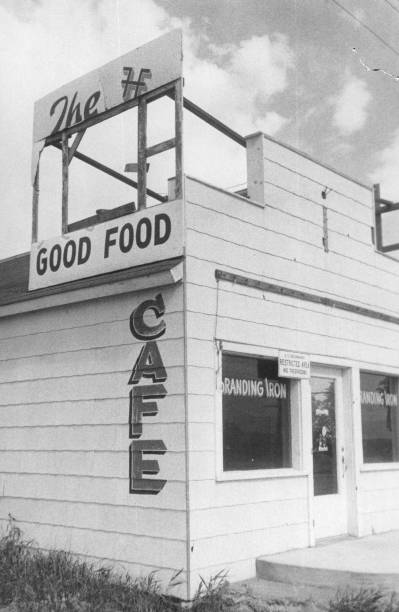
On February 19, 1956, J.C. Kinner told a Colorado Springs Gazette and Telegraph reporter that there was once a grammar school there in Husted, until the days of consolidated schools made it obsolete. "It had a saloon, which became a store, which became a postoffice, which in turn became a church. Finally the same frame was used to make the present forlorn Branding Iron Cafe," Kinner said.
The reporter from the Gazette and Telegraph described the Branding Iron Cafe's state in early 1956.
"Has a 'no trespassing' sign. Jones General store has a few boxes of Wheaties, some Certo; a couple of cans of sauer kraut still on it shelves, but the store is closed. The empty gas pump at the Allison's Service Station reads: this sale, $0.00."
The forlorn description goes on.
"Tourist and truckers speeding thru Husted don't know that in the window of the store there's a plaid calico camel. It's been tossed aside. It gathers dust. It's unwanted. But once upon a time some child hugged that plaid calico camel with tender love."
The town of Husted was like that.
From the 1956 description: "A dozen or so buildings make up Husted today. The Branding Iron Cafe still has its paneled knotty pine walls, its coffee counter, its sink. Picturesque symbolic menus boasting 'we sell soup in pints and quarts' are scattered over the floor. A year ago you could get a minced ham and scrambled eggs with toas for 48 cents. The ubiquitous tumble weeds in the the back room tell a different story today."
Homes, shacks, pigpens, garage, and the train station... all abandoned.
"Once an important stop on the Santa Fe and Rio Grande railroad, once a bustling center of ranchers and lumbermen, is a dead town — sacrificed on the altar of progress."


Photo information:
Colorado & Southern train, engine number 371, engine type 4-6-2 and engine number 9980, engine type EMD E5. Photo by Otto, Perry, Train #22, Texas Zephyr; 14 cars, fine smoke effect. Photographed: Husted, Colo., June 15, 1945.
Western History/Genealogy Dept., Denver Public Library

Husted's Branding Iron Cafe in 1956. Denver Post Photo.

Saturday, January 21, 2012

Hopelessly lost, but making good time


Into the 100-year time warp

By Rob Carrigan, robcarrigan1@gmail.com

Sometimes, as I wander in the hills and think about those who wandered there before me, I can’t help but feel a little lost. Lost in time, lost in space, lost in my own thoughts.
“Not all who wander are lost,” however, according to J. R. R. Tolkien. But the story-master didn’t know this little hobbit.
Wistfully during the wanderings, I often imagine a 100-year warp, or fold, or rip in the time continuum, in which one is able to freely pass from this century, backwards and on into the last.
At almost precisely such a moment, I’ll trip and stumble over an old, stonewall, or a rail tie, or cement foundation that extends a finger out from the past.
It may be difficult considering how much is left, but I almost turfed it one day as I daintily danced over the foundation remnants of East Husted Station.
The dogs like to run down the Santa Fe Trail that follows the former rail grade on the edge of the United States Air Force Academy. Just a little south of the North Gate, on the trail, lies the remains of lost village of Husted. We generally stay on the trail but there is a marker out there calling attention to the once-thriving metropolis. You can wander out a little ways into the yucca, dry grass and oak brush. Evidence of a road winds around down through the gamble oak and pine trees.
What remains of the remains, is not much. You have to almost scratch at the ground to find the base of the one-time train stop on the Santa Fe and the Denver & Rio Grande railroads.
“Husted was never a big village but it had stores, a saloon, church, school, post office, and a restaurant. When automobiles became popular it had several filling stations along the highway,” wrote historian Lucile Lavelett in “Monument’s Faded Neighbor Communities and its Folklore.”
The community’s history stretched way back into the early 1860s (and perhaps before) when the first white settlers came to this area. Sawmills, the Indian uprising of 1868, lynchings for cattle rustlers in Dead Man’s Canyon, whiskey stills in prohibition, a D. & R.G. roundhouse, fox farms, and a horrific train wreck in 1909, all played prominent roles in that colorful account. But by 1920, the place was pretty much on the wane, as the Post Office closed and railroads began to shift from steam, reconfigure traffic, and eliminated the need for a round house. The coming of the Academy was the last straw, as the government purchased the property from those living in the burg, and surrounding ranches as they prepared to build the new installation. Several of the buildings from the town were moved into Monument and are still used today.
Where is the life we have lost in living? Where is the wisdom we have lost in knowledge? Where is the knowledge we have lost in information?
###
Please see related story by clicking title below:

Saturday, September 25, 2010

Waved to his wife and headed for a train wreck


By Rob Carrigan, robcarrigan1@gmail.com

Not far from my house, very near the present-day North entrance to the United States Air Force Academy, once stood the town of Husted. Named after pioneer lumberman and early El Paso County Commissioner Calvin R. Husted, the town was never what you might call a thriving metropolis. But until the late 1950s, when most of its buildings were removed in preparation for the coming academy, it was an important stop on the Sante Fe and Denver & Rio Grande (D. & R.G.) railroads. It also was the location of one of the most horrific train accidents in Colorado history.
“On the D. & R.G. railroad at West Husted was a round house, turn table that employed several engineers, brakeman, and other crew men all year,” wrote Lucille Lavelett in her book “Monument’s Faded Neighbor Communities and its Folklore.”
“The steam engines had power to pull the freight and passenger trains from Colorado Springs to Husted, but not enough power to pull the steep grade to Palmer lake to the “Divide,” therefore extra helper engines and crews of men were kept at Husted. They turned around at the ‘Y’ at Palmer Lake and returned to Husted,” wrote Lavelett.
The Colorado Springs Gazette of August 14, 1909, related the story of the rail accident there over 101 years ago.
“Nine persons are dead, and others are expected to die; between forty and fifty are injured; three engines are in the ditch; two baggage cars, including the contents, are smashed to kindling wood, and several passenger coaches are badly damaged as the result of a head-on collision between east bound passenger train No. 8, and westbound passenger No. 1, on the Denver & Rio Grande, near Husted, thirteen miles north of this city, at 10:25 a. m. today. The wreck was due to a misunderstanding of orders, it is said.”
Report from papers all over the nation carried the dispatches.
As No. 8 drew into Husted about forty miles an hour, the crew of the engine saw a light engine standing on the switch north of the station.
“Mistaking the engine for the second section of No. 1, the crew did not stop, and went through the station as fast as the two engines could draw the thirteen heavily laden coaches. As soon as the train got out of the station, the engineer of the first engine of No. 8 saw another train coming slowly down the incline. He slammed on the air brakes, and the emergency brakes, and then shouted to the other members of the two crews to jump. Before they had time to jump, No. 3 had rammed No. 1 so hard that all three engines lay in the ditch,’ according to the Nebraska State Journal at the time.
“Fireman J. A. GOSSAGE, of train No. 8, was killed as he was firing his engine, and never knew what struck him. The members of the other crew escaped serious injury by jumping.”
The smoker, attached to train No. 8, was the car in which the people were killed. All those badly injured were in the same car.
Other reports said that J.A. or Jack Gossage, the fireman on the helper engine who lived at Husted and had just waved to his wife as the train passed his home was trapped between the engine and the tender when the collision occurred.
Jack Gossage's wife continued to work for the railroad for many years afterward as a cook for crews in Husted, and the Gossage name eventually became quite famous for other reasons in Colorado Springs. Jack Gossage is grandfather to Colorado Springs standout and major league baseball hall of famer Rick “Goose” Gossage.
“The wreck occurred just east of the east switch at Husted. The impact of the trains was terrific and the locomotives and the baggage and smoking cars of both trains were badly damaged,” reported papers at the time.
“The shrieks of the wounded were pitiful and those who were not injured among the passengers immediately started the work of rescue. It was impossible to accurately determine the number of dead, but first reports indicated that eight had been killed.”
Later reports blamed the wreck on one of the train crews negligence.
An August 20, 1909, account in Carbon County, Utah, related the following:
“The coroner's jury which investigated the head on collision on the Denver & Rio Grande railroad at Husted, Colo, Saturday morning, when ten persons were killed and three score injured returned its verdict on Tuesday. The verdict finds that the wreck was due to criminal negligence on the part of the train crew, composed of Engineers Lezsig, and Hollingsworth, Fireman Wright, Conductor Dalton and Brakeman McElhern. The verdict also declares that the evidence shows that a defective system for issuing train orders was employed by the railroad at the time of the wreck. An order was sent to Denver to arrest the members of the train crew.”
Wilbur F. Fulker and his brother Iven were passengers on the southbound train out of Monument involved in the collision. Wilbur took a series of photographs with a new camera using glass plates that famously chronicled the accident. Wilbur’s son, also Wilbur, is the tuba-playing inspiration for the Colorado Spring’s landmark “Uncle Wilber’s Fountain” at Acacia Park and longtime teacher and administrator at the Colorado Deaf and Blind.
###

Sunday, April 19, 2009

Murdered mysteriously, brutally, viciously


No one is really sure what happened at the house and in the stable near the vanished town of Edgerton

By Rob Carrigan, robcarrigan1@gmail.com

Edgerton was once a bustling little village on the Denver and Rio Grande Railroad about nine miles north of Colorado Springs (near the present location of Ice Lake at the United States Air Force Academy.) It took its name from one David Edgerton who homesteaded there in 1872. Nearly 350 people called the place home by the turn of the century. There was the railroad platform, V.C. Lewis Hotel, a general store that also served as the post office and was operated by W.M. Smith, a doctor’s office, and even the Cascade Ice Company that cut ice from three reservoirs on the stone damned west fork of Monument Creek. For the most part, it was peaceful haven for ‘lungers’ and farmers, ice cutters, railroad workers and their families.
That is why news of two murders, an elderly woman and her young grandson, on a ranch two miles northwest of the Edgerton post office, was such a shock when reported in the Colorado Springs Gazette on April 29, 1888. Not only murdered, but mysteriously, brutally, and viciously.
Neighbor, S.K. Harris, and Mrs. Kearney’s daughter, a Mrs. Beach of St. Louis, discovered the victims, Mrs. M.J. Kearney and her eight-year-old grandson, little Jimmy Hand. The daughter and the neighbor had been alerted by other neighbors that perhaps something was wrong. Mrs. Beach had traveled here from Missouri after a telegram addressed to her mother, Mrs. Kearney, was undeliverable. The telegram messenger, from Husted, which was the nearest station, found all the doors at the ranch locked and no sign of any recent activity. The neighbor and the daughter decided to go see for themselves what was going on the morning of April 28.
“That afternoon they proceeded to the ranch where they found all the doors locked, strange to say, from the inside,” wrote Carl F. Mathews, in a historical paper called “Unsolved Crimes of the Pikes Peak Region,” in March of 1962. Mathews was a noted historian with the Denver Westerners and a 32-year veteran of the Bureau of Identification with the Colorado Springs Police Department. “Forcing one of the doors, they found Mrs. Kearney’s hat, bonnet and cloak in one room and on the kitchen table two pans of biscuits and some pies ready to place in the oven. A more complete examination resulted in finding two sets of dirty dishes, consisting of three plates each. One set had been used for a meal and set aside; the other on the table apparently used.”
Finding nothing more in the house they continued to search the surrounding ranch buildings.
“They went to a small stable near the house, where they made a horrible and ghastly discovery. In one corner of the little grain room was the body of Mrs. Kearney in an advanced state of decomposition, and the examination of a grain box in another corner disclosed the body of the little boy. So small was the box that one foot was left protruding. His body was not badly decomposed and blood could plainly be seen on the neck, evidently from a wound,” wrote Mathews.
“On May 1st, Coroner Davis, in company of Dr. S.A. Fisk of Denver, a friend of the family, reached the premises and it was found necessary to drag the body of Mrs. Kearney from its position in order to examine it closely. Buried in the right side of the skull was the head of a hatchet with a newly whittled handle about two feet long. Examination of the body of the little boy led Dr. Fisk to believe he had been shot but the coroner found a large gash on the side of the forehead about three inches in length, cause by the sharp edge of the hatchet.”
The police at the time followed several leads and developed a number of theories and possible suspects.
The hatchet was found about three years previous by W.H. Thompson, who had given it to a Mr. Haliday, who at one time rented the ranch.
“Thompson’s cabin was only a few hundred yards from Mrs. Kearney’s house; he cut kindling wood for her, did her chores and carried her mail from the post office for a long time,” noted Mathews in his 1962 paper. “Thompson loved his whiskey and about June 1st came to Colorado City, became drunk and was arrested. On the expiration of his sentence he became intoxicated again and while in jail let fall a word or two conveying the impression that he knew more about the murder than had been told. In one of the saloons he stated in the presence of four witnesses: ‘I killed Mrs. Kearney but I did not kill the boy.’ A preliminary hearing was held on July 24th and twice continued to July 27th, at which time Justice Gorman could find nothing to warrant holding him for trial, so he was accordingly released.”
Other possible scenarios that were suggested but never wrapped up in the form of convictions or even arrests were that the killer was a transient woodcutter hired by Mrs. Kearney, or perhaps a man she had arrested and tried for theft about three years prior to the murder, or perhaps a vagrant wandering through, that supposed she had large amounts of money stashed.
To date, no one is really sure what happened at the house and in the stable located in a deep gulch, two miles northwest of the vanished town of Edgerton. Even the roof of the lonely outpost could barely be seen from the road, and the nearest neighbor was largely considered the prime suspect. The brutal hatchet murder of the elderly Mrs. Kearney and little Jimmy Hand has never been solved.
###

Monday, September 15, 2008

Air Force Academy is a newcomer


Bootleg whiskey, fox farms, governor's horse ranch, and pioneer cabins


By Rob Carrigan, robcarrigan1@gmail.com

In the scheme of things, the Air Force Academy really is a virtual newcomer to this area. Selected as the architect of the massive undertaking, the firm (actually a joint venture of several companies) of Skidmore, Owings and Merrill, was not even awarded the contract for the project until July 23, 1954, according to author Steven A. Simon in “The Building of the Air Force Academy,” an article appearing the special publication celebrating 50 years of the Academy. Most of the now well-known buildings on the 18,455-acre military reservation were built in the mid- to late 1950s.
But what came before?
As early as 1860, lumber concerns began appearing in an area later to be known as Husted. In what is now located just about at the North entrance of the Academy, Calvin R. Husted built a sawmill, and by the late 1860s, nearly 200 people lived nearby as the town with many businesses, a church and even a newspaper (Husted Banner) developed around the mill.
“Husted operated the mill for many years. Calvin Husted was one of the earliest county commissioners in El Paso County. He was known as a generous man; during his prosperous years he was said to have given many a handout and grubstake. He died in the poorhouse in Colorado Springs,” wrote Perry Eberhart in Ghosts of the Colorado Plains.
Eventually the sawmill was abandoned but the town survived for years as a shipping point for ranches in the area. The buildings disappeared little by little over the years.
“One of the oldest was the Branding Iron café; It became a saloon, then a store, then a post office, and finally a church. The service station and store closed in 1956. The last signs of Husted were completely destroyed with the construction of the Academy and the U.S. 85-87 freeway,” wrote Eberhart.
But prior to then, the little burg had an interesting run. There was even a West Husted and East Husted separated by Monument Creek and positioned alternately near the Rio Grande tracks and the Santa Fe tracks. And at one time the D & R.G. maintained a roundhouse or turntable in West Husted.
“The steam trains had power to pull the freight and passenger trains from Colorado Springs to Husted, but not enough power to pull the steep grade to Palmer Lake to the ‘Divide,’ therefore extra helper engines and crews were kept at Husted,” wrote local historian Lucille Lavelett.
It was an area known for train tragedies as well. Rock Island and Rio Grande trains collided head-on near there in 1888 killing only two people but another wreck in 1909 took the lives of seven and injured nearly 60 people.
Interestingly enough, there was also an early airport there.
“An unwitting precursor to the area’s eventual grand purpose, a small airport and flying school were built in the late 1930s on land currently used for cadet airmanship operations. In fact, Charles Lindbergh rented a plane and flew from this location while a member of the Academy Site Selection Commission,” Simon says.
Additionally, in the canyons west of Husted, bootleg whiskey stills proliferated during Prohibition and cattle rustlers, horse thieves and other undesirables were reportedly hanged in nearby Deadman’s Canyon, thereby giving it that rather dubious namesake.
Fox farms operated near there in 1930s, and former Governor Oliver Shoup owned the Cathedral Rock ranch not far from Husted on what is now Academy land.
Other towns at one time existed on or close to what is now the military reservation. Among them, Pring Siding, Edgerton, Monument Station (on the south end of the Academy), Henry, Borst, and Stanley Camp to name a few. But they each have unique stories of their own.
The Burgess Ranch Cabin, constructed in 1869-1870 by William A. Burgess, remains today in the Douglas Valley housing area on the Academy. It is one of the oldest remaining buildings in the Pikes Peak region and is on the National Register of Historic Places. Three small lodges built in 1929 also remain standing close by.
###