Showing posts with label Air Force Academy. Show all posts

Tuesday, October 11, 2016

Keeping track of numbers in local school districts


There were no high school grades in Monument until 1917, when a teacher was hired to teach 9th and 10th grades.


 By Rob Carrigan, robcarrigan1@gmail.com

Though no math wiz, I have a pretty good head for numbers, and a strong background in history. The local districts are a challenge to me, however.
"While General William Jackson Palmer was busy developing Colorado Springs, ranchers and farmers homesteading in Douglass, Pine, and Woodmen Valleys were busy organizing the twentieth school district in El Paso County. The new district, established in 1874, two years before Colorado became a state, consisted of 36 square miles. Children met in homes for their education until 1886 when the first school in the district opened in the community of Edgerton that was located at the confluence of Monument and West Monument Creeks. Typical of a one-room rural school, it featured an entryway where coats and lunches were stored, a podium in the front of the classroom for the teacher’s desk, and a potbellied stove in the middle of the room. The district’s first bus barn was the four-horse shed located on the back of the property. Stories abound of this first school of bullets fired by deer hunters flying through the school, of children fishing in Monument Creek during lunch and recess, and of the County Superintendent arriving by train that stopped on the tracks below the school," according to info from Academy District 20.
Different stories circulate, however, of the naming designation of District 38.
"The history of education in the Black Forest parallels that of the original District 20. This area became a part of the original thirty-eighth district in El Paso County organized in 1888. The old Black Forest log school located on the corner of Shoup and Black Forest Roads has been preserved as a reminder of that past," according to District 20's web site.
"The one-room schools in both District Twenty and District Thirty-Eight in Black Forest served students in grades one through six. Secondary students were bussed to schools in outlying districts. This was not a satisfactory situation for the patrons of the districts who wanted the highest quality of education for their children. The solution to the educational needs of these two communities came in the early 1950s when the United States Air Force purchased the 18,500 acres of land that would become the Air Force Academy. The 1957 consolidation of Woodmen District Twenty, the Black Forest, and the Air Force Academy increased the size of the rural District Twenty from 36 to 130 square miles and provided the funds to build the district’s first high school."
District Twenty existed for over twenty years with one high school, one junior high, and up to six elementary schools. The decade of the 1980s brought the district’s major building boom, with the addition of two high schools, two middle schools, and five elementary schools. Nine new schools were added in the 1990s and seven were added between 2000 and 2010," says Academy District 20.
The numbers story seems to differ slightly according to District 38.
"The original Monument School District #5 was founded August 20, 1874, and was called, “The Lewis School District.” School was held in several one-room schoolhouses. This school served 1st through 8th grades. There were no high school grades in Monument until 1917, when a teacher was hired to teach 9th and 10th grades. The latest school house was moved south of the Village Inn, off Interstate-25 in Monument, (former Tri-Lakes Chamber of Commerce building.)

"Palmer Lake School began in the late 1800s and was housed in several one-room schoolhouses. Those buildings are still in existence and currently have been remodeled as residences in the town of Palmer Lake. This school also served 1st through 8th grades only," the District 38 site says.
"In 1921, the Inez Johnson Lewis School had one graduate, Bernice Ingersoll. In 1922, the high school was accredited. Donald McKay, who was the district's superintendent as well as principal and math teacher, was credited with helping to get the high school accredited. The school used gas lights because there was no electricity in Monument at the time. To be accredited, the school had to have electricity, and Mr. McKay was instrumental in getting electricity to the school," District 38's history records.
"Palmer Lake School District #33 paid tuition for their high school students to attend the new high school in Monument. In 1935, Palmer Lake built a new elementary school at 115 Upper Glenway. Since then, there have been three additions to the Palmer Lake Elementary School. The school has served elementary students since its inception, with the exception of 1980-1985, when it closed and all elementary students attended classes at the facility on Lake Woodmoor Drive. In 1986, Palmer Lake Elementary was renovated and reopened for elementary students. The latest addition took place in 1992 when the new cafeteria was added," according to a District 38 history.
"On July 28, 1948, Palmer Lake School District #33 and Lewis Consolidated School District #5 of Monument voted to merge. At this election, it was decided to give the combined districts a new number by adding 33 and 5. Thus, the district became #38 and was renamed "The Lewis-Palmer Consolidated Schools." 

A new high school was built at 66 Jefferson Street in Monument in 1957. It continued to serve as the district's high school until 1980, when Lewis-Palmer High School opened at 1300 Higby Road in South Woodmoor. 
In 1973, Lewis-Palmer Elementary School opened at 1315 Lake Woodmoor Drive as a middle school for grades 4-8. It wasn't until 1980, with the opening of a new high school and the transfer of grades 6-8 to the former high school site, that Lewis-Palmer Elementary School served students in grades K-5. Prior to that time, K-3 elementary students went to school at the Palmer Lake facility. 
In 1980, the old high school became the middle school and continued as that until Lewis-Palmer Middle School opened in 1994 at 1776 Woodmoor Drive. In 1995, after considerable remodeling and renovation, Grace Best Elementary School opened in the old high school and middle school facility at 66 Jefferson Street in Monument as the district's fourth elementary school. 
Another District 38 school, Kilmer Elementary School opened in 1988 at 4285 Walker Road, east of Highway 83, to accommodate the growth in the eastern part of the district. However, until numbers increased in that area, students from the Monument area were bused to that facility for school. Kilmer grew to nearly 600 students with the addition of three portables in the 2000-2001 school year.  
In June of 1998, the original Pine Grove one-room school was donated by the landowners to Kilmer Elementary. The school was once located just north of Hwy. 83 on Palmer Divide/ County Line Road. An El Paso County family donated the land and a Douglas County family donated a bunkhouse for the building which was refurbished by the families into Pine Grove School. The school opened full time in the fall of 1913. Thanks to the help and donations of Kilmer families, Pine Grove was moved and restored to its original appearance where children can still learn within her walls.
To confuse things a little more, at the time of this writing, Ray Kilmer, the namesake of Kilmer Elementary, lived down the block from me... In District 20.


Photo Information: 
1: Monument Elementary School, Class of 1916
2: First Palmer Lake School
3: Inez J. Lewis School, 1928.
4:Monument's first school, just north of Dirty Woman Creek.
5: Monument School 8th Grade, 1925-26 


Sunday, May 3, 2015

Town disappears from sight, but not memory


Homes, shacks, pigpens, garage, 

and the train station ... all abandoned

By Rob Carrigan, robcarrigan1@gmail.com

Nearby dairies would load the milk cans off their wagons on to the rail platform for pickup.  If you look hard enough, you still might find remnants of the cement underpinnings of that platform on the edge of the jogging trail today. Husted station, back in the day.
Look hard enough again, and you might see the last vestiges of the road that arched around the flat that was once the perimeter of the town.
"Just north will be the main entrance to the Air Force Academy. Here will be a national monument, one of the finest service schools ever conceived man. Thousands of future officers of the United States Air Force will get their training here. They won't know about Husted, and they won't care. Anymore than they care about Ramona, Glasstown, Frog Hollow, Piedmont, Lihue, Montclar —other towns swallowed up by progress in the Pikes Peak region.
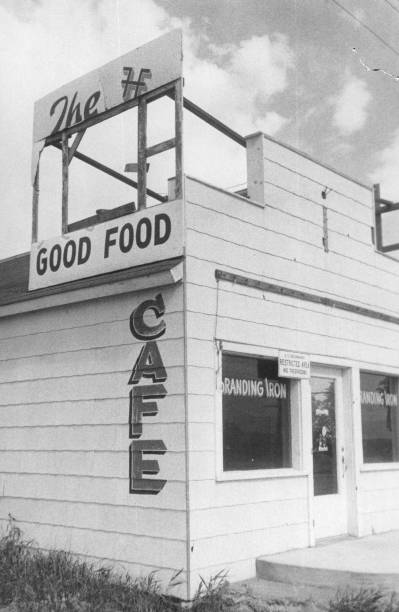
On February 19, 1956, J.C. Kinner told a Colorado Springs Gazette and Telegraph reporter that there was once a grammar school there in Husted, until the days of consolidated schools made it obsolete. "It had a saloon, which became a store, which became a postoffice, which in turn became a church. Finally the same frame was used to make the present forlorn Branding Iron Cafe," Kinner said.
The reporter from the Gazette and Telegraph described the Branding Iron Cafe's state in early 1956.
"Has a 'no trespassing' sign. Jones General store has a few boxes of Wheaties, some Certo; a couple of cans of sauer kraut still on it shelves, but the store is closed. The empty gas pump at the Allison's Service Station reads: this sale, $0.00."
The forlorn description goes on.
"Tourist and truckers speeding thru Husted don't know that in the window of the store there's a plaid calico camel. It's been tossed aside. It gathers dust. It's unwanted. But once upon a time some child hugged that plaid calico camel with tender love."
The town of Husted was like that.
From the 1956 description: "A dozen or so buildings make up Husted today. The Branding Iron Cafe still has its paneled knotty pine walls, its coffee counter, its sink. Picturesque symbolic menus boasting 'we sell soup in pints and quarts' are scattered over the floor. A year ago you could get a minced ham and scrambled eggs with toas for 48 cents. The ubiquitous tumble weeds in the the back room tell a different story today."
Homes, shacks, pigpens, garage, and the train station... all abandoned.
"Once an important stop on the Santa Fe and Rio Grande railroad, once a bustling center of ranchers and lumbermen, is a dead town — sacrificed on the altar of progress."


Photo information:
Colorado & Southern train, engine number 371, engine type 4-6-2 and engine number 9980, engine type EMD E5. Photo by Otto, Perry, Train #22, Texas Zephyr; 14 cars, fine smoke effect. Photographed: Husted, Colo., June 15, 1945.
Western History/Genealogy Dept., Denver Public Library

Husted's Branding Iron Cafe in 1956. Denver Post Photo.

Sunday, November 3, 2013

Regular guy, janitor at the Academy, and Medal of Honor recipient


Bill Crawford seemed like a regular guy.
He grew up in Pueblo, served in the Army until his retirement as a master sergeant in 1967.  After retirement, his life was fairly unremarkable, getting a janitor job, serving as director of the Lucretia Vaile Museum.  In fact, as a janitor at the Air Force Academy, he didn't really stand out. Went to work, took care of his custodial details, returned home to Palmer Lake in the evening.

Cadet James Moschgat described it this way.

"As a janitor William “Bill” Crawford certainly was an unimpressive figure, one you could easily overlook during a hectic day at the U.S. Air Force Academy. Mr. Crawford, as most of us referred to him back in the late 1970s, was our squadron janitor," he wrote later.

"Maybe it was Mr. Crawford’s personality that rendered him almost invisible to the young people around him. Bill was shy, almost painfully so. He seldom spoke to a cadet unless they addressed him first, and that didn’t happen very often. Our janitor always buried himself in his work, moving about with stooped shoulders, a quiet gait, and an averted gaze. If he noticed the hustle and bustle of cadet life around him, it was hard to tell. So, for whatever reason, Bill blended into the woodwork and became just another fixture around the squadron. The Academy, one of our nation’s premier leadership laboratories, kept us busy from dawn till dusk. And Mr. Crawford...well, he was just a janitor," wrote Moschgat.

"That changed one fall Saturday afternoon in 1976. I was reading a book about World War II and the tough Allied ground campaign in Italy, when I stumbled across an incredible story. On September 13, 1943, a Private William Crawford from Colorado, assigned to the 36th Infantry Division, had been involved in some bloody fighting on Hill 424 near Altavilla, Italy. The words on the page leapt out at me," said Moschgat.

The citation he stumbled upon read as follows:
"For conspicuous gallantry and intrepidity at risk of life above and beyond the call of duty in action with the enemy near Altavilla, Italy, 13 September 1943. When Company I attacked an enemy-held position on Hill 424, the 3d Platoon, in which Pvt. Crawford was a squad scout, attacked as base platoon for the company. After reaching the crest of the hill, the platoon was pinned down by intense enemy machinegun and small-arms fire. Locating one of these guns, which was dug in on a terrace on his immediate front, Pvt. Crawford, without orders and on his own initiative, moved over the hill under enemy fire to a point within a few yards of the gun emplacement and single-handedly destroyed the machinegun and killed three of the crew with a hand grenade, thus enabling his platoon to continue its advance. When the platoon, after reaching the crest, was once more delayed by enemy fire, Pvt. Crawford again, in the face of intense fire, advanced directly to the front midway between two hostile machinegun nests located on a higher terrace and emplaced in a small ravine. Moving first to the left, with a hand grenade he destroyed one gun emplacement and killed the crew; he then worked his way, under continuous fire, to the other and with one grenade and the use of his rifle, killed one enemy and forced the remainder to flee. Seizing the enemy machinegun, he fired on the withdrawing Germans and facilitated his company's advance." 

Bill Crawford, the janitor, was a Medal of Honor recipient. 
Though, because Crawford was captured by the Germans and presumed dead in the battle following, in 1944 the Medal of Honor was presented posthumously to his father. Later in the year, Crawford was among a group of soldiers rescued from German captivity. He had not been presented the medal himself, as was the custom for living recipients.

Years later, in 1984, the commencement speaker at the Academy was the President of the United States, President Ronald Reagan. Looking over the sea of young faces that represented the very best our Nation has to offer, he said: "America's men and women of today have made us a great Nation." And then the President turned his attention to the past, calling forward a 66-year old janitor crisply dressed in a uniform that still fit his trim frame. Forty years after his heroism at Altavilla, Italy and 17 years after his retirement from a military career, the President hung the Medal of Honor around the janitor's neck. 

The cadets themselves, had decided proper recognition of their janitor was long overdue, and had taken steps to see an "oversight" corrected. 

Crawford died at his home in Palmer Lake on March 15, 2000.  He is one of four Medal of Honor recipients from Pueblo, Colo.


Yo Hablo: It is all part of the program


“Honor to the soldier and sailor everywhere, who bravely bears his country's cause. Honor, also, to the citizen who cares for his brother in the field and serves, as he best can, the same cause.” 
__ Abraham Lincoln

At 82, Bill Frier knows about honor and service. Twenty years in the Air Force, third in a line of West Point graduates in 1954, flying C-130s, teaching at the Academy here in Colorado Springs — it is all part of the program for him.  
And the thing is, he knows about programs, too.
As the one-time Chief of Television for the Air Force, that is to be expected.
One of his proudest moments he will tell you, however, is development of his "Yo Hablo" program teaching conversational Spanish and pioneered in the early days at the Air Force Academy.
"In 1961, B. Gen. Robert McDermott (Dean of Academies, U.S. Air Force Academy and future CEO of USAA) launched a pioneer program teaching conversation Spanish over a newly-installed, close-circuit TV system to over 500 military families on base. He chose me, then an Associate Professor Spanish, to write and present, three times daily, the program — live, as there was no videotape available," says Frier.
"I was given the freedom to present my course my 'fun and easy way,' with cartoons and humor which had proven very effective when teaching the cadets. The pioneer experiment was a grand success."
He duplicated that success again in 1968 when the program was launched on CBS and later Educational Television, the forerunner of PBS, aired the program, and the president of CBS at the time, granted him use of the company's studios to put the production together. Today the course is certified in the Colorado prison system for inmates and employees.
Frier's enthusiasm for Spanish and Spanish speakers began in 1935 when his family moved to Mexico City, according to forward in the "Yo Hablo" book created to supplement the program. He returned to the US when he was 13 speaking Spanish like the natives. He also has a Master's degree in Spanish.
"Pulling from his memory of childhood cartoon characters he drew while growing up in Mexico, and using that musical language which was his second tongue, Bill devised the "Yo Hablo" show. The childish cartoons were revised, humanized, and sophisticated under the subtle hands of friend and artist Bob Dover of Colorado Springs. The artist transformed the ideas of the child into living people. These people populate the view's guide accompanying the series as an integral part of the learning experience."
Bob Dover polished his craft working with the Walt Disney Company.
"I last met with General McDermott approximately eight years ago (he was the CEO of USAA) on his last visit to Colorado Springs. We renewed old memories of the pioneer Spanish course and its successes. He strongly urged me to 'turn Yo Hablo upside down' teaching English to Hispanics — he emphasized the huge need it would fulfill, and with modern technology ... even one program could reach millions of families through the internet — and the central script already exists for 52 lessons.
"I launched in 2008, in the Hispania News, (a free newspaper in Colorado Springs) 'Y Ahora Yo Habo Ingles' one lesson per week," said Frier.
"I put together all of the lessons presented in 2008 and early 2009. Sadly, the editor of Hispania News, Bob Armendariz, died suddenly and Hispania News closed its doors."
Despite the setback, Frier hopes to share the value of his Spanish/English program that potentially could reach millions. He wants to transfer the entire course to the internet and perhaps sell, for a small fee, the cartoon text to fund future endeavors, such as editing the Spanish program "upside down" on to video, and teaching basic conversational English to Hispanics, as General McDermott suggested. 
The program, if he is successful or not, is just one more example of a lifetime of honor and service.


Sunday, April 19, 2009

Murdered mysteriously, brutally, viciously


No one is really sure what happened at the house and in the stable near the vanished town of Edgerton

By Rob Carrigan, robcarrigan1@gmail.com

Edgerton was once a bustling little village on the Denver and Rio Grande Railroad about nine miles north of Colorado Springs (near the present location of Ice Lake at the United States Air Force Academy.) It took its name from one David Edgerton who homesteaded there in 1872. Nearly 350 people called the place home by the turn of the century. There was the railroad platform, V.C. Lewis Hotel, a general store that also served as the post office and was operated by W.M. Smith, a doctor’s office, and even the Cascade Ice Company that cut ice from three reservoirs on the stone damned west fork of Monument Creek. For the most part, it was peaceful haven for ‘lungers’ and farmers, ice cutters, railroad workers and their families.
That is why news of two murders, an elderly woman and her young grandson, on a ranch two miles northwest of the Edgerton post office, was such a shock when reported in the Colorado Springs Gazette on April 29, 1888. Not only murdered, but mysteriously, brutally, and viciously.
Neighbor, S.K. Harris, and Mrs. Kearney’s daughter, a Mrs. Beach of St. Louis, discovered the victims, Mrs. M.J. Kearney and her eight-year-old grandson, little Jimmy Hand. The daughter and the neighbor had been alerted by other neighbors that perhaps something was wrong. Mrs. Beach had traveled here from Missouri after a telegram addressed to her mother, Mrs. Kearney, was undeliverable. The telegram messenger, from Husted, which was the nearest station, found all the doors at the ranch locked and no sign of any recent activity. The neighbor and the daughter decided to go see for themselves what was going on the morning of April 28.
“That afternoon they proceeded to the ranch where they found all the doors locked, strange to say, from the inside,” wrote Carl F. Mathews, in a historical paper called “Unsolved Crimes of the Pikes Peak Region,” in March of 1962. Mathews was a noted historian with the Denver Westerners and a 32-year veteran of the Bureau of Identification with the Colorado Springs Police Department. “Forcing one of the doors, they found Mrs. Kearney’s hat, bonnet and cloak in one room and on the kitchen table two pans of biscuits and some pies ready to place in the oven. A more complete examination resulted in finding two sets of dirty dishes, consisting of three plates each. One set had been used for a meal and set aside; the other on the table apparently used.”
Finding nothing more in the house they continued to search the surrounding ranch buildings.
“They went to a small stable near the house, where they made a horrible and ghastly discovery. In one corner of the little grain room was the body of Mrs. Kearney in an advanced state of decomposition, and the examination of a grain box in another corner disclosed the body of the little boy. So small was the box that one foot was left protruding. His body was not badly decomposed and blood could plainly be seen on the neck, evidently from a wound,” wrote Mathews.
“On May 1st, Coroner Davis, in company of Dr. S.A. Fisk of Denver, a friend of the family, reached the premises and it was found necessary to drag the body of Mrs. Kearney from its position in order to examine it closely. Buried in the right side of the skull was the head of a hatchet with a newly whittled handle about two feet long. Examination of the body of the little boy led Dr. Fisk to believe he had been shot but the coroner found a large gash on the side of the forehead about three inches in length, cause by the sharp edge of the hatchet.”
The police at the time followed several leads and developed a number of theories and possible suspects.
The hatchet was found about three years previous by W.H. Thompson, who had given it to a Mr. Haliday, who at one time rented the ranch.
“Thompson’s cabin was only a few hundred yards from Mrs. Kearney’s house; he cut kindling wood for her, did her chores and carried her mail from the post office for a long time,” noted Mathews in his 1962 paper. “Thompson loved his whiskey and about June 1st came to Colorado City, became drunk and was arrested. On the expiration of his sentence he became intoxicated again and while in jail let fall a word or two conveying the impression that he knew more about the murder than had been told. In one of the saloons he stated in the presence of four witnesses: ‘I killed Mrs. Kearney but I did not kill the boy.’ A preliminary hearing was held on July 24th and twice continued to July 27th, at which time Justice Gorman could find nothing to warrant holding him for trial, so he was accordingly released.”
Other possible scenarios that were suggested but never wrapped up in the form of convictions or even arrests were that the killer was a transient woodcutter hired by Mrs. Kearney, or perhaps a man she had arrested and tried for theft about three years prior to the murder, or perhaps a vagrant wandering through, that supposed she had large amounts of money stashed.
To date, no one is really sure what happened at the house and in the stable located in a deep gulch, two miles northwest of the vanished town of Edgerton. Even the roof of the lonely outpost could barely be seen from the road, and the nearest neighbor was largely considered the prime suspect. The brutal hatchet murder of the elderly Mrs. Kearney and little Jimmy Hand has never been solved.
###

Friday, November 28, 2008

Jimmy Stewart serves as icon of Air Force


Jimmy Stewart's enduring legacy


When the Air Force celebrated its 60th anniversary (Sept. 17, 2007), it was tempting to search for an icon.

By Rob Carrigan, robcarrigan1@gmail.com

The United States Air Force has a tremendous presence in the Pikes Peak Region with the Academy, Peterson Air Force Base, Schriever Air Force Base, and more than a few retired Air Force personnel.
The Air Force Academy, by itself, has nearly 6,500 active duty personnel and an economic impact of $700,693,967, according to its 2006 economic impact statement.
Being civilian, it is impossible to miss an impact like that, but still we try to put a face on it. Yes, the Air Force to us is the beautiful Academy campus, or the retired Colonels living next door, or the flyovers during football games.
But still, for convenience, some of us need something emblematic to tie to 60 years and the image of the Air Force.
I choose James Stewart.
Maybe that is right, wrong or irrelevant – you are the judge – but here is my reasoning.
Jimmy Stewart, the eldest son of hardware store owner from Indiana, Pennsylvania, saw WWII coming and joined the Army Air Corps as a private in 1940.
Stewart had already won and Oscar for “Philadelphia Story,” according to the official website of the United States Air Force but put service before himself.
“Despite attempts to use him for publicity, he fought to become a pilot and fought to get into the war,” the site says.
“Stewart went on to fly B-24 Liberator bombers over Europe, commanding at the squadron and wing level. Ironically, his first film back after the war was “It’s a Wonderful Life,” in which he played 4-F George Bailey. After the war, Stewart also played a major role in the formation of the Air Force, serving as a spokesman for the Air Force Association’s effort to advocate the need for a separate Air Force – ultimately succeeding when President Truman signed legislation in September 1947.”
Stewart continued to serve in the reserves and eventually reached the rank of Brigadier General in 1959. Among his military awards are: Distinguished Service Medal, Distinguished Flying Cross with Oak Leaf Cluster, Air Medal, French Croix de Guerre and the Presidential Medal of Freedom.
Stewart did not try to call attention to his service, preferring instead to avoid mixing his celebrity status and military accomplishments, if possible.
He died at the age of 89, on July 2, 1997.
“When interviewed about his techniques, the self-effacing actor replied characteristically,” according to his obituary that appeared in the New York Times.
''I don't act, I react,'' and described himself as an ''inarticulate man who tries,'' without having ''all the answers, but for some reason, somehow, I make it.'' He offered his criterion for success: ''If you can do a part and not have the acting show.''

###

Saturday, October 25, 2008

Simpson is local version of Forrest Gump


Simpson has witnessed change and participated


It has been decades since I first talked to Bill, and years since I have followed up and I am not sure how he is getting along, but he never failed to provide a connection to the Tri-Lakes community.

By Rob Carrigan, robcarrigan1@gmail.com

“Wherever men have lived there is a story to be told,” according Henry David Thoreau. “And it depends chiefly on the story-teller or historian whether that is interesting or not.”
That is why it’s my fault if this fellow’s local life doesn’t reach out and grab you.
Start pulling on one of the many threads of Tri-lakes history that connect Bill Simpson to the area’s past and the whole fabric unravels in front of you.
From his father’s exploits tracking down the mountain lion “Ol’ Disappearance,” in the 1920’s to the growth of today, Simpson has seen it all and been involved in most of it.
His dad ran the ice house operation on Monument Lake that harvested ice to cool rail cars before refrigeration. He recalls area motorist suffering frequent flat tires for years in the mid 1940s after the large warehouse was blown apart in a wind storm scattering shingle nails and other debris everywhere.
He was in the last class to graduate from “Big Red” in 1957. That building now serves as the administration building for District 38. He is also able to tell you the exact location of the last five Monument Post Offices, as his mother served as Post Master at most of them.
Among his fondest memories is his time spent out at the Monument Nursery and the sign shop there.
“I worked over there pulling weeds and picked up pine cones by the bushel,” he said.
The nursery would let the cones dry out and then put them in a big tumbler that looked like the drum that produces Colorado Lottery winning numbers. The loose seed were planted, grown locally, and then shipped around the country.
“White Fir cones were the most lucrative,” he said because they only produced cones in the very tip-top of the trees.
“We were paid $4 or $5 per bushel for White Fur. That was a lot of money back then.”
One technique involved finding and raiding a squirrel’s cache. You could take half and leave half of the cache with no negative effects on the squirrel, he said.
“Sometimes a cache would have five or six bushel in there.”
Yes, Simpson has witnessed change and participated.
“I have seen a lot of change. One of the major ones was when the Academy arrived. I worked out there in ’55 and ’56 when they were building part of it,” he said.
“Being in the construction business, I haven’t fought it. I have been a part of it.”

####

Monday, September 15, 2008

Air Force Academy is a newcomer


Bootleg whiskey, fox farms, governor's horse ranch, and pioneer cabins


By Rob Carrigan, robcarrigan1@gmail.com

In the scheme of things, the Air Force Academy really is a virtual newcomer to this area. Selected as the architect of the massive undertaking, the firm (actually a joint venture of several companies) of Skidmore, Owings and Merrill, was not even awarded the contract for the project until July 23, 1954, according to author Steven A. Simon in “The Building of the Air Force Academy,” an article appearing the special publication celebrating 50 years of the Academy. Most of the now well-known buildings on the 18,455-acre military reservation were built in the mid- to late 1950s.
But what came before?
As early as 1860, lumber concerns began appearing in an area later to be known as Husted. In what is now located just about at the North entrance of the Academy, Calvin R. Husted built a sawmill, and by the late 1860s, nearly 200 people lived nearby as the town with many businesses, a church and even a newspaper (Husted Banner) developed around the mill.
“Husted operated the mill for many years. Calvin Husted was one of the earliest county commissioners in El Paso County. He was known as a generous man; during his prosperous years he was said to have given many a handout and grubstake. He died in the poorhouse in Colorado Springs,” wrote Perry Eberhart in Ghosts of the Colorado Plains.
Eventually the sawmill was abandoned but the town survived for years as a shipping point for ranches in the area. The buildings disappeared little by little over the years.
“One of the oldest was the Branding Iron café; It became a saloon, then a store, then a post office, and finally a church. The service station and store closed in 1956. The last signs of Husted were completely destroyed with the construction of the Academy and the U.S. 85-87 freeway,” wrote Eberhart.
But prior to then, the little burg had an interesting run. There was even a West Husted and East Husted separated by Monument Creek and positioned alternately near the Rio Grande tracks and the Santa Fe tracks. And at one time the D & R.G. maintained a roundhouse or turntable in West Husted.
“The steam trains had power to pull the freight and passenger trains from Colorado Springs to Husted, but not enough power to pull the steep grade to Palmer Lake to the ‘Divide,’ therefore extra helper engines and crews were kept at Husted,” wrote local historian Lucille Lavelett.
It was an area known for train tragedies as well. Rock Island and Rio Grande trains collided head-on near there in 1888 killing only two people but another wreck in 1909 took the lives of seven and injured nearly 60 people.
Interestingly enough, there was also an early airport there.
“An unwitting precursor to the area’s eventual grand purpose, a small airport and flying school were built in the late 1930s on land currently used for cadet airmanship operations. In fact, Charles Lindbergh rented a plane and flew from this location while a member of the Academy Site Selection Commission,” Simon says.
Additionally, in the canyons west of Husted, bootleg whiskey stills proliferated during Prohibition and cattle rustlers, horse thieves and other undesirables were reportedly hanged in nearby Deadman’s Canyon, thereby giving it that rather dubious namesake.
Fox farms operated near there in 1930s, and former Governor Oliver Shoup owned the Cathedral Rock ranch not far from Husted on what is now Academy land.
Other towns at one time existed on or close to what is now the military reservation. Among them, Pring Siding, Edgerton, Monument Station (on the south end of the Academy), Henry, Borst, and Stanley Camp to name a few. But they each have unique stories of their own.
The Burgess Ranch Cabin, constructed in 1869-1870 by William A. Burgess, remains today in the Douglas Valley housing area on the Academy. It is one of the oldest remaining buildings in the Pikes Peak region and is on the National Register of Historic Places. Three small lodges built in 1929 also remain standing close by.
###