Friday, May 22, 2020

Colorado was full of colonists

 Newspaper editors played a role


By Rob Carrigan, robcarrigan1@gmail.com

Webster says a colony is a body of people living in a new territory but retaining ties with the parent state. 

Colorado, in its infancy as a territory, was full of colonies in those early days. The first of those colonies seemed to be heavily influenced by newspaper editors and publishers. 

Wet Mountain Germans

"The first colony to actually take up lands within the territory was a thorough-going, full fledged cooperative endeavor. Carl Wulsten had come to the United States from Prussia before the Civil War. He had served in the union Army and then settled in Chicago where he edited a German-language newspaper. In that fast-growing, rapidly industrializing city, he saw around himself, and his fellow Germans, nothing but misery and dirt and long hours of back-breaking work in the city's factories. Prompted by the concept of communal living as a means to escape this plight, and envisioning an agricultural society in the Great American West where fellow immigrants could again attain dignity and economic well-being, Wulsten organized the German Colonization Society in August, 1869," wrote "A Colorado History" editors Carl Ubbelohde, Maxine Benson, and Duane Smith. 

By 1870, they began building homes in the Wet Mountain Valley, plowed fields, and planted their first Colorado crops in a town they named "Colfax" after the vice-president of the United States, at the time. "Capital, labor and profits, if any, were to be pooled for five full years in a communistic arrangement," says the history text.

"But, as so often happened in other such ventures, dissensions began to erupt immediately within the group."

Many eventually moved to other towns in the territory, such as Pueblo, Canon City and Denver.
"There was considerable hostility to the group in some parts of southern Colorado, based partly on the "alien" character of the settlement, and partly on the rumors that the Republican administration in Washington was championing the settlement as the first of several groups designed to supply a Republican majority in otherwise normally Democratic areas of the territory," says "A Colorado History."

Union Colony

Roughly, about the same time the Germans in the Wet Mountain Valley were trying to cobble together their cooperative settlement, Nathan Meeker, the Ag Editor for the  New York Tribune,  was also looking around for a site in the West.

"Meeker was an experience hand at cooperative colonies. From 1844 to 1857 he had been a resident at the Trumball Phalanx, at Braceville, Ohio. By the time he returned from his western tour, Meeker was convinced it would be possible to settle a cooperative community in Colorado. His publisher and editor, Horace Greeley, who already has seen something of the territory, endorsed the idea enthusiastically," notes the history text.

At a public meeting at the Cooper Institute in New York City, on Dec. 23, 1869,  the Union Colony was born. Meeker was chosen as president, and memberships were sold for $155 to men of temperance and good character. The money would be used to purchase a site for the colony.

In the the spring of 1870,  Union Colonist began arriving at the confluence of the Cache La Poudre and the South Platte Rivers. The town established there was known as Greeley.

To supplement their tents and other make-shift structures a large building was purchased in Cheyenne and transported via Union Pacific to Greeley. The building was retrofitted and became lodging, in the form of "Hotel de Comfort," built schools, and dug the first irrigation ditches.

Horace Greeley,  Meeker, and their newspaper, all were controversial. But sobriety, agriculture know-how, and luck, led the Union Colony to early prosperity. The irrigation system was well-planned and improved upon successfully over the years. Greeley farmers harvested amazing crops. Nearby ranching operations didn't always get along with the "Saints" of the colony there was some friction over an expensive fence erected by Union colonists, saying it had been erected to separate the "Bible-loving inhabitants" of Greeley from "barbarians" on the outside.
"The rather spectacular successes on the Union colonist made it inevitable the it would become the prototype of other such enterprises," says "A Colorado History."

Others followed
 

In 1871, the Chicago Colorado Colony located on Middle St. Vrain Creek, creating the town of Longmont, with the help of its "fairy godmother" Mrs Elizabeth Thompson, of New York, who purchase memberships for poor settlers and and otherwise encouraged the settlement, which prospered from its strategic location along Left Hand and Boulder Creeks, as well as St. Vrain.

Evans was successful, as well, south of Greeley, with advantageous rail service, flowered. Platteville boomed. But Green City on the South Platte River failed because they were "over promoted" and didn't fulfill promises.

"Fort Collins came closer satisfying the requirements of a true colony than many other new settlements." The site had been a military reservation, named Camp Collins, but abandoned, and bought up by a town company which planned the new city of Fort Collins. Memberships in the Fort Collins Agriculture Colony were offered to persons of "good moral character" for $50, $150, or $250, for city lots, farming land, or both.

In Fremont County, the Hebrew Immigrant Aid Society settled Jewish emigrants from Russia and Poland in the Wet Mountain Valley, but with limited success. Cotopaxi families later were relocated to with the help from Denver Jewish families to other locations.

Several southern Colorado newspaper editors were dead set against what they called a "Mormon plot" to establish a belt of communities, 25 miles apart, in the San Luis Valley all the way from Utah through Colorado to Nebraska. "Actually the Mormons proved to be more interested in farming than politics, and friendships developed with their Spanish-speaking Catholic neighbors sufficient to quiet whatever fears of the alarmist Anglo editors had raised among the actual residents of the Valley."

Much later, Monument historian Lucille Lavelett  noted that other colonies were prone to develop, though sometimes with limited success.

"The Nudist had a retreat one mile south of Monument, on Mrs. Judd's old farm in 1954," she wrote. "The cold wind from the top of Pikes Peak and the sun behind Mount Herman early in the afternoons kept it too cold for them, so they were only there about a year. It was named 'Roaming Acres'," she wrote in her 1975 history of Monument.

###

Photo 1:
Richard Hart of Greeley, Colorado in Weld County stands outside of the original Union Colony (original name for Greeley). The wood-frame building has board-and-batten siding, a front gable, shingles, and two entry doors. Advertisements are posted on the side of the building. Signs include "Saddle and Harness Shop."

Photo 2:
Photo of fourteen portraits of early Greeley pioneers (known initially as Union Colony,) Colorado in Weld County.


Thursday, April 9, 2020

Spain gets a 'bad rap' for 1918 flu

Origins may have been closer to home

By Rob Carrigan, robcarrigan1@gmail.com

A virulent strain of influenza, called the Spanish flu because it was incorrectly believed to have started in Spain, spread throughout the globe beginning in the spring of 1918.
Its origins may have been much closer to home.

By early October, it had resulted in shutdowns in Denver, mandated by progressive health officials, who closed the city for three weeks.

"The closing of Denver depends wholly of the spread of the disease," said Dr. (William H.) Sharpley. (Sharpley was the city's manager of health.) "It will be, naturally, absolutely necessary for the city to be closed while there is any danger. The main danger now menacing Denver is from outside towns and strangers arriving in the city from various sections of the country where the scourge is prevailing," according to Rocky Mountain News of Oct. 10, 1918.

Headlines in the Rocky, for that date read:

CITY TO BE SHUT
THREE WEEKS TO
CHECK EPIDEMIC
Five Additional Deaths Reported Yesterday
Scourge Believed To Be Under Control

"There were approximately 500 cases in the city reported to Dr. Sharpley yesterday and he says that the death rate shows the disease is well in hand in Denver, but that in Denver and in towns thruout the state will be closed for the full three weeks, the run of the disease."

The newspaper outlined other cities in the state where public meeting places, including schools, churches, theaters, pool halls and lodge rooms  were suspended: Colorado Springs, Boulder, Golden, Pueblo, Sterling, Fort Morgan, Delta, La Junta, Rocky Ford, Florence, Gunnison, Walsenburg

Scientists still cannot say for sure where the Spanish Flu originated, though theories point to France, China, Britain, or the United States, where the first known case was reported at Camp Funston in Fort Riley, Kansas, in March of 1918. Many American scientists believe infected soldiers spread the disease to other military camps across the country, then brought it overseas. In March 1918, 84,000 American soldiers headed across the Atlantic and were followed by 118,000 more the following month.

According to the History channel:
"The Spanish Flu did not originate in Spain, though news coverage of it did. During World War I, Spain was a neutral country with a free media that covered the outbreak from the start, first reporting on it in Madrid in late May of 1918. Meanwhile, Allied countries and the Central Powers had wartime censors who covered up news of the flu to keep morale high. Because Spanish news sources were the only ones reporting on the flu, many believed it originated there (the Spanish, meanwhile, believed the virus came from France and called it the “French Flu.)"

Just before breakfast on the morning of March 4, Private Albert Gitchell of the U.S. Army reported to the hospital at Fort Riley, Kansas, complaining of the cold-like symptoms of sore throat, fever and headache. By noon, over 100 of his fellow soldiers had reported similar symptoms, marking what are believed to be the first cases in the historic influenza pandemic of 1918, later known as Spanish flu. The flu would eventually kill 675,000 Americans and an estimated 20 million to 50 million people around the world, proving to be a far deadlier force than even the war those troops were sent to fight..

"Spanish Flu” was first reported in Colorado on September 21, 1918, among the Student Army Training Corp stationed at the University of Colorado in Boulder. Hundreds of soldiers were sickened and 19 later died, according to Katie Randolph, of the Denver Public Library On September 27, 1918, a young Denver University student named Blanche Kennedy, died of pneumonia a few days after returning from a trip to Chicago, according to University of Michigan Center for the History of Medicine. It was Denver’s first influenza-related death.

The initial outbreak of the disease, reported at Fort Riley in March, was followed by similar outbreaks in army camps and prisons in various regions of the country. The disease soon traveled to Europe with the American soldiers heading to aid the Allies on the battlefields of France. (In March 1918 alone, 84,000 American soldiers headed across the Atlantic; another 118,000 followed them the next month.) Once it arrived on a second continent, the flu showed no signs of abating: 31,000 cases were reported in June in Great Britain. The disease was soon dubbed the Spanish flu due to the shockingly high number of deaths in Spain (some 8 million, it was reported) after the initial outbreak there in May 1918.

Photo Info:
1. Nurses and patients are treated in the makeshift hospital at the Sopris mining camp in 1918.
2. Canon City High School students wear masks during the 1918 pandemic. History Colorado.
3. Doctors at that time knew little about the prevention or cure for the virus.


Thursday, April 2, 2020

Gwillimville traces though local legacy


“That sensation of a void within which never left us, that irrational longing to hark back to the past or else to speed up the march of time, and those keen shafts of memory that stung like fire.”
― Albert Camus

 Diphtheria epidemic broke out in January of 1880


By Rob Carrigan, robcarrigan1@gmail.com

A fine spring of good soft water flowed through a beautiful meadow in 1869.  Gwillim R. Gwillim, a native Welshman from North South Wales, decided to make it home — for he and his wife and young son.

West Cherry Creek, about five miles east of Monument, is where Richard Gwillim,  his 22-year-old trailing brother found him after disembarking from the train in Greenland in 1871, and young Richard decided to build a life after after arriving in New York by a steamer from Inman line. Farming with his brother, for several years, Richard decided to stay on and bought 320 acres adjoining from the government to the east. He named the spot Bryn Mawr.

For the last nearly 20 years, it has been a local Longhorn operation out at Cherry Springs Ranch (with other grazing ground out in Ellicott) on the former site of Gwillimville. Founded in 1869 by Gwillim R. Gwillim, originally from North South Wales, and six miles east of Monument on Highway 105.

"The cabin and hay shed in the bottom of the pasture dates back to the time of the town," noted Stan Searle in tour during a Chamber event several years ago.

Gwillimville was never incorporated. In its heyday, a cheese factory, creamery, store, blacksmith shop, several saloons, a post office, school, church and worker's quarters sprang from the earth around Cherry Springs and the source of Cherry Creek. The Gwillimville School was eventually moved to Monument, becoming Sunday school for the Presbyterian Church and in the 1980s, the former Tri-Lakes Chamber of Commerce building on Highway 105 in Monument.

In January of 1880, a Diphtheria epidemic broke out affecting brother of the founder's family Richard Gwillim's two daughters, according to Monument historian Lucille Lavelett.

"The family had four little girls," wrote Lavelett. "And the two older ones were stricken. Dr. Bonnett of Monument was summoned but he did not seem to know how to treat the disease, so Mr. Gwillim sent word to Dr. Solly of Colorado Springs, who made several trips to Monument by train, where Mr. Gwillim met him and took him to see the two sick little girls."
"Of course, there was no antitoxin for battling the disease at that time. A few days later, Dr. Buchtel of Denver was summoned. He also came by train to Monument, where Mr. Gwillim drove a team of horses to the station to meet him and took him to the farm." According to Lavelett, it was expensive healthcare for the time.

"Dr. Solly's trips were $25 each, and Dr. Cuchtel's were $500," she wrote.

"In spite of all efforts, the two little girls passed away within a few days of each other. These girls are buried in the Spring Valley Cemetery. The day the second girl died, Mrs. Gwillim gave birth to a baby boy." wrote Lucile Lavelett in her Monument's Faded Neighboring Communities.

"A very strange and sad coincidence happened that two children in every family in the neighborhood died of Diphtheria during that epidemic."

Misfortune plagued the family again in 1895, when Richard Gwillim's home burned, pretty much spelling the end of Gwillimville. Although the house was rebuilt, the Gwillims never returned, eventually moving to Colorado Springs and much later Richard served as El Paso County Assessor from 1913 to 1915.

Stan Searle's career in the media business was not confined to Longhorns however and had fingers reaching out in several directions. Locally, he was the founder and manager of Tri-Lakes Cable, which was sold to Adelphia in 2000, (later becoming part of Comcast) and managed other trade magazines related to cable and other business.

Named among the top 100 Pioneers of the cable industry, Stan's heart however, was in the cattle business. Suggesting that some of his inspiration comes from legendary trail founder Charles Goodnight, Stan co-founded International Texas Longhorn Association and is a recipient of their prestigious "Charles Goodnight Award. The Goodnight-Loving Trail beginning with the "Gather" in Texas after the Civil War, goes through Monument, on into Denver.

With much fanfare, the Tri-Lakes Chamber of Commerce moved into the Highway 105 location in 1985, but the building itself has quite a storied history. It's been a bit transient.

According to a letter dated March 15, 1985, from long-time Monument historian Lucille Lavelett, the building has been bopping around Monument since perhaps as early as 1869.

"The C.E. (Christian Education) Building was once a one-room Gwillimville School. Gwillimville was once a small, thriving community five miles east of Monument on Highway 105. It was founded by Gwillim R. Gwillim in 1869."

Lavelett relates the following story:

"During a period of a few years, a dozen or more families had come from Wales and several from England, and settled in the community. Church services were held in the one-room Gwillimville School until the Gwillimville Church was built in 1893. This Church was built on the northwest corner of (Highway) 105 and Highway 83," wrote Lavelett.

"On Aug. 6, 1919, Monument School consolidated with three smaller districts which were Pring, three miles south of Monument, Husted, six miles south (Husted is now part of the United States Air Force Academy), and Stout, which was east of Husted. The following year, Gwillimville joined the new district (1920)," she wrote.

"It was in the late 1920s or early 1930s, Rev. R.J. Hassted, minister of the Presbyterian Church, and Earl Thompson moved the little white school into Monument and put it south of the Presbyterian Church to be used as a Sunday School and community services. To help the church, the Monument Homemakers Club in 1938, and 1939, paid for having ceiling and walls re-plastered and painted, built a new flue in the west end, bought a large coal circulator heater to heat the building and put linoleum in the kitchen area. The east end had a cook stove, sink and cupboards. Cook stove did not give enough heat to warm the building, so the new flue was built," Lavelett said.

"In the late 1940s, the church built the new kitchen and Sunday School room on the north side of the building. Also a rest room. The town, at that time, had natural gas, so a gas heater was installed," she said.

At the time of the 1985 move to its present location, Lavelett noted that this was third move for the old Gwillimville School.

"When it was built, its home was about one and a half miles north of (Highway) 105 where the children had to walk through a cattle pasture. Children were afraid of the cattle, so it was move close to 105. Moved then to Monument, and in 1985 to home of the Chamber of Commerce," according to historian Lavelett.

Then County Commissioner Frank Klotz and Chamber President Sandy Smith turned a spade-full of dirt in honor of the new building in February, and actual move took place in April of that year, reported the forerunner of the Tribune at the time. The chamber had been organized nine years prior to spearhead efforts to attract business and industry to the Tri-Lakes area.

Tri-Lakes Chamber of Commerce moved to what was once the Monument Town Hall at 166 Second Street in Monument, in February, 2015,  to a building which also recently served as Tri-Lakes Monument Fire Protection District's administration building.

Photo Info:

1. Longhorns at Searle's Cherry Springs Ranch near the former site of Gwillimville.

2.  Building was once a one-room Gwillimville School in an earlier life.


Wednesday, April 1, 2020

World-class art discovered locally at Chapungu


  Serenity spot in walking park nearby


By Rob Carrigan, robcarrigan1@gmail.com

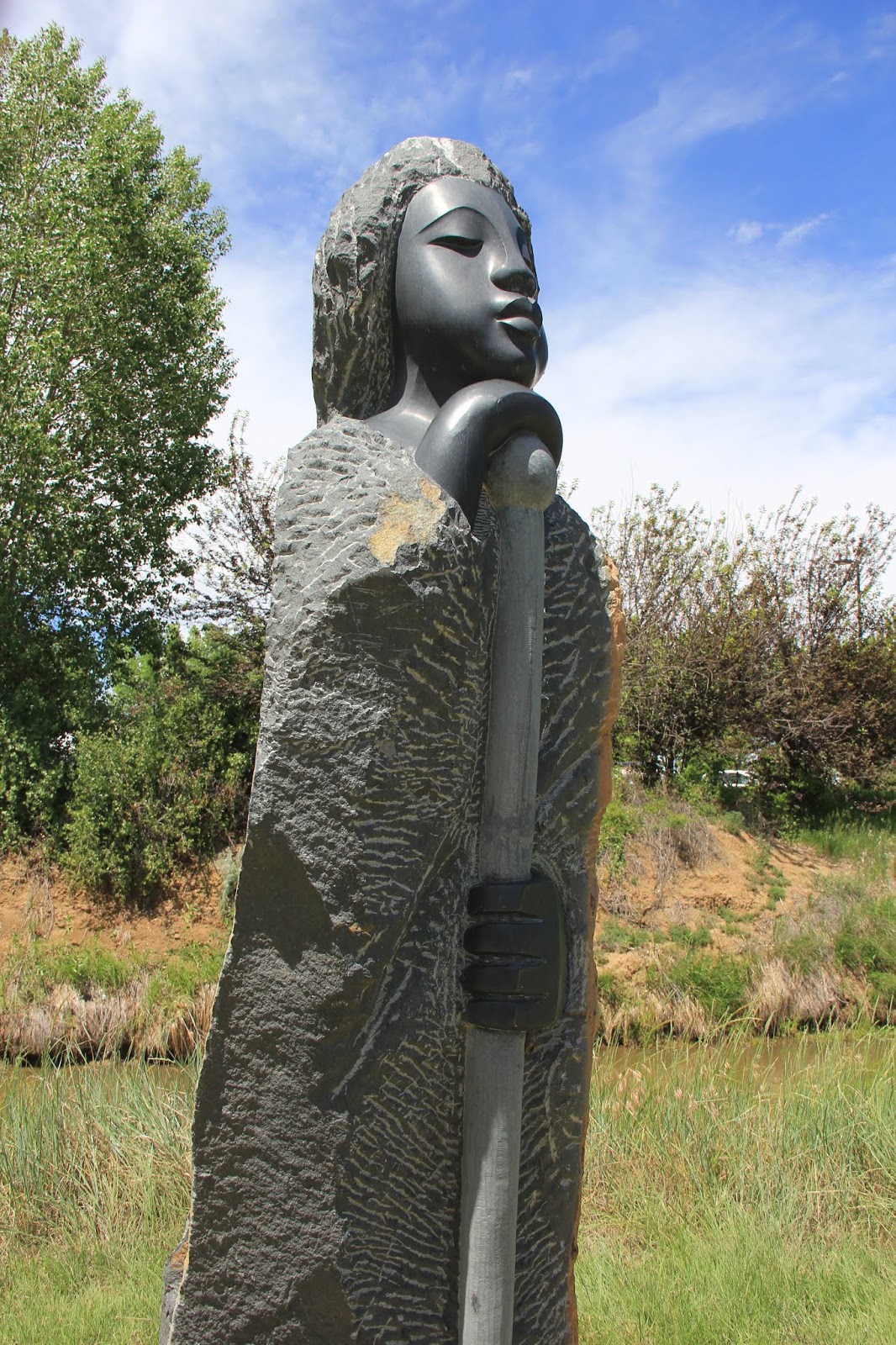
A pleasant surprise awaits locally with the discovery of world-class art in the form of Chupungu (pronounced CHA-poon-goo), the 26-acre Sculpture Park in Centerra off US. Highway 34, near Interstate 25 in Loveland. The park features more than 80 stone sculptures carved by artists from Zimbabwe, displayed in beautiful landscaped gardens.

"Opened in 2007 Chapungu Sculpture Park at Centerra is the only outdoor exhibit in the world displaying 82 monumental works of art traversing 26 acres of natural landscaped gardens. Since the 1950s, Zimbabwe stone sculpture has been a contemporary art phenomenon that has played a significant role in the development of art from Africa," according to information from Centerra.
"This explosion of cultural expression had early influence from Joram Mariga and Nyanga Group in 1957, but the main thrust came from National Gallery under its first director, Frank McEwan in 1957 and 1958. Other important communities such as Tengenenge in Guruve and Chapungu Scupture Park became involved in the late 60s and still support and promote artists to this day," according to Centerra info.

"Since 1970, Chapungu has been foremost in the promotion of this art form and has run almost all the major exhibitions of importance such as: Royal Botanical Gardens at Kew, London, U.K., Chicago Botanic Gardens, Chicago, Il., Kasteel Groenvelt & African Museum, Netherlands, Jerusalem Botanical Gardens, Jerusalem, Israel, Fort Canning Park, Singapore, Kirsten Botanic Gardens, Cape Town, South Africa,  Missouri Botanical Gardens, St. Louis, Mo, Palmengarten, Frankfurt, Gemany, and the Denver Botanic Garden."

The walking park is free and handicap accessible, open year-round from 6 a.m. to 10:30 p.m., and is comprised of eight universal themes: Nature & Environment, Village Life, The Role of Women, The Elders, The Spirit World, The Family, The Children, Custom & Legend.


Friday, March 20, 2020

I used to work in Dolores, In a hardware store


By Rob Carrigan, robcarrigan1@gmail.com

"I Used to Work in Chicago" is a drinking song. I have adapted it to fit my own circumstances, and 'regionalized' for my own narrative. It follows below.
Years ago, my good friend Jeff used to "bring up the house" with his guitar and this little ditty in the oldest bar in Fort Collins, when it was still a 3.2 beer only place.
The song was written by songwriter and entertainer Larry Vincent. The earliest printed date for the song is March 1945 in the underground mimeographed songbook Songs of the Century, however versions of the song circulated "on the street" as early as 1938 according to the Digital Tradition Folk Music Database. Many of the lyrics are considered humorous because of the oblique sexual references. The song is often chanted by various British university sports teams, often Rugby teams.
After World War II, there were various versions of this song commercially recorded (e.g. by Spike Jones).

  • A variation of this song is also occasionally performed by Eddie Vedder of Pearl Jam during their live performances with the final lines, "Liquor she wanted / Lick her I did / I don't work there anymore."
  • The same (Liquor/Lick her) version is also sung by Dusty and Lefty, played by Woody Harrelson and John C. Reilly, in the film A Prairie Home Companion.
  • One verse sung by Charles Durning in the movie Jerry and Tom. "A woman came in for a house dress. I asked her what kind she wore. 'Jumper,' she said. Jump her I did and I don't work there anymore."
From USED TO WORK IN CHICAGO
(Traditional)
Three Bits Of Rhythm - 1946
Also recorded by: Merle Travis; Oscar Brand;
Rick Bedrosian; Sammy Kaye & His Orch. 
Adapted by Rob Carrigan, regional emphasis.
 
 We used to work in Dolores
In a hardware store
We worked in the candy department
We did, but we don't anymore
A lady came in for some candy
"And what will you have?" we said
"Kisses" she said, and kisses she got
We'll never work there anymore

SPOKEN: And then we got fired

I used to work in Dolores
In a hardware store (You did?)
I worked in the hat dept
I did, but I don't anymore (What happened?)
A lady came in for a hat one day
"What'll you have?" I said (What'd she say?)
"Felt," she said, and felt 'er I did
I'll never work there anymore

SPOKEN:
1st Voice: That was my Wife!
2nd Voice: She's all right
1st Voice: I'm not talkin' to you
2nd Voice: I'm not askin' you
1st Voice: Ooh!

I used to work in Dolores
In a hardware store
I worked in the glove department
I did, but I don't anymore
A lady came in for some gloves one day
"And what will you have?" I said (What she say?)
"Rubber" she said, and rub 'er I did
I'll never work there anymore

SPOKEN:
1st Voice: I love my work
2nd Voice: I bet you do

I used to work in Dolores
In a hardware store
I worked in the shoe department
I did, but I don't anymore
A lady came in for some shoes one day
"What kind would you like?" I said
"Boot" she said, and boot 'er I did
I'll never work there anymore

SPOKEN:
1st Voice: You get a kick out the work, don't you?
2nd Voice: Well, you see, that was my mother-in-law

I used to work in Dolores
In a department store
I worked in the stockings department
I did, but I don't anymore
A lady came in for some stockings
"And what'll you have?" I said
"Hose" she said, and hose she got
I'll never work there anymore

SPOKEN:
1st Voice: You're fired!
2nd Voice: You can't fire him, he means Nylons
1st Voice: Ooh!

I used to work in Dolores
In a hardware store
I worked in the bakery department
I did, but I don't anymore (Make any dough, Joe?)
A lady came in for some bakeries
"And what will you have?" I said
"A layer" she said, a layer she got
I'll never work there anymore

SPOKEN: I love my work

I used to work in Dolores
In a hardware store
I worked in the poultry department
I did, but I don't anymore
A lady came in for some poultry one day
"And what will you have?" I said
"A goose" she said, and a goose she got
I'll never work there anymore

We used to work in Dolores
In a hardware store
We worked in the meat department
We did, but we don't anymore
A lady came in for some meat one day
"And what will you have?" we said
"Baloney", she said, and wieners she got
We'll never work there anymore
 
Photo Information;
Hollywood gathering years ago. Photos courtesy of Scott Weinmaster.


Thursday, March 12, 2020

Swords to Plowshares in Colorado, nearby New Mexico

“But we are only termites on a planet and maybe when we bore too deeply into the planet there'll be a reckoning. Who knows?”
― Harry S. Truman 

"What's important about morality in politics is us. We own the chicken farm. We must give our bird-brained, feather-headed politicians morals. Politicians love to think of themselves as "free-range" but they do not have the capacity to hunt or gather morals in the wild. If we fail to supply them with morality, politicians begin to act very scary in the barnyard. These are enormous headless chickens and they have nukes."
— P.J. O'Rourke (Don't Vote, it Just Encourages the Bastards) 


In search of Peaceful Nuclear Explosions (PNE)


By Rob Carrigan, robcarrigan1@gmail.com

In the late 1960s and the early 1970s,  remote locations in Colorado and nearby New Mexico became testing grounds designed to salvage the idea that we can be peaceful and useful — with nukes.

Project Plowshare was the overall United States program for the development of techniques to use nuclear explosives for peaceful constructive purposes. As part of the program, 31 nuclear warheads were detonated in 27 separate tests. Plowshare was the US portion of what are called Peaceful Nuclear Explosions (PNE).

A similar Soviet program was carried out under the name Nuclear Explosions for the National Economy.

"On May 17, 1973, the U.S. Atomic Energy Commission (AEC), the predecessor agency of the U.S. Department of Energy (DOE), detonated three nuclear devices nearly simultaneously in a single emplacement well at depths of 5,840; 6,230; and 6,690 feet at the Rio Blanco site.
The test was conducted in low-permeability, gas-bearing sandstones at the base of the Fort Union Formation and the upper portion of the Williams Fork Formation. This was the third and final natural gas reservoir stimulation test in the Plowshare Program, which was designed to develop peaceful uses for nuclear energy. The two previous tests were Project Gasbuggy in New Mexico and Project Rulison in Colorado. The AEC conducted the test in partnership with CER Geonuclear Corporation and Continental Oil Company (Conoco)," according to a fact sheet from the U.S. Department of Energy.

'Project Rio Blanco' was an underground nuclear test that took place on May 17, 1973 in Rio Blanco County, Colorado, approximately 36 miles northwest of Rifle.

"The purpose of the Rio Blanco test was to stimulate the flow of natural gas in low-permeability geologic formations. The detonations produced extremely high temperatures that vaporized a volume of rock, temporarily creating a cavity at each depth. The fractured rock above each cavity collapsed shortly after the detonation, forming a rubble-filled cavity and a collapse chimney that extends above each detonation point. It was expected that the collapse chimneys created by the detonation would be connected, allowing for improved gas production from the fractured rock surrounding each collapse chimney," says the Department of Energy information.

Three 33-kiloton nuclear devices were detonated nearly simultaneously in a single emplacement well at depths of 5,838, 6,230, and 6,689 feet below ground level.

This was the third and final natural-gas-reservoir stimulation test in the Plowshare program, which was designed to develop peaceful uses for nuclear energy.

The two previous tests were 'Project Gasbuggy' in New Mexico and Project 'Rulison' in Colorado.

The United States Atomic Energy Commission conducted the test in partnership with CER Geonuclear Corporation and Continental Oil Company. A placard, erected in 1976, now marks the site where the test was conducted. The site is accessible via a dirt road, Rio Blanco County Route 29.

Project Rulison, named after the rural community of Rulison, Colorado, was an underground 40-kiloton nuclear test project in the United States on September 10, 1969, about 8 miles (13 km) SE of the town of Grand Valley, Colorado (now named Parachute, Colorado) in Garfield County.
The location of "Surface Ground Zero" is 39°24′19.0″N 107°56′54.7″W. The depth of the test cavity was approximately 8,400 ft (2,600 m) below the ground surface. It was part of the Operation Mandrel weapons test series under the name Mandrel Rulison, as well as the Operation Plowshare project which explored peaceful engineering uses of nuclear explosions. The peaceful aim of Project Rulison was to determine if natural gas could be easily liberated from underground regions. This site remains under active monitoring by the U.S. Department of Energy Office of Legacy Management.

The test succeeded in liberating large quantities of natural gas; however the resulting radioactivity left the gas contaminated and unsuitable for applications such as cooking and heating homes. Although projected public radiation exposures from commercial use of stimulated gas had been reduced to less than 1% of background, it became clear in the early 1970s that public acceptance within the U.S. of any product containing radioactivity, no matter how minimal, was difficult if not impossible.

The Department of Energy began a cleanup of the site in the 1970s which was completed in 1998. A buffer zone put in place by the state of Colorado still exists around the site. A January 2005 report by the DOE stated that radioactivity levels were normal at the surface and in groundwater, though a later report due in 2007 was expected to more fully explore if there was subsurface contamination and whether or not radioactivity was still spreading outward from the blast site itself.

A placard, erected in 1976, now marks the site where the blast took place. It is accessible via a gravel road, Garfield County Route 338.
'Project Gasbuggy' was an underground nuclear detonation carried out by the United States Atomic Energy Commission on December 10, 1967 in rural northern New Mexico. It was part of 'Operation Plowshare,' a program designed to find peaceful uses for nuclear explosions.

Gasbuggy was carried out by the Lawrence Livermore Radiation Laboratory and the El Paso Natural Gas Company, with funding from the Atomic Energy Commission. Its purpose was to determine if nuclear explosions could be useful in fracturing rock formations for natural gas extraction.

The site, lying in the Carson National Forest, is approximately 21 miles southwest of Dulce, New Mexico and 54 miles east of Farmington, and was chosen because natural gas deposits were known to be held in sandstone beneath Leandro Canyon. A 29 kilotons of TNT device was placed at a depth of 4,227 feet underground, then the well was backfilled before the device was detonated; a crowd had gathered to watch the detonation from atop a nearby butte.

The detonation took place after a couple of delays, the last one caused by a breakdown of the explosive refrigeration system. The detonation produced a rubble chimney that was 80 feet wide and 335 feet high above the blast center.

After an initial surface cleanup effort the site sat idle for over a decade. A later surface cleanup effort primarily tackled leftover toxic materials. In 1978, a marker monument was installed at the Surface Ground Zero (SGZ) point that provided basic explanation of the historic test. Below the main plaque lies another which indicates that no drilling or digging is allowed without government permission.
The site is publicly accessible via the Carson National Forest, F.S. 357 dirt road/Indian J10 that leads into the Carson National Forest.

Following the 'Project Gasbuggy' test, two subsequent nuclear explosion fracturing experiments were conducted in western Colorado in an effort to refine the technique. They were Project 'Rulison' in 1969 and 'Project Rio Blanco' in 1973. In both cases the gas radioactivity was still seen as too high and in the last case the triple-blast rubble chimney structures disappointed the design engineers. Soon after that test the 15-year 'Project Plowshare' program funding dried up.

Later, with the coming of the millennium, early fracturing tests such as these were, for the most part, replaced by hydraulic fracturing technologies.

Photo information:
Workers with the Atomic Energy Commission place a nuclear device into a shaft drilled on Doghead Mountain on Sept. 10, 1969, as part of the government's attempt to find peaceful uses for nuclear explosions. This effort sought to extract natural gas from the Rulison Field near Rifle. The gas that came out, however, was radioactive and could not be sold.
Department of Energy/1969

Thursday, March 5, 2020

You are never going to kill storytelling

Sam Strong: "Betrayer of women, couldn't keep a promise, litigious and quarrelsome"

By Rob Carrigan, robcarrigan1@gmail.com

 J.K. Rowling is given credit for the idea that "No story lives unless someone wants to listen. And the stories we love best, do live in us forever." But I personally hold that a lot of fine stories live because somebody who doesn't want to listen — got killed because of it. 

So goes the tale of Cripple Creek millionaire mine owner Sam Strong.
Papers all over the country, from the New York Times to the papers in San Francisco, reported his death.

Mining areas and labor hotbeds like Telluride, and local publications like Daily Journal (Telluride), August 22, 1901, were particularly interested.

SAM STRONG KILLED AT CRIPPLE CREEK

The Millionaire Owner Meets His Fate In a Drunken Quarrel in a Gambling House.

Cripple Creek , Colorado, Aug . 22 . —Sam Strong, the millionaire mine owner, and one of the best known characters in Cripple Creek, was shot and killed this morning in a quarrel with Grant Crumley. Sam Strong at 6 o' clock this morning entered a gambling house and met Crumley. He became abusive over an old trouble and finally pulled his gun and shot. The bullet missed the mark, and other men jumped in between the two, while Crumley stepping behind the bar, picked up a gun, took aim at Strong and fired, blowing nearly the whole top of his head off. The incident caused the wildest sensation in the gold camp.

A not-so-flattering obituary in the same paper, also on the front page, followed immediately.

Colorado Springs , Aug . 22 . —Sam Strong, the millionaire mine owner, killed this morning in a gambling house brawl at Cripple Creek, lived here for some time. He was not a cultured man and his personality made him few friends. Despite his wealth he was practically ostracized socially. Wealth spoiled all the good traits in the man. He cut his old friends, developed into a typical Shylock, loaned money at heart-breaking rates of interest, was notorious as a betrayer of women and when he married for the second time last year, a Miss Lewis sued him for breach of promise and secured a judgment, the largest verdict ever returned for a similar case in this county. He was sued by many women and was a born rake. He was tried a few months ago for blowing up his own mine, but was acquitted.

For a story-telling event sponsored by the Victor Lowell Thomas Museum, the museum noted Sam Strong's death was a favorite.

"The most famous story about the Strong Mine has to do with its founder. The mine’s 1890’s owner, Sam Strong, was killed in an argument in the Newport Saloon in Cripple
Creek in 1901, his shooting the result of an argument over gambling. As a result of the incident, the mayor at the time outlawed guns and gambling in Cripple Creek.
In the August 23 issue of the Colorado Springs Evening Mail, Mayor Crane ran a decree on the front page. He publicly denounced Strong and all other gamblers for the common practice of carrying concealed weapons, saying: ‘I believe that in a community so well governed as Cripple Creek, where warrants are worth 100 cents on the dollar, any person who carries a gun or other dangerous weapon concealed on his person is either a coward, a bully or an outlaw.’ Crane ordered that all gambling houses in Cripple Creek be closed and that ‘all persons carrying concealed weapons quit said practice.’"

Other stories about Sam Strong had made headlines before. In the San Francisco Call, April 14, 1900:

Strong Must Pay Heavy Damages for Breach of Promise. Special Dispatch to The Call.

COLORADO SPRINGS. Colo., April 13.— The jury In the breach of promise case of Nellie Lewis vs. Sam Strong this afternoon returned a verdict In favor of the plaintiff for $30,000. The trial was sensational in many respects. The defendant is a millionaire, having made a fortune in Cripple Creek, principally in the famous Strong mine. The parties to the action met in June, when the plaintiff was 15 years of age. The relations began between the two six months later, continuing to January last, when the defendant married Regina Neville, a belle of the mining camp of Altman.

Local historian Jan MacKell linked Strong's death to troubles for the gambling industry at the time and reported this way in her book "Cripple Creek District: Last of the Colorado's Gold Booms, in a chapter titled "Eleven Years of Gambling (1991 to 2002)."

"The death of Sam Strong, gold mining magnate, seemed to punctuate gambling problems in 1901. Sam had ran up a gambling tab of $2,500 at the Newport, which he paid by check. The next day, Strong stopped the check, claiming the roulette wheel was fixed. A week later, Strong settled with Grant Crumley for $200. All seemed well until one night when Sam and some of his friends ambled in the Newport. Strong was very drunk and jeered at Crumley, even when he managed to win $140. At the bar, there was brief exchange of words, before Strong suddenly withdrew a revolver. He shouted at Crumley to take his hands from his pocket. Crumley reacted by pulling a saw-off shotgun from under the bar. In the next moment, Strong lay on the floor, in a puddle of blood slowly spreading around his head. He died a few hours later, and Crumley was acquitted of the killing. Grant Crumley's action put one cap in Sam Strong and another cap on first gambling era of Cripple Creek."

Academics like Benjamin McKie Rastall got in to the act with "The Labor History of the Cripple Creek District: A Study in Industrial Evolution

"It has been generally believed in some quarters that the blowing up of the Strong mine was accomplished by Mr. Sam Strong himself, in order to prevent the property from being worked, and in this manner to break the valuable lease, which would revert to himself. This is exactly what did happen, and Messrs, Lennox and Giddings, the lessees of the mine, later brought suit for heavy damages against Mr. Strong on the above charge. The admission by prominent union men that the mine was really destroyed by a party of miners now settles the question beyond any doubt, and clears Mr. Strong of all suspicion."

And even Labor experts  got in the act. Following is an account by Emma Langdon, in her book "The Cripple Creek Strike," of that reported exoneration.

"The following morning a number of men quietly entered the building of the Strong mine and ordered Sam McDonald, Charles Robinson and Jack Vaughn to come out. They declined to do so and retreated down the shaft. Dynamite was then deliberately placed in the boiler inside the shaft house, and with an electric battery, the same was exploded, demolishing the building together with the its valuable machinery. Great interest in the fate of Sam McDonald, and the two men with him in the shaft of the destroyed Strong mine was felt, but twenty-six hours after the calamity, voices were heard in an old shaft connected with the main shaft of the mine by drift, and the imprisoned miners were taken out. After getting washed and something to eat, they were taken to what was known as 'Bull Hill stronghold.' Charles Robinson suffered considerably as a result of the terrible experience, but none of the others suffered to any extent. Who was responsible for the destruction of the Strong mine is still a mystery?"

Photo info:

Photograph posed days after the death of Strong, by Strong supporters in the Newport.  From the Ray Drake collection at the Cripple Creek District Museum.