Showing posts with label Palmer Lake. Show all posts

Friday, December 16, 2022

Pushing a century and a half


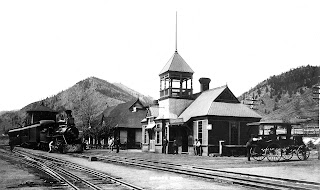
Top Photo info: William H.Walker, photographer. Palmer Lake, El Paso County, Colorado, shows tracks of the Denver & Rio Grande, water tank and Atchison, Topeka and Santa Fe, railroads and depots. Date: [between 1889 and 1897], Western History/Genealogy Dept., Denver Public Library

Join in praise of the town's spirit at the milestone

By Rob Carrigan, robcarrigan1@gmail.com

A hundred and thirty-some years seems like a long, long time.
When the town of Palmer Lake was incorporated in 1889, and its first mayor, Dr. William Finley Thompson, was elected that April,  Benjamin Harrison had just replaced Grover Cleveland as U.S. President. The Wall Street Journal had just started publishing. Coca Cola was incorporated, and the Brassiere was invented, that same year.
Thompson served only one year before feeling the financial strain of building The Rockland Hotel, which was completed in 1890, and left for Mexico.
In the coming years, the town watched the rise and fall of the Rocky Mountain Chautauqua movement, the emergence of recreation community of Pine Crest, the creation of the Little Log Church in the 1920s, the inception of the Yule Log tradition in 1934, and at about the same time, came the idea for creating the 500 foot star of Palmer Lake that was built in 1935 and enhanced in successive years.
At the celebration of Palmer Lake's Centennial in 1989, then President George Bush noted, "As you well know, Palmer Lake is more than a collection of buildings, it is more than a place on the map. From its earliest days, it has nurtured the lives and accomplishments of countless individuals — individuals united through years by a common love for the place they call home.  That deep sense of community, of responsibility toward one's neighbor and the common good, resonates through all cities and towns across America. This milestone gives you a splendid  opportunity to reaffirm that community spirit, taking just pride in the past and rededicating yourselves to the promise of a bright future."
Then Colorado Governor Roy Romer also joined in praise of the town's spirit at the milestone.
"Palmer Lake's history is characteristic of the rich heritage that makes Colorado a great state. Colorado appreciates the spirit of community and the American values that you aim to preserve," Romer wrote.
It really is the spirit of notable figures like Lucretia Vaile, who visited here every summer with her family as child from Denver, and in the 1950s built a modern home, only to donate it, and much of the rest of her estate, later to the town.
Grace Best had that spirit as well, when she help arrange for additional funding, and made it possible to build the library and museum.
The same spirit held for people like Charles Orr, who was affectionately known as "Mr. Palmer Lake" and had lived there for more than 50 years until his death at 101 years in April of 1988. He was a 1908 graduate of Colorado College and had piloted "Jennies" during World War 1.
Elenor Romack had the spirit, living there in Palmer Lake all her life at the time of the Centennial, and remembering the days of only a few cars, with one resident owning a Stanley Steamer that had to be backed up hills to get enough power to get it going. She also remember how the place grew, first a one-room school, doubled to two.
"There were four pupils per grade, and everyone in town knew each other," Romack recalled in the late 1980s.
Challenges have come and gone over the years. Often they were dealt with directly, deftly handled and the community moved on to new challenges.
There in lies the lesson, I think, for future challenges.
A hundred and thirty-some years seems like a long, long time.


Thing of the past ...

Main Street, Wilson (Post Office) Store, McIntyre Cottage, Rocklands Hotel, Rocklands Store in Palmer Lake, 1912.


Thing of the past ...
 
Harry S. Maddox, station agent, Palmer Lake, Denver and Rio Grande Railroad (D. &.R. G.) , note Express Signage on corner, 1899. Maddox was later agent Monument, and had other local positions with D & R.G.


Thing of the past ...

Newell McIntyre with best friend and shot gun, in front yard of McIntyre cottage in Palmer Lake. Rocklands Hotel in the background. Date: 1890s-1920?
 

Thing of the past ...
 
Palmer Lake as a vacation destination for men and women wearing hats and paddling in skiffs with train, tank and buildings in background. Date: 1890.
 

Thing of the past ...
Denver & Rio Grande rail dept in Palmer Lake about 1900. Men, women, and dogs on busy, wooden platform as frequent train arrivals come in.


Saturday, December 5, 2020

Palmer Lake as a Christmas town

Yule Log marks the way back through the years,

and forward to the future


By Rob Carrigan, robcarrigan1@gmail.com

Ritual gives comfort and provides bearings to navigate a changing world. For many years, I have marveled at the Palmer Lake customs of searching for the Yule Log and the separate fanfare and ceremony of lighting the star. It truly has established the little berg as a "Christmas Town," of national and international renown.

Each year, new memories and fresh markers are formed in the hills around Palmer Lake, providing a way back on the trail to something ancient, and empowering and wonderful — all in the name of Christmas and community. 


"The familiar custom of burning the Yule log dates back to earlier solstice celebrations and the tradition of bonfires. The Christmas practice calls for burning a portion of the log each evening until Twelfth Night (January 6). The log is subsequently placed beneath the bed for luck, and particularly for protection from the household threats of lighting and, with some irony, fire. Many have beliefs based on the yule log as it burns, and by counting the sparks and such, they seek to discern their fortunes for the new year and beyond," notes American folklorist Linda Watts.


As early as 1725, Henry Bourne sought meaning and understanding ritual of the Yule log.

"Our Fore-Fathers, when the common Devices of Eve were over, and Night was come on, were wont to light up Candles of an uncommon Size, which were called Christmas-Candles, and to lay a Log of Wood upon the Fire, which they termed a Yule-Clog, or Christmas-Block. These were to Illuminate the House, and turn the Night into Day; which custom, in some Measure, is still kept up in the Northern Parts. It hath, in all probability, been derived from the Saxons. For Bede tells us, That [sic] this very Night was observed in this Land before, by the Heathen Saxons. They began, says he, their Year on the Eight of the Calenders of January, which is now our Christmas Party: And the very Night before, which is now Holy to us, was by them called Mædrenack, or the Night of the Mothers … The Yule-Clog therefore hath probably been a Part of those Ceremonies which were perform'd that Night's Ceremonies. It seems to have been used, as an Emblem of the return of the Sun, and the lengthening of the Days. For as both December and January were called Guili or Yule, upon Account of the Sun's Returning, and the Increase of the Days; so, I am apt to believe, the Log has had the Name of the Yule-Log, from its being burnt as an Emblem of the returning Sun, and the Increase of its Light and Heat. This was probably the Reason of the custom among the Heathen Saxons; but I cannot think the Observation of it was continued for the same Reason, after Christianity was embraced. …"


Following are some photos, particular to Palmer Lake,  I have come across over the years, and taken myself. I return to them as not only a reminder of where we have been, but as a guide to where we hope to go.


Saturday, July 8, 2017

Locally, we benefited from "Harvey Girls."


The record describes a Harvey House in Cascade in the 1890s


By Rob Carrigan, robcarrigan1@gmail.com

In most cases, I am just like many other western historians, with my blinders on, pretty much ignoring the idea that women had much to do with the history of the west. Not because I think they didn't.  I am positive they had a key role in the taming of the country that was severely under-reported and assigned less import than what actually occurred. It is just not documented.
A longtime resource, from my hometown in southwestern Colorado identifies the problem precisely, though he was talking about all folk, and legacy in general terms.
"They were working people and left much less documentation and monuments to their existence. Their business deals were done with a handshake and their accomplishments are more likely to be made of hard work and sweat, instead of bricks, stone and newspaper articles. History is much richer when we know the story of the people who built the fancy house on the hill along with the people who lived in it," notes my friend, Ellis Miller.
America's tales about taming the Wild West rarely include women. But in the late 19th and early 20th centuries, more than 100,000 pioneering young women left home to work as waitresses in restaurants located on train platforms along the Atchison, Topeka & Santa Fe Railway.
Locally we benefited from that.
By sketchy accounts, the record describes a Harvey House in Cascade in the 1890s.
"Which I had never heard of, and doesn’t show up in any company documents. With the help of Peter Hansen, editor of Railroad History, and Colorado Midland trainiac Tom VanWormer, we’ve discovered either three or four 'new' Harvey locations in Colorado —which the company ran from 1890-1895, the years the then-troubled Santa Fe owned the Colorado Midland," says Stephen Fried, One Nation Under Fred, a blog about all things Harvey.
"So we can now report there were Harvey Houses and Harvey Girls in: Cascade, Idyllwild and Leadville, and the Cascade house at some point in the early 1890s moved to the Woodland Park depot. This brings the number of Harvey locations in Colorado to 10. Fred had one of his pre-Santa Fe eating houses in Hugo and then beginning in 1879, was in La Junta, Pueblo, Trinidad, Palmer Lake (briefly, a lunchroom from 1899-1902) and then in Colorado Springs. The last Colorado Harvey House, El Otero Hotel in La Junta, closed in 1948," Fried says.
The Harvey House restaurant chain began in Leavenworth, Kansas, after entrepreneur Fred Harvey, left his native England at the age of 15 and found work in New York’s growing restaurant industry. "As the Civil War was brewing, he began working with the railroads, achieving more senior positions as he moved west. Despite his seniority, Harvey never forgot his restaurant roots and, recognizing the poor quality of food for rail travelers, decided to do something about it," says the film documentary, "The Harvey Girls: Opportunity Bound," by 2013 - Assertion Films, Los Angeles, Calif.
"In 1870, Harvey started a company designed to serve travelers throughout the Southwestern U.S. good food at reasonable prices in clean, elegant restaurants. The women who worked for these restaurants — the Harvey Girls — later became icons, themselves, playing an important role in World War II and helping to transform society's view of women's work," the film describes.
"The Harvey House company left its mark by not only providing work opportunities for women, but by promoting cultural diversity in the workplace. Harvey hired Hispanic and Native American women to be waitresses alongside their Anglo peers," according to the film.
In 1946, MGM turned the Harvey Girls into legend when they released the motion picture musical "The Harvey Girls" starring Judy Garland. This fictional Hollywood movie was the only film, until recently, to touch on their place in history.
"Judy Garland got one of her biggest song hits by accepting a film she didn't really want to do and had started out as another star's project in the first place. "The Harvey Girls (1946)" came about through the kind of happy accidents that only could happen in Hollywood," says Leonard Maltin's Classic Movie Guide, in 2005.
"The story started as a novel by Samuel Hopkins Adams based on the real-life restaurant chain that had helped civilize the West. With waitresses of certified good character, the Harvey houses provided a reliable source of family dining for travelers in the Southwest during the latter part of the 19th century."
Maltin says MGM originally bought rights to the novel in hopes that it would inspire a dramatic film for rising star Lana Turner. Then associate producer Roger Edens saw a tryout performance of Oklahoma! in New Haven. He knew a hit when he saw it and realized that the trailblazing musical probably wouldn't be available to the screen for years (it wasn't filmed until 1955). So he came up with the idea of turning The Harvey Girls into a western musical at MGM, with Judy Garland as a high-spirited waitress. Only Garland wasn't interested," reported Maltin.
"She had wanted to work with Fred Astaire for years and thought a project Arthur Freed was developing for him, "Yolanda and the Thief (1945)", would finally give her the chance. In addition, her husband, Vincente Minnelli was directing it, and the two were trying to work together whenever possible. Edens convinced her that the female lead in Yolanda and the Thief wouldn't be a big enough role for her, and promised that "The Harvey Girls" would be built around her talents.
"It took eight writers to turn The Harvey Girls into a movie, with Samson Raphaelson, who had written some of Ernst Lubitsch's best films, tying them all together. The result was a showcase for Garland's comic, dramatic and musical skills, while also offering juicy supporting roles to deadpan comedienne Virginia O'Brien, sultry Angela Lansbury and a young dancer named Cyd Charisse, who had her first speaking part in the picture."
Best of all was the score by Harry Warren and Johnny Mercer, which included a tribute to the railroad that helped win the West, "On the Atchison, Topeka and the Santa Fe." The number was inspired by Garland's hit from "Meet Me in St. Louis (1944)", "The Trolley Song," and like it was almost an instant hit. Garland recorded it on her own, but the top-selling version featured lyricist Johnny Mercer and the Pied Pipers. It held the number one spot on the hit parade for eight weeks. As was the custom then, MGM released the song to recording companies before the film was even finished. In fact, Bing Crosby's version of it was playing on the radio as director George Sidney drove to MGM to film the number. "On the Atchison, Topeka and the Santa Fe" picked up the Oscar for Best Song, the first of four awards Mercer would receive in that category.
The classic movie depiction probably has little basis in reality, but at least it helped us remembered that the Harvey Girls existed. Their accomplishments though undocumented, I am sure,  were made of hard work and sweat — instead of bricks, stone and newspaper articles.

By Rob Carrigan, robcarrigan1@gmail.com


Sunday, July 2, 2017

Uniquely tied to Colorado and Fourth of July

Celebrate Independence: 

We have a long history of doing it right


By Rob Carrigan, robcarrign1@gmail.com

I know the rest of the country is entitled to celebrate Independence Day but there seems to be something uniquely tied to Colorado and Fourth of July, in my mind.

Maybe it is just fond recollections from July Fourths of the past, in places like Telluride, and Monument, and Dolores, and up in Teller County.

Legendary celebrations have been held here and after all, we are the Centennial State.

Congress had approved Colorado admission to statehood in March of 1875 and laid out provisions and conditions of statehood but it wasn’t until August 1, 1876, when President Ulysses Grant ratified admission. Communities all over the state had already begun celebrating, and really, have never slowed down.

In Denver in 1890, in celebration of the Fourth and the completion of the Capitol building, reportedly five miles of tables were set up for the barbecue attended by over 60,000.

“There were no greedy gluttonous displays, but every man, woman, and child clamored for food until they had their fill. Just think of it! Three hundred and fifty sheep, 75 calves, 237 fat steers, 13,000 loaves of bread, 3,000 pounds of cheese, 10 barrels of pickles, not to mention a 1,000 gallons of lemonade,” itemized the Rocky Mountain News at the time. “The run on the beer saloons was unprecedented.”

During the American Revolution, the legal separation of the Thirteen Colonies from Great Britain in 1776 actually occurred on July 2, when the Second Continental Congress voted to approve a resolution of independence that had been proposed in June by Richard Henry Lee of Virginia declaring the United States independent from British rule. After voting for independence, Congress turned its efforts to the Declaration of Independence, a statement explaining this decision, which had been prepared by a Committee of Five, with Thomas Jefferson as its main scribe. Congress debated and revised the wording of the Declaration, finally approving it two days later on July 4.

A day earlier, John Adams, brewer and maltster whose product would have come in handy in modern celebrations, had written to his wife Abigail:

“The second day of July, 1776, will be the most memorable epoch in the history of America. I am apt to believe that it will be celebrated by succeeding generations as the great anniversary festival. It ought to be commemorated as the day of deliverance, by solemn acts of devotion to God Almighty. It ought to be solemnized with pomp and parade, with shows, games, sports, guns, bells, bonfires, and illuminations, from one end of this continent to the other, from this time forward forever more.”

Adams's prediction was, of course, off slightly. Americans celebrated independence on July 4 right from the beginning, the date shown on the much-publicized Declaration of Independence, rather than on July 2, the date the resolution of independence was approved in a closed session of Congress.

Historians have long disputed whether members of Congress signed the Declaration of Independence on July 4, even though Thomas Jefferson, John Adams, and Benjamin Franklin all later wrote that they had signed it on that day. Most historians have concluded that the Declaration was signed nearly a month after its adoption, on August 2, 1776, and not on July 4 as is commonly perceived.

Both John Adams and Thomas Jefferson, the only signers of the Declaration of Independence later to serve as Presidents of the United States, died on the same day: July 4, 1826, which was the 50th anniversary of the Declaration. Although not a signer of the Declaration of Independence, James Monroe, another Founding Father who was elected as President, also died on July 4, 1831. He was the third President in a row who died on the anniversary of independence. Calvin Coolidge, the 30th President, was born on July 4, 1872; so far he is the only U.S. President to have been born on Independence Day.

When Colorado was gearing up for statehood, the editor of the Del Norte Prospector had this to say about 38th state’s admission to the union.

“And when the Centennial shall come again. Colorado will be among the fairest of the sisters; her hillsides will have become beautiful under the joint ministry of nature and art: her mountaintops glorified by the sunlight of freedom: and all the bright blessings of civilization and religious liberty will shimmer around her pathway in a golden shower,”

On July 4, 1891, W.S. Stratton was prospecting on the side of Battle Mountain in what was to become Teller County. Based on geology, he reasoned rich ore could be found there. As he searched for gold, Stratton could hear shots fired into the air as miners began their celebration of the Fourth of July. That day, Stratton found and staked out the Washington and the Independence claims.

That claim, and other subsequent moves, made him tremendously wealthy. “He would eventually own one-fifth of the mining land in Cripple Creek and Victor,” writes historian Tom Stockman.

When I was a youngster, growing up in the little town of Dolores, in southwestern Colorado, we stretched back at least 200 years for things to celebrate in the summer of 1976, and every year after, because of our own discovery by Franciscan monks dispatched out of Santa Fe, about the same time as the Declaration of Independence.

"Father Fray Francisco Atanasio awoke somewhat improved, and in order to change terrain and climate rather than to make progress, we set out from the camp and Rio de San Lázaro toward the northwest. We traveled a little more than a league, swung west by west-northwest, and went five leagues through leafy forests and good pastures. Then we turned west, traveled two and a half leagues through a chamise thicket with little pasturage, went a quarter of a league to the north, crossed Rio de Nuestra Señora de los Dolores, and camped on its north bank. This river rises on the north slope of the Sierra de la Plata, and runs southwest to this place, where it makes a sharp turn. It is a little smaller than the Rio del Norte in this season. - Today a little more than eight and a half leagues," wrote Francisco Silvestre Vélez de Escalante, on August 12, 1776.

"We remained in camp, partly so that the Father might improve a little and be able to go forward, and partly to observe the latitude of this site and meadow of the Rio de los Dolores where we were. An observation was made by the sun and we found we were in 38° and 13 1/2' north latitude. Here there is everything needed for the establishment and maintenance of a good settlement in the way of irrigable lands, pastures, timber and firewood. On an elevation on the south bank of the river in ancient times there was a small settlement of the same form as those of the Indians of New Mexico, as is shown by the ruins which we purposely examined. Father Fray Francisco Atanasio felt better, and we decided to continue our journey next day," Escalante writes August 13, 1776.

As noted, Colorado has a unique relationship with Independence, and we have a long history of doing it right.


Saturday, August 6, 2016

Looking for the fountain of lake's youth?


"Whole valley was radiant with flowers; blue, yellow, pink, white, scarlet and purple, vying with each other in splendor."

By Rob Carrigan, robcarrigan1@gmail.com

Dr. Edwin James, a botanist with Maj. Stephen H. Long's 1820 expedition and the first to climb Pikes Peak, also recognized the Colorado Blue Columbines in the area around what later became Palmer Lake.
Then in 1843, Lt. John Fremont noted that the flowers near the "dividing ridge" made a "mountain garden" as the "whole valley was radiant with flowers; blue, yellow, pink, white, scarlet and purple, vying with each other in splendor."
The railroads came through in the 1870s and flowers served as a summertime attraction for tourist from all over.
One of the interesting aspects of Palmer Lake's unique history, to me at least, is its use by the railroads to re-water the steam locomotives of the early days of railroads. As a connoisseur of old photos, I have been fascinated by photos of Palmer Lake showing the fountain in the very early days.
I also remember a Palmer Lake Historical project bearing fruit in 1998 in the form of fountain in the lake.
The June 2, 1998 edition of the Tribune told the tale.
"Once again, Palmer Lake has a fountain, the Palmer Lake Historical Society bought and installed the fountain which will serve two purposes," wrote my friend Jeremy Bangs at the time.
"The fountain is meant to resemble one that was on the lake when it was owned by the railroads. Pipes from the town's upper reservoir once fed Palmer Lake with water and the gravity pressure of the water flow formed a large fountain at the south end of the lake."
Bangs said the new fountain was placed in a different location and didn't throw water as high as the original, but it would aerate the lake's contents, making them more hospitable for fish and other aquatic wildlife.
I don't know for a fact, but I assume the fountain was victim of time and drought that followed.
The lake completely dried up by July 2012 because of drought and water management changes.
In December 2014, the Awake Palmer Lake restoration group began dirt work to clear several feet of sediment from the north end of the Lake, exposing the top of the clay (benzonite) layer and filling the southern marsh with dirt. This served to resort the lake to its historical proportions and also to make it more sustainable for the future.
The volunteer group, at the same time, was working on a plan to have Palmer Lake refilled with water by spring of 2014. Palmer Lake's refill involved a court case involving water rights that the town of Palmer Lake  said it was granted in the late 1950s. Town leaders in neighboring Monument have objected to Palmer Lake's request. A state Water Court decision is expected to to determine that.
Meanwhile, in early December 2014, an extensive dirt work project restored the Lake, close to its historical proportions.
In mid-December, 2014 received word that  a Great Outdoors of Colorado (GOCO) grant of matching funds to total $350k had been awarded to be used to build a footbridge and recreational park around the lake and an the west side of the railroad tracks.
In February 2015, an agreement was reached with the town on Monument, as well as other communities, which allows the town of Palmer Lake to exercise senior railroad rights for the purpose of filling and maintaining the lake.
After the wettest May in over 70 years in 2015,  rains and spring activity filled the lake, to almost eight feet on the north end.
Also after June 24, 2015, Palmer Lake water supervisor Steve Orcutt began sending almost six ac/ft of water into the lake. Palmer Lake's industrial water rights were changed to residential, the town now fills the lake with up to 8.4 acre feet per month, and up to 67 acre feet per year. Drinking and household water needs still have top priority over recreational and aesthetic uses.

###


Photo 1:
Fountain is visible in this early photo of the lake, looking west.
Photo 2:
This early hand-colored photo shows the fountain and the Santa Fe Depot.
Photo 3:
Looking east, from the tracks, the fountain is shown beyond a steam locomotive.


Photos courtesy of Palmer Lake Historical Society

Monday, June 15, 2015

The afternoon skies turned black: Tornado in Palmer Lake, June 16, 1965


They had just lived in Palmer Lake about six months when the tornado hit that Wednesday afternoon


By Rob Carrigan, robcarrigan1@gmail.com

Fifty years is the big part of a lifetime.
But a most vivid memory could pop up just about anywhere in a long, happy span.
Rodger and Judy Voelker had just lived in Palmer Lake about six months when the tornado hit that Wednesday afternoon, a little after 1 p.m., and destroyed the rental house they lived in. They, will remember that forever.
“The U.S.G.S. said all the water that came afterward was a 100 year flood,” said Judy Voelker recently in their current house that survived the twisting winds, and torrential rains that devastated Palmer Lake back in 1965, though the one next to it was destroyed, same as the rental house downhill a bit, that they lived in at the time.
“We didn’t know a lot of people yet, but we got to know them pretty fast,” said Rodger Voelker.
After the storms, there was no running water in town for months, and “We met around the Fort Carson tank truck when we were filling up. Voelker remembers there being about 600 to 800 year-round residents in town at the time, swelling to about twice that in the summer.
“It was the kind of place that you would meet everyone in town out at the dump eventually,” he said.
The response by the locals to the disastrous storms convinced the Voelkers to stay — forever.
“So many people came to help us. That is when Rodger said we’re never going to leave here,” Judy said.
Rodger was working in the basement (no windows) and Judy was upstairs making bread.
“The day of the storm, the skies got really dark,” she said. “There was a terrible hollow feeling, and then the roof started lifting off. It peeled off like a roll top desk.”
When the roar of wind subsided, she ran to the basement door and broke the pane trying to get the door open.
“I said to Rodger, the house is gone,” she remembers. “He patted me on the head and said, “It’s OK.” He thought I was losing it.”
Judy said noise from the Bert and Norita Tatman home downhill at 244 Park Street got their attention that day.
The Tatman home was not destroyed, but heavily damaged. Bert, a co-worker, his wife Norita, and daughters Rhonda, 8, and Becky, 6, were home that day for lunch, after reading gas meters locally.
“The thing I remember most was that it got so dark that the street lights came on,” said Norita Tatman.
“We had finished lunch and I was standing in front of the picture window with the girls watching this storm.”
They (Bert and the coworker) were looking out the other window of the kitchen and saw a roof go by. They told us then to get to the basement.”
Norita said she grabbed the girls by their heads, tucking them under each arm and carrying them to the basement.
“I couldn’t carry them downstairs like that normally if I tried,” she said. In the basement, she said she laid on top of her daughters for protection, “Even though Becky was screaming that I was hurting her.”
“We could hear the roof go off. I was scared.” she said. “It didn’t last that long. Nobody got a scratch. We were covered with insulation.”
Bert said when the noise died down, he was able to climb through debris in the stairwell, and when he got to the ground floor, hail was hitting him in the face and he knew the roof was gone. In fact, one whole end of the house was gone. Norita said the roof was found half a block away, still intact.
“Right after it happened the neighbors (the Voelkers) came running down the hill with blankets.”
“Then, the rains came down,” she said. The Tatmans left town for a few days, staying in Colorado Springs. Later, the gas company Bert worked for supplied a trailer for them in trailer park, until the same builder who constructed the house nine months before the tornado, could rebuild it.
The Voelkers however were still in town when flooding occurred.
“After the tornado, you couldn’t drive anywhere. There were exposed wires and things everywhere,” she said and they went uphill to another neighbor, Andy Krueger’s house. The rain poured that afternoon and as they watched it continue to pour, eventually they heard another frightening roar.
“We saw a wall of water coming out of the canyon at the top of High Street and we heard a terrible roar,” she said. “We watched it hit Reba Bradley’s House and demolish it. It hit Florence Hafer’s house and totally wiped it out. Then it hit the pink stucco house. We watched it fill up with water. The water kept pouring out of the canyon. “By that point, you are just kind of numb.”
Rodger remembers helping in the rescue of Florence Hafer, 62, and Betty Schreiper, 50, who were trapped, neck-deep in swirling water for 90 minutes, under kitchen appliances and cabinets when streams swept away the foundation of their home. When and Air Force Academy crew cab pickup turned over in the mud, Rodger’s new 1965 Ford F-250 four-wheel drive pickup was used to transport the two women to an academy ambulance.
Both couples however, today talk of the good life in Palmer Lake that followed the chaos of that terrible Wednesday afternoon. Planting poppy seeds on hill behind, the quiet times in hills, watching wildlife, lights downvalley, and much more.
Fifty years of good neighbors — a nice, quiet place to live, memories, and knowing that your neighbors are there for you if something happens. Fifty years is a big part of a lifetime.
Records show May and June of 1965 as among the wettest on record with eight inches falling in May that year, and one to two inches of rain and hail falling for 15 days straight from June 7 to June 21. Torrential rain began falling starting June 14, 1965, creating one of the worst floods in Colorado history.


Saturday, June 6, 2015

After lunch, sit a while. After supper, walk a mile.


Last regularly-scheduled steam locomotive came through Palmer Lake in 1962 


By Rob Carrigan, robcarrigan1@gmail.com

It has been much more than 100 years, but good health and lunch has always been important in Palmer Lake.
Former car conductor John Reed Judd, and his wife Annie, came to Colorado on advice of their doctor. Annie suffered from chronic anemia.
"Judd's uncle, Irish Haddock, who owned the Cliff House in Manitou Springs, suggested the couple settle in Palmer Lake. In 1890, Judd was elected mayor and in 1898, he became the proprietor of the Palmer Lake Lunch Counter, which became known as Judd's Eating House," according to the Palmer Lake Historical Society.
"Also plagued with ill health, John Judd unsuccessfully sought a diagnosis from California and Oklahoma doctors for what ailed him. Never, really pinning it down, he died in 1914, and left Annie to manage the restaurant. In 1929, the restaurant was sold and Annie kept only the dishes marked "Palmer Lake" and those that had been preserved for General Palmer and Teddy Roosevelt," said Palmer Lake Historical society documents.
An advertisement touting the eatery about 1890, tells the story.
"PALMER LAKE LUNCH ROOM!," screams the headline. It goes on with colorful descriptions to entice customers.
"On the line of the Denver and Rio Grande, Missouri Pacific, and the Rock Island Railroads, John L Judd, prop. Palmer Lake Colorado. All passenger trains stop here for lunch!
Lunches for picnics, pavilion for dancing, boats for rowing or sailing, on the most beautiful sheet of water in Colorado. Palmer Lake is pre-eminently one of the GEMS OF THE MOUNTAINS, and together with its rocky glens, presents one of the most beautiful and picturesque grounds for picnics or other parties in the state."
Alan Lewis, in his book "Railroads of the Pikes Peak Region," says the railroad list allows placement in time of the advertisement.
"The mention of the Rock Island as one of the railroads serving Palmer Lake dates this advertisement to about 1890. With over a dozen trains per day, John Judd had plenty of customers, and the dances and picnics held on the weekends attracted even more visitors," Lewis said.
The Town of Palmer Lake purchased the lake, reservoirs and water rights form the D and R.G. Railroad in 1982.
"The Railroad opened for passenger and freight business on January 1, 1872. The Palmer Lake Depot and Judd's Eating House were built on the west side of the lake in 1882," another reference in Palmer Lake Historical documents says, though it may have originally been run by someone else, rather than John Judd and his wife Annie.
"The Atchison, Topeka and Santa Fe Railroad laid tracks and opened their station on the east side of the lake in 1887. During WWI when the U.S. government took over management of the railroads, the two lines were consolidated. Northbound trains were sent over the Santa Fe tracks and southbound trains used the Rio Grande tracks.
 As automobiles became the principal means of travel, the use of passenger trains dwindled and both stations were torn down about 1940.
A small station was moved to Palmer Lake from Pring in 1936 and run by Henry Rasmussen. It was closed in 1967 and moved to South Park. 
The last regularly scheduled steam locomotive came through Palmer Lake in 1962 and it belonged to the Colorado Southern Railroad.

Photo 1: Judd's Eating House interior.
Photo 2: Annie Judd
Photo 3: Palmer Lake Depot and Judd's beyond, in1894.
Photo 4: Judd's Palmer Lake Lunch Room.

photos from The Vaile Museum

Sunday, March 22, 2015

Adult and senior day care provides respite for caregivers


Suddenly, it is all just too hard. A person needs a break.
"The most important thing is that the caregivers are healthy. It is a 24-hour-a-day job," says Sonja Search of Lifting Spirits, Adult and Senior Day Care Center, of Palmer Lake.
Search describes the business as providing quality day services and companionship for adults and senior in a safe and comfortable setting. "We assist families by providing services needed to keep loved ones living at home while maximizing their independence and personal dignity."
Search began working with seniors in 2009 after being trained as a Certified Nurse Assistant.
"Years ago my father became chronically ill and my mother became his primary caretaker. Not unusual for a spouse, but I saw how the constant 24/7 responsibility tired her. I thought how different here experience could have been if she just had a few hours of respite for herself," she said of her reason for founding the business.
"It is the caregiver, as well as the patient, who needs a break. Having a cup of coffee with a friend, going shopping or just taking a few minutes to relax. These are necessities, not luxuries. But without a safe, clean, caring environment for your loved one, the necessities are difficult to accomplish."
Making the business prosper has not been easy however.
"I need to create a steady flow of clients," Search says, and like many businesses trying to get the word out, there has been some confusion about what services are offered.
"With my name Lifting Spirits, maybe they think I am a liquor store or a pot shop," she says.
She is inspected by the state of Colorado, Department of Health certified, and Qualified Medication Administration Personnel (QMAP) and can accommodate as many as eight clients, (without adding staff) with a private pay rate of $10 per hour.
"I don't know what I would do without her," says Stella Nicholson, who sometimes employs Lifting Spirits for care her husband Lloyd. "One of the main things seems to be the isolation. I felt almost ashamed, as I was seeing Lloyd lose pieces of himself. The important message is, you should not be ashamed, and you need to reach out and tell people that. I don't want to be shut off, and I want others to know about it, and use our resources."
Gary Coleman, and his son Travis frequent stop in at Lifting Spirits because his son enjoys the interaction and playing games there. "I didn't know her, but was looking for a place to set up our train," Gary says. "It's a nice place, and everyone is well-accepted. I was surprised to find out how she takes care of seniors and thought, Wow, what a cool idea."
The Colemans set up their 'N'-gauge Polar Express train there around Christmas time.
"She recognizes each person as unique. I am impressed with the operation and care," says Gary Coleman.

###

Photo 1:
Travis Coleman, Sonja Search, Joe Brockett and Letty Clark playing a variation of poker to keep sharp Friday at Lifting Spirits Adult and Senior Day Care Center in Palmer Lake.


Photo 2:
Letty Clark working on some knitting.


Photo 3:
Comforts of home at Lifting Spirits.


Photo 4:
Joe Brockett explains his answer in the midst of the game.


Friday, November 28, 2014

Jackson's images are like an old friend


Served as president and plant manager of Detroit Publishing Company which sold over seven million photographs by 1902

By Rob Carrigan, robcarrigan1@gmail.com

In Colorado, the images are like an old friend from your hometown that resurface every so often to help remind you of where you came from. They are familiar, inspiring, soulful and bear traces of your past and your future — a careful snapshot of place, and time, and being.

William Henry Jackson roamed the American West (and other places) taking photographs, painting, guiding other artists, documenting progress and promoting the western experience for more than 80 years. In just photographic negatives, an excess of 80,000 images attributed to Jackson, capture the essence of the period and space and time.

Inspiring rich development of the craft and launching thousands of artists along similar quests for beauty, understanding, and spirit — Jackson still impacts us today through the work of John Fielder, Ansel Adams, his own images, and just about everyone who stood out on a high point above their hometown, or river valley, or mountain, and photographed an expansive shot of their favorite places.

Locally, Jackson provides us with some of our earliest images of the places we call home and documented the construction of the railroads, the early Hayden Survey information of land forms before we started building, and peek at our past. Heyday in gold camps, embryonic construction of towns, and familiar landmarks offer us insight and understanding today, and far into any future.

"The trademark style of Jackson's railroad views quickly turned him into one of the most sought-after landscape photographers of the nineteenth century," wrote Eric Paddock, curator of the Photography of the Colorado Historical Society in the forward of John Fielder's popular "Colorado: W. H. Jackson, John Fielder, 1870-2000" coffee table book.

"The technology of the day forced him to develop his glass negatives on the spot, which required him to carry a portable darkroom and bottles of chemicals as he went. That burden also gave him the advantage of seeing his work immediately — he could take the pictures over and over until nightfall if necessary, making any changes that he wanted until satisfied," wrote Paddock.

"His success with the D & RG led to commissions from virtually every major railroad in the western United States and Mexico and most minor ones, too. Each assignment demanded that each railroad be cast in the most heroic light to boost tourist as well as freight traffic. Jackson often spent weeks or even months at a time, photographing the railroads and all of the cities and towns, ranches, factories, and resorts they served. These photographs gave his clients more than they asked for ..."

First learning the trade as a boy early studios of his boyhood homes of Rutland, Vermont and Troy, New York, Jackson's nine months as a soldier in the Union Army, including the battle of Gettysburg, later was noted as he attended the 75th commemoration and reunion of Gettysburg in July of 1938.

Among his long list of accomplishments: More than 10 years work on the Hayden Geographical Survey including some of the earliest and best documentation of Yellowstone area, Mesa Verde, Mancos Canyon, Jackson exhibited photographs and clay models of Anasazi dwellings at Mesa Verde in the 1876 Centennial Exposition in Philadelphia, owned portrait studios in Nebraska and on Larimer Street in Denver, served as president and plant manager of postcard maker Detroit Publishing Company which sold over seven million photographs by 1902, produced work with Harper's Weekly and the World Transportation Commission, and later in life, painted murals in the United States Department of the Interior in Washington, D.C., and served as a technical advisor on the filming of "Gone With the Wind." He died in New York City in 1942 at 99, and recognized as one of the last surviving Civil War veterans, and was buried in Arlington National Cemetery.


Photo Info:

Portrait of Jackson in 1930s.

Frame 1: Mining town of Cripple Creek shows the National Hotel and Gold Mining Stock Exchange, one and two-story wood frame residences, multi-story masonry commercial buildings, churches, and a school. Mining structure on hillside. A locomotive on trestle bridge and Mount Pisga are in the distance. W.H Jackson, circa 1910.

Frame 2: View of Cripple Creek (Teller County), Colorado. Shows flagpole in the middle of a dirt street, Central Meat Market and wood frame commercial buildings with false fronts, one under construction. A horse and wagon are near the flagpole. W.H. Jackson, circa 1891.

Frame 3: Glen Park and Palmer Lake shows frame houses, Atchison Topeka and Santa Fe Railroad grade under construction in the distance. A gazebo is on a hill. W.H. Jackson, 1887.

Frame 4: Casa Blanca near Palmer Lake. W. H. Jackson, circa 1885.

Frame 5: Elephant Rock (Phoebe's Arch) W.H. Jackson, circa 1885.
 
Frame 6: Modern-day Bennett Avenue in Cripple Creek. Rob Carrigan photo.

Frame 7: Elephant Rock today from a different angle. Rob Carrigan photo.

Frame 8: Overlooking Cripple Creek a few weeks ago. Rob Carrigan photo.

Frame 9: In the valley overlooking Rampart Range, near Palmer Lake and the Glenn. Rob Carrigan photo.

Frame 10: Casa Blanca, near Palmer Lake, today. Rob Carrigan photo.