Showing posts with label D & R.G.. Show all posts

Saturday, June 6, 2015

After lunch, sit a while. After supper, walk a mile.


Last regularly-scheduled steam locomotive came through Palmer Lake in 1962 


By Rob Carrigan, robcarrigan1@gmail.com

It has been much more than 100 years, but good health and lunch has always been important in Palmer Lake.
Former car conductor John Reed Judd, and his wife Annie, came to Colorado on advice of their doctor. Annie suffered from chronic anemia.
"Judd's uncle, Irish Haddock, who owned the Cliff House in Manitou Springs, suggested the couple settle in Palmer Lake. In 1890, Judd was elected mayor and in 1898, he became the proprietor of the Palmer Lake Lunch Counter, which became known as Judd's Eating House," according to the Palmer Lake Historical Society.
"Also plagued with ill health, John Judd unsuccessfully sought a diagnosis from California and Oklahoma doctors for what ailed him. Never, really pinning it down, he died in 1914, and left Annie to manage the restaurant. In 1929, the restaurant was sold and Annie kept only the dishes marked "Palmer Lake" and those that had been preserved for General Palmer and Teddy Roosevelt," said Palmer Lake Historical society documents.
An advertisement touting the eatery about 1890, tells the story.
"PALMER LAKE LUNCH ROOM!," screams the headline. It goes on with colorful descriptions to entice customers.
"On the line of the Denver and Rio Grande, Missouri Pacific, and the Rock Island Railroads, John L Judd, prop. Palmer Lake Colorado. All passenger trains stop here for lunch!
Lunches for picnics, pavilion for dancing, boats for rowing or sailing, on the most beautiful sheet of water in Colorado. Palmer Lake is pre-eminently one of the GEMS OF THE MOUNTAINS, and together with its rocky glens, presents one of the most beautiful and picturesque grounds for picnics or other parties in the state."
Alan Lewis, in his book "Railroads of the Pikes Peak Region," says the railroad list allows placement in time of the advertisement.
"The mention of the Rock Island as one of the railroads serving Palmer Lake dates this advertisement to about 1890. With over a dozen trains per day, John Judd had plenty of customers, and the dances and picnics held on the weekends attracted even more visitors," Lewis said.
The Town of Palmer Lake purchased the lake, reservoirs and water rights form the D and R.G. Railroad in 1982.
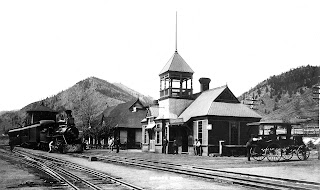
"The Railroad opened for passenger and freight business on January 1, 1872. The Palmer Lake Depot and Judd's Eating House were built on the west side of the lake in 1882," another reference in Palmer Lake Historical documents says, though it may have originally been run by someone else, rather than John Judd and his wife Annie.
"The Atchison, Topeka and Santa Fe Railroad laid tracks and opened their station on the east side of the lake in 1887. During WWI when the U.S. government took over management of the railroads, the two lines were consolidated. Northbound trains were sent over the Santa Fe tracks and southbound trains used the Rio Grande tracks.
 As automobiles became the principal means of travel, the use of passenger trains dwindled and both stations were torn down about 1940.
A small station was moved to Palmer Lake from Pring in 1936 and run by Henry Rasmussen. It was closed in 1967 and moved to South Park. 
The last regularly scheduled steam locomotive came through Palmer Lake in 1962 and it belonged to the Colorado Southern Railroad.

Photo 1: Judd's Eating House interior.
Photo 2: Annie Judd
Photo 3: Palmer Lake Depot and Judd's beyond, in1894.
Photo 4: Judd's Palmer Lake Lunch Room.

photos from The Vaile Museum

Sunday, January 19, 2014

S.K. Hooper created the business of railroad promotion

Hooper was known as the 'father of railroad publicity' 


By Rob Carrigan, robcarrigan1@gmail.com

I have spent most of my entire life, of course, in the newspaper business. But if born 100 years earlier, it might have been the railroads, or both — like Shadrack K. Hooper.
Newspaper editor Tim McGuire says "Many people have heard the old story about the railroads and how they should have realized they were in the transportation business in the same way newspapers ought to realize they're in the information business. I heard someone says a few years ago that in fact the railroad people knew they needed to be in the transportation business. They just loved the railroads so much they couldn't make the change. There is a lot of that in our business."
McGuire is right of course, but Hooper knew how to make it work.
"Hooper was known as the 'father of railroad publicity' and his extensive advertising efforts on behalf of the Rio Grande made the railroad known throughout America and Europe," wrote my friend, Palmer Lake historian Dan Edwards in one of his papers. "Many prominent hotels, union stations, and ticket offices displayed pictures of scenery along the route of the Rio Grande that Hooper had provided. He arranged for the photographer, William H. Jackson and the writer, Ernest Ingersoll, to travel over the Rio Grande in special trains and record in pictures and words what they saw. Hooper popularized the Royal Gorge and the Black Canyon's Curicanti needle that served as emblems of the railroad. He also published several booklets on tourist spots and landmarks along the route of the Rio Grande."
Those booklets... works of a lost art, as far as I am concerned.
"For the convenience and information of the traveling public this booklet is issued," writes Hooper in the introduction of his most circulated one. "The attempt is made in as few as words as possible to inform those who desire information, how they may easiest, with least expense and inconvenience, visit any or all of the many attractions in Colorado, Utah and New Mexico. A perusal of these pages will enable tourists to determine what points they visit, inform them of the attractions they will see while en route, and afford them much useful information."
S.K. Hooper, like so many in development of the railroads, had learned the trade in the Civil War. He worked for five different lines before becoming general passenger and ticket agent for the Denver and Rio Grande in 1884, a position he held for decades, scaling back duties at the end of his career, finally retiring in 1917.
"Major Hooper did not neglect Palmer Lake. He worked with Finley Thompson and to the officials of the Glen Park companies to promote Palmer Lake as a tourist destination and offer special railroad fares for Chautauqua travelers to Glen Park. Hooper bought a lot in Glen Park in 1887, and later spent time during the summers at 'Casa Pobre,' his cottage in Pine Crest. He vacationed at Palmer Lake as late as 1917. He died at Denver in March 1923," according to Dan Edwards' research.
Born more than 100 years earlier, I might like working for someone like S.K. Hooper. I might have found it hard to change over time. There is a lot of that in our business.