Showing posts with label Ludlow. Show all posts

Sunday, June 2, 2019

Hardware man, Womens' March, Mineworkers, and Unions


Ludlow, CF & I, and Colorado's role in the coal wars

By Rob Carrigan, robcarrigan1@gmail.com

 As a young "hardware man" at Taylor Hardware during late 1970s and early 1980s in southwest corner of the state at Dolores, I marveled at the reach and breadth of Colorado Fuel and Iron.
Much of what we sold in that store, and its two warehouses, had manufacturing origins in its main steel mill on the south side of Pueblo, clear on the other side of the big square state.
Fencing — 50-pound boxes of 47 varieties of nails, truck loads of bailing wire, corrugated roofing, stove pipe, regular iron pipe, smooth wire and much more — would arrive in a long, high trailer behind a long-haul truck, about every two weeks. And we would spend half a day unloading it, re-positioning material in the long track warehouse, and sometimes unavoidably ripping holes in our clothing on the exposed barbs of 80-pound rolls of wire fence.
I didn't know at the time, but CF &I was involved in much more than steel goods.
The Colorado Fuel and Iron Company (CF&I) by 1903, it was mainly owned and controlled by John D. Rockefeller, who, even today is widely considered the wealthiest American of all time, and the richest person in modern history. Jay Gould, and another one of America's all-time richest families, and his financial heirs, were Rockefeller's partners in the steel industry. Gould had the reputation as ruthless robber baron and was hated and reviled. Few would defend his hard-ball business tactics either then, or now. 
 The company came to control many plants throughout the country, with the main plant, the steel mill on the south side of Pueblo, Colorado. From 1901 to 1912, Colorado Fuel and Iron was one of the Dow Jones Industrials. The steel-market crash of 1982, eventually led to the decline of the company and in recent years, it has gone through several bankruptcies. It was acquired by Oregon Steel Mills in 1993, and changed its name to Rocky Mountain Steel Mills. In January 2007, along with the rest of Oregon Steel's holdings, was acquired by EVRAZ Group, a Russian steel corporation, for $2.3 billion.
Over the course of the previous century, however, CF&I operated coal mines throughout southern Colorado, as well as iron mines in Wyoming and Utah, limestone quarries, smaller mines for other materials going into the steel making process, and the Colorado and Wyoming Railway. In Redstone, Colorado, hundreds of coking ovens converted coal into coke, which was used in various national manufacturing entities across the country. 
The Mcnally, Cameron, Robinson and Walsen Mines located in the area of Walsenburg, Colorado, were just a few of the mines owned by the Colorado Fuel and Iron Company. The Colorado Supply company store was also owned and operated by CF&I. They also gained operational responsibilities at many furnaces throughout the country, including E.G. Brooke in Birdsboro, Pennsylvania.
In addition to wealth and financial power, the company had also attracted its fair share of controversy and ill will over time.  Especially with organized labor. Colorado became "Ground Zero" for industrial warfare in the early 1900s with violent strikes the gold fields of Cripple Creak and Telluride, pushing into the Coal regions of both the southern, and northern parts of the state.
By 1913, all hell was breaking.
"When the southern miners voted their strike, they listed their demands the recognition of their union, a ten percent increase in wages, stricter enforcement of the Colorado eight-hour law, health and safety regulations, and the right to select their own living quarters, eating houses and doctors," said a "A Colorado History" by Carl Ubbelohde, Maxine Benson, and Duane A. Smith.
Which seem fair enough, but:
"John Lawson assumed leadership of the Colorado units of the United Mine Workers. He was aided during the strike by the best talents among the union's national organizers, including the spectacular Mary Harris Jones, the miner's "Mother Jones" — an eighty-two-year-old Socialist."
Colorado Fuel and Iron, acting as spokesman for the group of mine owners, attempted to open their properties with non-union labor; the miners bent every effort to keep the strike breakers out of the coal fields. The owners hurried appeals the statehouse; the governor sent the militia to the region. As the striking miners withdrew from the underground works, they formed tent colonies near the mines where their families were sustained by union funds.
Mary G. Harris was born in Cork, Ireland, the daughter of Roman Catholic tenant farmers Richard Harris and Ellen (née Cotter) Harris. Mary Harris and her family were victims of the Great Famine, as were many other Irish families. This famine drove more than a million families, including the Harrises, to emigrate to North America when Mary was ten years old.
Mary was a teenager when her family emigrated to Canada. In Canada (and later in the United States), the Harris family were victims of discrimination due to their immigrant status as well as their Catholic faith. Harris, who eventually became "Mother Jones," and a socialist endured much hardship in life span. As an Irish-born American schoolteacher and dressmaker who became a prominent organized labor representative, community organizer, and activist. She helped coordinate major strikes and co-founded the Industrial Workers of the World.
Jones worked as a teacher and dressmaker, but after her husband and four children all died of yellow fever in 1867 and her dress shop was destroyed in the Great Chicago Fire of 1871, she became an organizer for the Knights of Labor and the United Mine Workers union.
From 1897, she was known as Mother Jones. In 1902, she was called "the most dangerous woman in America" for her success in organizing mine workers and their families against the mine owners. In 1903, to protest the lax enforcement of the child labor laws in the Pennsylvania mines and silk mills, she organized a children's march from Philadelphia to the home of President Theodore Roosevelt in New York.
By early January, 1914, Mother Jones had been arrested in Colorado. As the New York Times reported:
"Mother" Jones, strike leader, who was deported from the Southern Colorado coal fields Jan. 4 by the militia, returned to Trinidad this morning from Denver. As soon as her presence was learned by the military authorities she was arrested and taken to the San Rafael Hospital, where she was held a prisoner and was permitted to see no visitors.
She left the train at the outskirt of Trinidad and later appeared at a local hotel. She was arrested by a detail of State troops, hurried out of the hotel, placed in an automobile, and whirled through the streets with a cavalry escort galloping at full speed in front and behind the machine.
Several hundred coal mine strikers lined the streets and cheered wildly while "Mother" Jones waved her hand in response.
DENVER, Jan. 12-Gov. Ammons tonight issued a statement in which he assumed full responsibility for the arrest of "Mother" Jones by the military and declared that she would be held until such time as she saw fit to give her promise to leave the strike zones of the State."
In the meantime, pressure built up in the Colorado coal fields and violence seemed inevitable. Miners and soldiers scuffled through until spring.
"The climax came on April 20, at Ludlow Station, 18 miles north of Trinidad. When miners and militia tangled, the soldiers began to drive the miners from their tent colony which housed some 900 miners, women and children. Five miners and one militaman were killed, but even worse, fire burned through the colony and it was later discovered that two women and 11 children had been burned to death, or suffocated, in what the United Mine Workers immediately labeled the 'Ludlow Massacre.'"   
A ten-day war of burnings, dynamitings, and murders engulfed the southern coal fields.
Governor Elias Ammons decided it was beyond the states resources, and asked for help from President Woodrow Wilson. United States troops were in place in the coal fields by the end of April. With federal troops keeping an uneasy peace, negotiations proceeded and the strike was over by December. Strikes settled for less than they had been asking, being refused bargaining rights for the union and withdrawing from the fields unorganized, but the owners promised better hours, higher pay and protected conditions.
Colorado Fuel and Iron established a "company union" which purported to give a vehicle for voicing worker's grievances.
"The 'Rockefeller Plan' in time demonstrated the flaws that the trade union men had always objected to with company unions. It proved in many ways a weak friend to the laboring man," according to "A Colorado History."
The publicity generated by Mother Jones's arrests, and by the massacres and violence, did, however, lead to a change in American public opinion that tarnished the images of Rockefeller and his colleagues. Further investigation revealed that Rockefeller had detailed knowledge of the events and violence in Colorado, and even knew about the formation of the special troops used to perform the Ludlow massacre. Rockefeller put his company through a massive public relations cleansing in order to improve his image. This public relations campaign largely involved tarnishing the images of union leaders such as Mother Jones, but Rockefeller did agree to an "Industrial Representation Plan" which instituted a policy of a closed-shop union. Emphasizing his empathy for the workers, Rockefeller visited the mines and celebrated with the mine families. These actions gave him good press, and gave him control over a company union that had all the publicity and credibility of a real union. The UMW opposed the plan, but it had no power to resist.
In effect, Rockefeller, became his own "hardware man" for CF&I, and the company prospered for nearly 70 more years, until long after he had left this world.

Photo info:
1. Coffins in front the Catholic Church in Trinadad, after the deaths at Ludlow.
2. Colorado National Guard in the coal fields.
3. Ludlow funeral procession.
4. John D. Rockefeller, in 1885.
5. Mary Harris Jones.
6. Womens' March in Trinidad, protesting Mother Jones' arrest in Colorado.


Sunday, October 16, 2011

Death around every turn in the mine tunnel.


“Life comes to the miners out of their deaths, and death out of their lives.”
__ Mary Harris “Mother” Jones

Accidents, labor wars, cave-ins and explosions

 By Rob Carrigan, robcarrigan1@gmail.com

It was mining, of course, the brought the big rush to Colorado in the first place.  Gold, and then silver miners, flooded into the state from the east in 1859. But the dangerous business, violent surroundings, and unhealthy lifestyle also sent many packing for the pearly gates.
And mines beget more mines. With the influx of people and the need for power and heat, development of massive coalfields in several areas of the state occurred. With coal mining came more death.
“Early coal mining in Colorado was extremely dangerous, and the state had one of the highest death rates in the nation,” according to Miningartifacts.org.  “During the three decades from 1884 to 1914,  more than 1700 men died in Colorado's coal mines."
As in many other states, there was no organized reporting of mine fatalities initially, but in 1884 the death of 59 miners at the Crested Butte coal mine in Gunnison County, brought about legislation in the state requiring mining companies to report their accidents.
But just because the mine companies had to report them, it didn’t mean the deaths and mining accidents stopped occurring – quite the contrary.
Of particular note was the string of bad luck experienced in Las Animas County in 1910.
“On the last day of January, 1910, 35 of the 110 men in Primero mine had already walked out of the mine and another four were in the portal mouth when an explosion shot out of the portal. Three of these four were killed when they were hurled against a set of moving coal cars. One man inside was found alive. The last of the bodies was found three and a half months later for a total of 75 dead,” according to Sangres.com (Your Daily Dose of the Mountains.)
“Then, at ten o'clock on the night of October 8 that same year, 56 were killed by a dust explosion in the Starkville mine. Only a month later at Victor-American's number three mine at Delagua, 79 more were killed, three of these killed by flying rocks and timbers outside the portal. After a four month lull, Cokedale blew; and then Hastings on June 18, 1912. Twelve men were killed by an explosion caused by a defective safety lamp carried by the fire boss. Hastings was to have yet a worse day before the end of the decade.” On April 27, 1917, a fire at the Victor American Hastings Coal Mine in Hastings left 121 miners dead.
But it wasn’t just mining that could get you killed. Organizing and unionizing proved to be deadly for some miners and their family as well. In the notable examples of Ludlow in April of 1914, and the Columbine Mine massacre in 1927, the Colorado National Guard or the Mine Owner’s machine guns could take you out.
In Ludlow, deaths occurred during a night attack by the Colorado National Guard after a day-long fight between strikers and the Guard. The massacre resulted in the violent deaths of between 19 and 25 people; sources vary, but all sources include two women and eleven children who were asphyxiated and burned to death under a single tent.
In the case of Columbine Mine, A fight broke out between Colorado state police and a group of striking coalminers. Machine guns were used by the police, or by guards working for the mine (it is not clear which), against the unarmed miners and six strikers were killed. Many more were injured.
Add all that to together with the threat from silicosis if you were a hardrock miner, or black lung disease for coalminers, and general dynamite and equipment accidents – an earlyday Colorado miner didn’t stand much of a chance for a rocking chair passing.
The morticians and the coffin builders did booming business in the camps around the state.
###
Photo info: Two images in Las Animas County, Colorado. Top image shows a long funeral procession with carriages, drivers with top hats, horses, and people on foot; a fire, from a mine disaster, shows beyond the town; bottom image shows wagons piled high with wooden coffins. Western History/Genealogy Dept., Denver Public Library.

Saturday, May 1, 2010

Give up Gatling when pried from the crank


"You can get a lot farther with a kind word and a gun than a kind word alone."
__ Al Capone

"The end move in politics is always to pick up a gun."
__ Richard Buckminster Fuller

Martial law, military force and the use of a Gatling gun

By Rob Carrigan, robcarrigan1@gmail.com

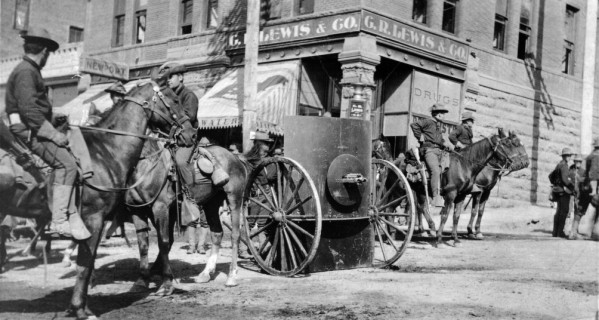
Having problems with labor? Can’t get a strike settled? Uppity miners won’t go back to work? Two, out of three turn-of-the-century Colorado mine owners prefer martial law, military force and the use of a Gatling gun.
A hand-cranked weapon with six barrels revolving around a central shaft with cartridges gravity fed into the top through a hopper, the Gatling gun was invented during the Civil War by Dr. Richard Jordan Gatling. The first version of the gun was capable of firing 600 rounds a minute. Each barrel fired 100 rounds per minute and could continue at that pace for hours without overheating. By 1900, most armies around the world included the Gatling Gun in their arsenals.
In 1877, Dr. Gatling was living next door to the widow of the late Samuel Colt (of Colt Firearms) at whose factory the Gatling Gun Company then manufactured their guns. Colt’s neice, Elizabeth Jarvis, was a frequent visitor to the Gatling's home in Hartford, Connecticut, and Gatling explained to her in a letter his beliefs in developing the guns.
“In 1861, during the opening events of the war, (residing at that time in Indianapolis, Md.,) I witnessed almost daily the departure of troops to the front and the return of the wounded, sick, and dead. The most of the latter lost their lives, not in battle, but by sickness and exposure incident to the service. It occurred to me if I could invent a machine--a gun-- which could by its rapidity of fire, enable one man to do as much battle duty as a hundred, that it would, to a great extent, supersede the necessity of large armies, and consequently, exposure to battle and disease be greatly diminished. I thought over the subject and finally this idea took practical form in the invention of the Gatling gun.”
In Colorado, during the hard rock miners strikes in Cripple Creek and Telluride, and during the Coal Wars in the southern part of the state after that, the gun was an instrument of intimidation.
“At the time of the 1904 strike a group of the strikers had been arrested by the militia under Adjutant General Sherman Bell,” wrote Raymond Colwell in 1961. “The District Judge, Lewis, I believe, issued a writ ordering Bell to produce the prisoners in court for a habeas corpus proceeding. The District was under martial law of the State at the time, and Bell refused to turn the prisoners over to the civil authorities, but did bring them in under military guard. The District Court room then was in the Mining Exchange Building.”
Colewell was a freshman in high school at the time and attended classes just across the alley from the excitement.
“There were militiamen all over the place, sharpshooters on the top of the National Hotel and the high School, which was just across the alley from court room, and Gatling guns in the street intersection. Militiamen were lined up practically shoulder to shoulder on the Fourth Street side of the Mining Exchange Building.”
In Telluride it was a similar story.
Capitalist Author A. Collins, to make the mines there more profitable, instituted a contract system that in effect reduced the miner’s standard $3 per eight hour a day pay rate and pushed them into working longer and more dangerous shifts. In protest, the union miners went on strike in 1901. The union, Western Federation of Miners, agreed to having issues arbitrated by the State Board of Arbitration, but the offer was rejected by Collins, and he hired strikebreakers at the same rate that he refused to give to the union. Armed union miners tried to discourage non-union laborers from working for weeks and violence broke out one morning eventually, and resulted in three deaths and six serious injuries as well as strikebreakers being forced out of town. The violence on both sides continued for years.
Collins was assassinated with a shotgun blast through his window nearly year later while playing cards with friends. And the Telluride district also fell under martial law administered also by Sherman Bell but eventually turned over to a citizen’s militia.
“In preparation for the transfer of military command, Bell took Troop A through maneuvers around town at a gallop, trundling the Gatlin gun along and out to the ballpark,” wrote MaryJoy Martin in her 2004 book, “The Corpse on Boomerang Road.”
“Sergeant Jack Bowman put the men through training and target practice, cutting down trees at 800 yards... Bowman allowed Sheriff (John) Rutan to have a ‘crank’ and the sheriff was aghast at the firing power. ‘That’s the most wicked machine I ever witnessed in operation,’ he said. And once again, Bell impressed upon the town that he meant to use the wicked machine if necessary. Intimidation at its finest was meant to scare off the remaining union men and Socialists,” wrote Martin.
In the southern Colorado coal mine areas, it was once again a strike, though by a different union, that brought out the Gatling gun.
In 1913, when the United Mine Workers of America went out on strike in the southern coalfields of Colorado, additional detectives from Baldwin-Felts were brought in from West Virginia by the Coal operator Colorado Fuel & Iron (CF&I) for the express purpose of protecting mine property and strikebreakers.
With them they brought the “Death Special.”
“To goad the strikers into violent action, the coal companies mounted a harassment campaign, shining high-powered searchlights on the tent colonies at night or using the “Death Special,” an improvised armored car to which a Gatling-type machine-gun was affixed, to periodically spray certain colonies with machine-gun fire. On more than one occasion people were killed,” according to historic information on the Colorado Bar Association’s Web site.
“A discussion on the Death Special was included in a Congressional investigation by the House Committee on Mines and Mining after its use in West Virginia earlier. The first Colorado use of the Death Special was at the Forbes colony of October 17 where the entire unprotected tent colony was raked with machine gun fire. One miner was killed, one child shot nine times in the leg, and 148 bullet holes were found in one tent alone.”
The troubles increased for both miners and operators eventually resulting in one of Colorado’s darkest miner-operator incidents, the Ludlow Massacre, in which 25 people were killed in a single day. Among the dead: 11 children, most of which suffocated in pit under a tent that was set afire by Colorado militia. The incident occurred in one of the union’s largest tent cities known as Ludlow. Afterward, a battle waged for weeks in the camps and towns from Walsenburg to Trinidad and President Woodrow Wilson was finally forced to call in federal troops to end the carnage.


###
Photo Info: 
1.The “Death Special,” an improvised armored car to which a Gatling-type machine-gun was affixed, to periodically spray certain colonies with machine-gun fire.
2. Civil War, Indian Wars, and here in Colorado, the gun was an instrument of intimidation.
3. Colorado National Guard is posted with shielded Gatling Gun in front of the Mining Exchange Building on Bennett Avenue in Cripple Creek during Western Federation of Miners strike in 1903.