Showing posts with label Western Federation of Miners. Show all posts

Sunday, December 14, 2014

Miners' Union Hall somewhat disfigured, but still in the ring


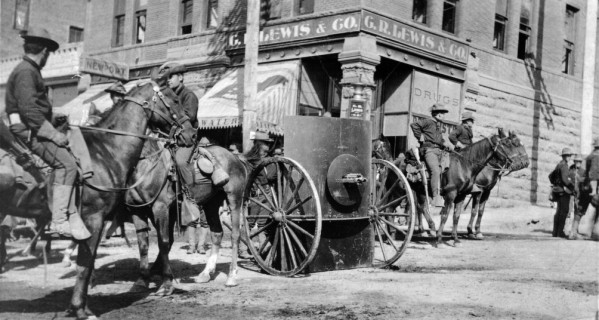
Critical piece of the town’s history


By Rob Carrigan, robcarrigan1@gmail.com

This story was written in late 2014. It was the hope of the owner, and many others then, that the building could still be saved.

In July, (2014) after a being struck by lightning, the historic Miners' Union Hall in Victor was nearly destroyed in a fire that started around 2 p.m. July 26. Fire crews from Victor, Cripple Creek, Four Mile, Divide and Northeast Teller County Fire Protection District helped battle the blaze this summer.
Barbara McMillan owns the building and began restoring it once again in October. Built in 1899, after the devastating fire that destroyed much of the town of Victor, the union hall is a critical piece of the town’s history.
On Monday, June 6, 1904, the Union Hall first found it's place in history when two men were killed, three others were gravely wounded, in the lot below the Gold Coin shaft house across from the Union Hall.
A fight broke out that afternoon as Clarence Hamlin, of the Mine Owner's Association called for chasing "these W.F.M scoundrels out of the district," after the bombing of the Independence train platform killing 13 non-union miners that morning, and injuring at least a dozen more. What began as fist fight, escalated into gunfire and some of the fire seemed to have come from the windows of the Union Hall.
"The militiamen surrounded the Union Hall. Sheriff Ed Bell and Postmaster Danny Sullivan entered the club and told the W.F.M. members to come out," wrote Marshall Sprague, in "Money Mountain."
They refused, he reported and "The militiamen aimed their rifles and poured volley after volley into the rooms, wounding four men. The rest surrendered and were led off by the militia. Berserk civilians rushed into Union Hall, wrecked the walls, smashed furniture, ripped curtains, and destroyed membership ledgers. Afterwards, this gang and other gangs roamed the gold camp for W.FM. members and wrecked every union hall and union store. About two hundred men were imprisoned."
Altogether 225 union members were loaded on trains and deported under guard to Kansas and New Mexico locations.
Because of the dynamiting of the Independence, the W.F.M. became extremely unpopular, and mine owners were able to force them out of the district, according to Sprague.
Years later, the Union Hall served a different, yet noteworthy, purpose.
Margaret Whitehill Geddes, in her book Gold Camp Indian Summer, recalls her husband Kenneth being named the new high school principal of Victor in the late1920s. Kenneth and Margaret later became publishers of the Cripple Creek Times-Record, a merger of the Cripple Creek Times and the Victor Record newspapers and an ancestor of the Pikes Peak Courier.
"He was not only the new principal, but we were to have the apartment in Miners' Union building which had been recently remodeled (roughly) to be used as a gymnasium," wrote Geddes.
"Oh that apartment! The second floor of the building was reached by a long staircase with swinging doors halfway up. On the right at the top were tow doors, one leading to the kitchen, one to the dining room. In front of these were the bedroom and living room. Glass partitions divided the dining room and living room, and the kitchen and the bedroom. Each room was square and there were full length windows in the two front rooms. The windows had been replaced but the marks of the bullets of the miners' strike in 1904 were still showing in the bricks and plaster around them," Geddes wrote.
"Outside the apartment a hall led to the big auditorium, sometimes gym, with a stage at one end. The auditorium was heated two stoves at the far end. Two boys came after school to make the fires. Soon after I'd hear the clump clump of feet on those steep stairs as the basketball boys came up for practice. (Not until later was there a football team, and basketball went on for most of the school year)," Geddes said.
"Besides the games, at least twice a year there were plays staged in the auditorium," she noted.
"The plays produced were not the cheap no-royalty shows, but productions that had been successes on the Broadway stage, probably some time before, but legitimate hits, and they were popular and drew good crowds. The Victor Opera house sadly had been torn down about two years before and people said they appreciated having something to take its place, even if it was only a high school play with local young people taking the parts."
After the lightning strike and the fire this year (2014), McMillan expressed dismay and sorrow, citing not only the potential loss but the lack of funds. “I’m out of money,” she said in July.
In October, however, McMillan submitted a plan to the city to start the cleanup and remodel.
The plan includes repairing holes in the wall, removing the flashing as well as the unstable and damaged bricks. “They’re going to monitor that to make sure the walls aren’t moving,” said Deb Downs, Victor’s city manager.
Soon after McMillan submitted the plan, the contractor, Daniel Halbrook Masonry, pulled permits from the city and started work Oct 3. But difficulties continued, and the building is not restored.

Photos: #1 Front, after fire on July 26, 2014. #2 This photo of the Western Federation Miners Union Hall in Victor was taken just a few months before fire nearly destroyed the building in July. #3 Historic photo of the Union Hall early in the 20th Century. #Historic photo taken shortly after it was built. #4 Back of the building after the recent fire. #5 Front window after July fire. Bullet holes are still visible from the 1904 strike violence.

Saturday, May 1, 2010

Give up Gatling when pried from the crank


"You can get a lot farther with a kind word and a gun than a kind word alone."
__ Al Capone

"The end move in politics is always to pick up a gun."
__ Richard Buckminster Fuller

Martial law, military force and the use of a Gatling gun

By Rob Carrigan, robcarrigan1@gmail.com

Having problems with labor? Can’t get a strike settled? Uppity miners won’t go back to work? Two, out of three turn-of-the-century Colorado mine owners prefer martial law, military force and the use of a Gatling gun.
A hand-cranked weapon with six barrels revolving around a central shaft with cartridges gravity fed into the top through a hopper, the Gatling gun was invented during the Civil War by Dr. Richard Jordan Gatling. The first version of the gun was capable of firing 600 rounds a minute. Each barrel fired 100 rounds per minute and could continue at that pace for hours without overheating. By 1900, most armies around the world included the Gatling Gun in their arsenals.
In 1877, Dr. Gatling was living next door to the widow of the late Samuel Colt (of Colt Firearms) at whose factory the Gatling Gun Company then manufactured their guns. Colt’s neice, Elizabeth Jarvis, was a frequent visitor to the Gatling's home in Hartford, Connecticut, and Gatling explained to her in a letter his beliefs in developing the guns.
“In 1861, during the opening events of the war, (residing at that time in Indianapolis, Md.,) I witnessed almost daily the departure of troops to the front and the return of the wounded, sick, and dead. The most of the latter lost their lives, not in battle, but by sickness and exposure incident to the service. It occurred to me if I could invent a machine--a gun-- which could by its rapidity of fire, enable one man to do as much battle duty as a hundred, that it would, to a great extent, supersede the necessity of large armies, and consequently, exposure to battle and disease be greatly diminished. I thought over the subject and finally this idea took practical form in the invention of the Gatling gun.”
In Colorado, during the hard rock miners strikes in Cripple Creek and Telluride, and during the Coal Wars in the southern part of the state after that, the gun was an instrument of intimidation.
“At the time of the 1904 strike a group of the strikers had been arrested by the militia under Adjutant General Sherman Bell,” wrote Raymond Colwell in 1961. “The District Judge, Lewis, I believe, issued a writ ordering Bell to produce the prisoners in court for a habeas corpus proceeding. The District was under martial law of the State at the time, and Bell refused to turn the prisoners over to the civil authorities, but did bring them in under military guard. The District Court room then was in the Mining Exchange Building.”
Colewell was a freshman in high school at the time and attended classes just across the alley from the excitement.
“There were militiamen all over the place, sharpshooters on the top of the National Hotel and the high School, which was just across the alley from court room, and Gatling guns in the street intersection. Militiamen were lined up practically shoulder to shoulder on the Fourth Street side of the Mining Exchange Building.”
In Telluride it was a similar story.
Capitalist Author A. Collins, to make the mines there more profitable, instituted a contract system that in effect reduced the miner’s standard $3 per eight hour a day pay rate and pushed them into working longer and more dangerous shifts. In protest, the union miners went on strike in 1901. The union, Western Federation of Miners, agreed to having issues arbitrated by the State Board of Arbitration, but the offer was rejected by Collins, and he hired strikebreakers at the same rate that he refused to give to the union. Armed union miners tried to discourage non-union laborers from working for weeks and violence broke out one morning eventually, and resulted in three deaths and six serious injuries as well as strikebreakers being forced out of town. The violence on both sides continued for years.
Collins was assassinated with a shotgun blast through his window nearly year later while playing cards with friends. And the Telluride district also fell under martial law administered also by Sherman Bell but eventually turned over to a citizen’s militia.
“In preparation for the transfer of military command, Bell took Troop A through maneuvers around town at a gallop, trundling the Gatlin gun along and out to the ballpark,” wrote MaryJoy Martin in her 2004 book, “The Corpse on Boomerang Road.”
“Sergeant Jack Bowman put the men through training and target practice, cutting down trees at 800 yards... Bowman allowed Sheriff (John) Rutan to have a ‘crank’ and the sheriff was aghast at the firing power. ‘That’s the most wicked machine I ever witnessed in operation,’ he said. And once again, Bell impressed upon the town that he meant to use the wicked machine if necessary. Intimidation at its finest was meant to scare off the remaining union men and Socialists,” wrote Martin.
In the southern Colorado coal mine areas, it was once again a strike, though by a different union, that brought out the Gatling gun.
In 1913, when the United Mine Workers of America went out on strike in the southern coalfields of Colorado, additional detectives from Baldwin-Felts were brought in from West Virginia by the Coal operator Colorado Fuel & Iron (CF&I) for the express purpose of protecting mine property and strikebreakers.
With them they brought the “Death Special.”
“To goad the strikers into violent action, the coal companies mounted a harassment campaign, shining high-powered searchlights on the tent colonies at night or using the “Death Special,” an improvised armored car to which a Gatling-type machine-gun was affixed, to periodically spray certain colonies with machine-gun fire. On more than one occasion people were killed,” according to historic information on the Colorado Bar Association’s Web site.
“A discussion on the Death Special was included in a Congressional investigation by the House Committee on Mines and Mining after its use in West Virginia earlier. The first Colorado use of the Death Special was at the Forbes colony of October 17 where the entire unprotected tent colony was raked with machine gun fire. One miner was killed, one child shot nine times in the leg, and 148 bullet holes were found in one tent alone.”
The troubles increased for both miners and operators eventually resulting in one of Colorado’s darkest miner-operator incidents, the Ludlow Massacre, in which 25 people were killed in a single day. Among the dead: 11 children, most of which suffocated in pit under a tent that was set afire by Colorado militia. The incident occurred in one of the union’s largest tent cities known as Ludlow. Afterward, a battle waged for weeks in the camps and towns from Walsenburg to Trinidad and President Woodrow Wilson was finally forced to call in federal troops to end the carnage.


###
Photo Info: 
1.The “Death Special,” an improvised armored car to which a Gatling-type machine-gun was affixed, to periodically spray certain colonies with machine-gun fire.
2. Civil War, Indian Wars, and here in Colorado, the gun was an instrument of intimidation.
3. Colorado National Guard is posted with shielded Gatling Gun in front of the Mining Exchange Building on Bennett Avenue in Cripple Creek during Western Federation of Miners strike in 1903.