Sunday, May 9, 2021

High-graders resist everything but temptation

“But there are some things, child, that you should steal. That you must steal, if you have enough love and courage in your heart. You must snatch freedom from the hands of the tyrant. You must spirit away innocent lives before they are destroyed. You must hide secret and sacred places.” 

― Lian Tanner, Museum of Thieves


Independence Mine, near Victor, Colorado, about 1910. The railroad in the foreground is the Florence and Cripple Creek Railroad and the trestle crosses Wilson's Creek. Squaw Mountain to the left in background, Battle mountain to the right, and Ajax Mine in background. History Colorado, Denver Public Library.

 Finders, keepers, think light-fingered ore sample sneakers.

Stripping orders follow, mine owners' Pinkerton guard peepers.

 By Rob Carrigan, robcarrigan1@gmail.com

In mining, high-grading refers to employees selectively harvesting and keeping only the most valuable material for themselves, rather than turning over that valuable property to to owner of the mine.  The term is frequently associated with fraud, but was a fairly common practice in very rich districts like Cripple Creek and Victor.

"So much 'blossom rock' was encountered in the workings that many miners were tempted beyond their strength and indulged in high-grading," wrote historian Lambert Florin in his 1970 book "Ghost Towns of the West." 

"The practice became so general that a society for the purpose of protecting the miners involved was organized, the 'High-graders Association." 

"Exchanges were organized for the purpose receiving the rich material, but internal disorders developed as miners accused operators of keeping more than share of the profits, and several offices were bombed," according to Florin. "At least one of the dynamitings was blamed on the mine owners who were understandably opposed to the whole thing."

"Overall losses from the practice of high grading were tremendous, one mine alone, the Independence, losing $1,000,000. Many measures for prevention were attempted, none being entirely effective. At the Independence the men were compelled to strip naked at the end of each shift and pass inspection. This stringent order was later rescinded and a milder one substituted — the men could keep their underwear on," said Florin.

In September 1900, the Independence mine was the first mine in the district to introduce a new stripping order requiring all underground workers to undress in one room of a change house and walk into another room in the nude while a guard observed. This was to take place at start and end of each shift. The new rule was implemented to prevent highgrading (theft of gold ore) by the mine workers.

Five hundred miners met at Victor's Armory Hall, and they decided that while they would help stop ore thieves, they refused to work under the stripping rule. A compromise was reached which allowed the miners to strip to their undergarments. But the miners were unhappy. After the new practice was in place for about a month, a Pinkerton guard searched the miners at the end of a shift. No ore was found, and the miners walked out.

Three days later, Independence mine manager A.H. Shipman met with the Western Federation of Miners (WFM) Executive Board. He ultimately agreed to abolish the Pinkerton guard system, to appoint a guard for the change rooms from candidates the union proposed, and to accept a closed shop. Under the agreement, any miner suspected of high-grading could be searched by a fellow union member in the presence of a watchman. Shipman also announced that he would support membership in the WFM by miners in return for the union's help in stopping the practice of high-grading. 


Colorado National Guard is posted in front of Winfield Scott Stratton's Independence Mine during the Western Federation of Miners strike in 1903, Cripple Creek, Teller County, Colorado. One man sits with his feet in the sluice; tailings in background.

Years later, local miner Edgar McGowan, noted in letter home that the practice persisted however. The letter was later published by the Victor Heritage Society.

"I wrote an article on high-grading and it was published in the Cripple Creek “GOLD RUSH” paper. Along in the early fifties, there was a barber in Victor, who had not been there very long before this article was published, and he did not believe it when he read it. He said to me, “Mac, how come you made up such a bunch of lies about high-grading? You don’t expect anybody to believe them, do you?” To which I replied, “Ask Mr. A.W.Oliver, who came to Victor in the early 1890’s and who had lived here ever since.” He did and Mr. Oliver told him every word I had written was true as could be, that he himself knew of the truth of what I had written."

Edgar McGowan's Memories of the Gold Rush Era in Victor were excerpted from a letter he wrote from Riverton, Wyoming on March 31, 1961 to his cousin, Addie. The letter was published by Victor Heritage Society and appears on their site. The letter and accompanying photographs were submitted in July 2016 by Nancy McGowan Galbraith (daughter of Edgar McGowan and Gertrude Moore) who resides in Virginia Beach, Virginia. 

"There was a lot of “HIGH-GRADING” going on, up until about 1913. In case you do not know what “high grading” is, it was where the men who worked and even some of whom did not work, would steal some of the rich ore they mined and sell it to assayers for a small fraction of what it was worth. The men made big money out of the deals because the ore was so rich, running from a dollar to eighty dollars a pound. However, the assayers were the ones who made the most money," wrote Edgar McGowan.

"The biggest part of the high-grading took place prior to 1913. In that year the U.S. Government levied a production tax, similar to the income tax. It was one percent instead of the high levies we have to pay now. Many high-graders and assayers were arrested in the District, some of them being sent to a federal prison at Leavenworth, Kansas. That sort of stopped much of the hig-grading, but not all of it. A million dollars a year was being stolen in the Cripple Creek and Victor mines by high-graders and it no doubt was a good thing it finally was stopped." 

"Now, let your mind go back to the “GOLD RUSH” days in the Cripple Creek-Victor District, say when I first hit there in 1907. Of course, the camp had reached its heyday some few years before that, but it still was a busy burg when I first saw it in December of 1907. I was entranced by it, for it was new to me. I felt exhilarated merely by looking at it, all covered with snow, and teeming with ever busy human beings."


Independence (Teller County), Colorado. Shows mines (including the Delmonico), tailings, residences (including Jim Warford's), and Florence and Cripple Creek Railroad cars. In foreground is the foundation of the Golden Circle depot which was destroyed by a bombing in the labor wars.


Sunday, May 2, 2021

Across the years from Poverty to riches


Poverty Gulch Bridge east of Cripple Creek about 1901, Photographer Andrew J. Harlan, Andrew J., Photo courtesy of Pikes Peak Library District.

Bridge spans the original strike area


By Rob Carrigan, robcarrigan1@gmail.com

Legend has it that Bob Womack, following his cowboy hobby of prospecting on the side, found the first gold in the Cripple Creek district as early as 1874.  Promising rock sent in to Denver by Womack to be  assayed reportedly turned out to be worth $200 of gold per ton. He named the area where he found the rock Poverty Gulch. He spent the next 16 years before he found anything else of value. 

Friends and acquaintance ribbed him about his "so-called gold mine," for years. Though he did not profit as handsomely as others in the district, he did however, manage to secure the option of saying, "I told you so."

Later, in the heydays of the district, the timber trestle across Poverty Gulch on Colorado Springs and Cripple Creek District Railway was 400 feet long and 70 feet high, the largest on the line. The bridge was located east of the town of Cripple Creek and was integral to completing a rail line in 1901 providing a direct rail line to Colorado Springs traversing the south slope of Pikes Peak. 

This allowed freight trains to carry ore for delivery to reduction mills, such as the Golden Cycle, Standard, Telluride, and Portland located on the western edge of Colorado Springs. 

To the right and running along a hillside below the bridge another rail line can be seen with overhead catenary lines to provide power to the electric trams using this system. A large mining facility can be seen on the hillside above the bridge. 

Hand-printed on bottom of print "Poverty Gulch Bridge. C.S.&C.C.Ry." and "Harlan Photo. 339."

Tuesday, April 27, 2021

Things Zevon did in Colorado before he was dead

I called up my friend LeRoy on the phone
I said, Buddy, I'm afraid to be alone
'Cause I got some weird ideas in my head
About things to do in Denver when you're dead
I was working on a steak the other day
And I saw Waddy in the Rattlesnake Cafe
Dressed in black, tossing back a shot of rye
Finding things to do in Denver when you die

___ Waddy Wachtel / Warren Zevon / Leroy Marinell


Warren, Crystal and Ariel Zevon in 1978, from "I'll Sleep when I'm Dead."

Links abound here in Centennial state to odd song bird

By Rob Carrigan, robcarrigan1@gmail.com

You can tell a lot about a person by finding out what is their favorite Warren Zevon song. Some folks are only familiar with "Werewolves of London." Others know about his writing credits for Linda Ronstadt, and the resultant success there, and yet, some on-the-edge characters enjoy the strange world he accesses in twisted tunes such "Excitable Boy," and violence of "Rolland, The Headless Thompson Gunner."
But all might be surprised by his links to Colorado.

“My ex-wife grew up in Aspen, which is a sort of rarity, I presume,” Zevon explained. “So we ended up there. A friend of mine was running for Council (City of Aspen), and late one night in the Hotel Jerome bar, I said that if he won, I wanted to be appointed coroner. He said, ‘Well, it is an appointment.’ He won, and I was. I think of it like a perpetuity,” says an article by Colorado music historian G. Brown, of The Colorado Music Experience, a non-profit organization established to preserve the legacy of Colorado music, serves as a repository for informational and archival resources and presents them in intriguing, engaging and entertaining ways.


Warren Zevon and Hunter Thompson in Aspen.

Zevon's longtime friend, writer Hunter Thompson, at about the same time was running for Sheriff of Pitkin County representing "the Freak Party," and Zevon  mentioned the supposed appointment on several of his early visits to the David Letterman Show.

"Singer-songwriter Zevon’s ironic tales of physical and psychological mayhem had earned him a cult following, and he was dubbed “the Sam Peckinpah of rock” after the director who opened the door for graphic violence in movies. In 1978, he’d had a Top 10 single with “Werewolves of London.” But his career was temporarily set back by alcoholism, Brown wrote.

"After a year in the studio and “in training,” Zevon’s 1980 release, Bad Luck Streak in Dancing School, represented something of a comeback for him, and he was eager to tour. First, he enlisted the aid of East Coast guitar ace David Landau. Then he met the group called Boulder,

Boulder was seven players, most of them writers and five of them singers. The nucleus formed in Florida in 1972, and the other members, all veterans of bar bands throughout the U.S., joined in installments. The act was complete by 1976, when the members relocated to Colorado and acquired their name.

"Boulder did college and club dates, but the members were wary of becoming a copy band and burning out on the road. They finally built their own rehearsal studio in a two-car garage in the vicinity of Denver, says Brown.

“One of our roadies was a carpenter, and we went all out with hammers and nails and plasterboard,” drummer Marty Stinger recalled.

A lifelong fan of hardboiled fiction, Zevon was friendly with several well-known writers, who also collaborated on his songwriting during this period, including Thompson, Carl Hiaasen and Mitch Albom. Zevon also served as musical coordinator and occasional guitarist for an ad-hoc rock music group called the Rock Bottom Remainders, a collection of writers performing rock-and-roll standards at book fairs and other events. The group included Stephen King, Dave Barry, Matt Groening and Amy Tan, among other popular writers, and it has continued to perform one benefit concert per year since Zevon's death.

During the early 1970s, Zevon toured regularly with the Everly Brothers as keyboard player, band leader, and musical coordinator. Later the same decade, he toured with Don Everly and Phil Everly separately, as they tried to launch solo careers after their breakup. 

These small successes were not particularly rewarding financially, and Zevon's dissatisfaction with his career (and a lack of funds) led him to briefly move to Spain in the summer of 1975. There he lived and played in the Dubliner Bar, a small tavern in Sitges, near Barcelona, owned by David Lindell, a former mercenary. Together they composed "Roland the Headless Thompson Gunner".

By September 1975, Zevon had returned to Los Angeles, where he roomed with Stevie Nicks and Lindsey Buckingham, who had by now gained fame as members of Fleetwood Mac.There he collaborated with Jackson Browne, who produced and promoted Zevon's self-titled major-label debut in 1976.Contributors to the album included Nicks, Buckingham, Mick Fleetwood, John McVie, members of the Eagles, Carl Wilson, Linda Ronstadt, and Bonnie Raitt. Ronstadt elected to record many of his songs, including "Hasten Down the Wind", "Carmelita", "Poor Poor Pitiful Me", and "Mohammed's Radio." Zevon's first tour, in 1977, included guest appearances in the middle of Jackson Browne concerts, one of which is documented on a widely circulated bootleg recording of a Dutch radio program under the title "The Offender Meets the Pretender." Zevon reportedly lived with Browne in Hollywood Hawaiian Hotel for a short time. 

Boulder began recording material in Florida in January 1978 and did additional work at Caribou Ranch in Colorado. The band signed with Elektra/Asylum Records in November and moved to Los Angeles. The debut album, Boulder, included a version of Zevon’s “Join Me in L.A.”

“We liked the theme of the song, and we were moving to L.A., where we’d never been before,” lead singer Bob Harris explained.

So Zevon took to the road, not with the L.A. session guys from his albums, but with the little-known Colorado group. The so-called audition consisted of a spirited version of “Johnny B. Goode.” Zevon’s somewhat sudden decision to record his new touring band in concert spoke volumes about the guy’s essential rock ’n’ roll attitude.

“The idea always appeals to me to find a self-contained band, or at least find musicians who are accustomed to playing with each other,” he said.

The difference was apparent on the live recording, Stand in the Fire, cut at the Roxy in Los Angeles. One of Zevon’s best albums, Rolling Stone called it “a portrait of the artist defiantly walking the line between emotional exorcism and mass entertainment.”

Zevon often performed shirtless on the summer tour, which was titled “The Dog Ate the Part We Didn’t Like,” a line borrowed from his friend, novelist Thomas McGuane.

“That was the culmination of a two-year physical fitness period in my life. I think I was celebrating the Chuck Norris-like physique of that era,” Zevon said.

“It was a real turning point for Warren because he had just gotten out of rehab and kicked the bottle,” Harris said. “He had this incredible amount of energy. All of a sudden, he knew where to put it, and he could turn it into being good.

“He went to some tailor in Beverly Hills and bought these $1,200 suits and was going to play in them—he’d been doing dancing and karate and was going to come across really classy. And about two weeks into the tour, he’d ripped the pants and the coats just leaping around on stage. So after that, he went out in blue jeans and t-shirt.

“Seeing him onstage every night, he was probably the most consistent performer I’ve ever seen. On the bus one night, he said, ‘Man, I had to realize that these people out here are my friends.’ It went from being good to phenomenal.”

But the success wasn’t enough to keep Boulder going.

“The producer from Elektra scammed the whole deal and screwed the band—which is not an uncommon situation, but we had our turn at it,” Harris said.

Meanwhile, Zevon continued his solo career. Time magazine’s reviewers gave “Song Title of the Year” to his rollicking “Things to Do in Denver When You’re Dead” from Mr. Bad Example, his 11th album. People magazine called it “a hoot.”

“Um, it had to be a two-syllable town—Indianapolis wouldn’t work,” Zevon explained. “It had to start with a ‘D.’ It had to have a Rattlesnake Cafe. Those were kind of the parameters. Everyone seemed to enjoy it the last time I played Colorado.”

In 2003, Zevon died of mesothelioma, a form of lung cancer, at age 56.

From The New York Times obituary:

Warren Zevon, a singer and songwriter who came up with hard-boiled stories and tender confessions of love, died on Sunday at his home in Los Angeles. He was 56.

The cause was cancer, which was diagnosed last summer.

Mr. Zevon had a pulp-fiction imagination that yielded songs like "Werewolves of London," "Poor, Poor Pitiful Me," "Lawyers, Guns and Money" and "I'll Sleep When I'm Dead." They were terse, action-packed, gallows-humored tales that could sketch an entire screenplay in four minutes and often had death as a punchline. But there was also vulnerability and longing in Mr. Zevon's ballads, like
"Mutineer," "Accidentally Like a Martyr" and "Hasten, Down the Wind."

Behind Mr. Zevon's stoic baritone, the music changed with its central instrument. His piano songs suggested marches, hymns and the harmonies of Aaron Copland, while his guitar songs connected rock, Celtic and country music.

Mr. Zevon made his last album, "The Wind" (Artemis), knowing that his time was running out. In August 2002, a week after deciding to start a new album, Mr. Zevon felt
chest pains while exercising and eventually went to see a physician for the first time in 20 years.

A lifelong smoker, Mr. Zevon was diagnosed with mesothelioma, a type of tumor that can occur in the
membranes around the lungs, that had advanced too far for treatment, and given a few months to live. He choseto work on the album, completed it and lived to see it released this year, on Aug. 26. In an interview last year, he said that the diagnosis had led to "the intensest
creative period of my life."

Mr. Zevon was prized by other songwriters. Bob Dylan performed his songs on stage and performers on "The Wind" included Bruce Springsteen, Jackson Browne, Tom Petty, Emmylou Harris, Don Henley, Ry Cooder and Dwight Yoakam. Mr. Springteen has described Mr. Zevon as writing about "the good, the bad and the ugly" and called him "a moralist in cynic's clothing."

Mr. Zevon was born in Chicago but grew up in Arizona and Los Angeles. His father, he said in an interview, was a Russian-Jewish gangster; his mother was a Mormon and often in fragile health. Mr. Zevon studied classical piano, idolizing composers like Stravinsky and Copland, and picked up guitar as a teenager. When his parents divorced, he drove a sports car his father had won in a card game to New York City to try to make it on the folk circuit.

But he had better luck in Los Angeles, where he formed the duo Lyme and Cybelle with a friend, Tule Livingstone, and began getting his songs heard. The Turtles made one of his songs, "Like the Seasons," the B side of the hit single "Happy Together," providing royalties that paid his rent for years.

Mr. Zevon's first album, "Wanted Dead or Alive," was released in 1969 and widely ignored. He worked around Los Angeles, writing commercial jingles and leading the Everly Brothers' backup band. And he made his way into the coterie of songwriters, among them Jackson Browne and J.D. Souther, that was bringing new depth to the California soft-rock of the mid-1970's.

Linda Ronstadt chose "Hasten Down the Wind" to be the title song of her 1976 album, the same year that
Jackson Browne produced Mr. Zevon's major-label debut album, "Warren Zevon." Two years later, Mr.
Zevon's album "Excitable Boy" reached the Top 10 with its own hit single, "Werewolves of London." He was married and divorced twice in the 1970's and 1980's, and had two children, Jordan and Ariel. They survive him along with two grandchildren. Jordan Zevon was the executive producer of "The Wind."

Success brought pressure and temptations, and Mr. Zevon succumbed: taking drugs and alcohol, toting a
gun, losing control onstage. "I ran around like a psychotic," he said.

He made no albums between 1982 and 1987, and spent time in rehab. He considered alcoholism "a coward's death," he said in 1981. And he re-emerged to a steady, well-respected career. He toured and made albums that included "Transverse City" in 1989, "Mr. Bad Example" in 1991, "Mutineer" in 1995 and "Life'll Kill Ya" in 2000.

Members of R.E.M. backed Mr. Zevon on his 1987 album "Sentimental Hygiene"; other songs they recorded together were released under the name of Hindu Love Gods in 1990. In the early 1990's, Mr.
Zevon also wrote theme songs and scores for television series - "Tales from the Crypt," "Route 66,"
"Tekwar" - and he was a frequent guest bandleader on David Letterman's late-night show.

When he was diagnosed with cancer, Mr. Zevon was the first to recognize that songs like "My Ride's Here,"about a hearse, had become self-fulfilling prophecies. "I keep asking myself how I suddenly was thrust into the position of travel agent for death," he said last year. "But then, of course, the whole point of why it's so strange is that I had already assigned myself that role so many years of writing ago." He allowed a camera crew from VH1 to make a documentary during the recording sessions.

"The Wind" has death-haunted songs like "Prison Grove" and "Keep Me in Your Heart," as well as a version of Mr. Dylan's song about a dying sheriff, "Knockin' on Heaven's Door." But songs like "Disorder in the House" maintain Mr. Zevon's old sardonic humor. While he was recording
the album, Mr. Zevon said he was planning to write goodbyes to people and to make one other point: that, he said, "This was a nice deal: life."

And later Lucy Mohl wrote a great review of ex-wife Crystal Zevon's tell-all book "I'll Sleep When I'm Dead." Mohl is a senior features producer for seattletimes.com. Crystal Zevon, foreword by Carl Hiaasen

"Even by rock-star standards, Warren Zevon was an Exhibit A crash case waiting to happen (“trouble waiting to happen” was a typical Zevon lyric). In the end, though, it wasn’t the drinking, smoking and acid, or the guns, pills and womanizing, that took him in his mid-50s, but a rare case of a quick, lethal cancer. Although clean and sober in the 18 years before his diagnosis (he was even an ex-smoker for five years), when Zevon was given three months to live in 2002, he treated it as both a gift and a death sentence. His old friend, David Letterman, devoted an entire “Late Show” evening as a tribute, and the world suddenly knew Zevon was about to go. Friends (Bruce Springsteen, Jackson Browne, Don Henley, among others) showed up to help on his final album, “The Wind.” There was the inevitable VH-1 special.
 
On Sept. 7, 2003, Zevon died at home.

On the one hand, it sounds like a sad but well-planned moment, as recounted in “I’ll Sleep When I’m Dead”:

“Jordan Zevon, Warren’s son: Driving over, I remember thinking, Dad always knew what was coming. He planned his life, he planned his career, and he was prepared for the end. I mean, I don’t think he ever expected to be an old man. He would have hated that.”

On the other hand, it was Warren Zevon:

“Jordan Zevon: After everyone left, I got to clean out the porn. That was my job. That’s what we discussed, Dad and me … If he passed away, I was supposed to go in there and get out the porn. The thing was, I thought it going to be … X-rated videos … [but] it was porn of him. And women. He made them himself.”

As Bonnie Raitt comments in the book, “We had to be truly twisted to be able to get Warren — and I mean that in a good way.”

"It’s too bad one part of his audience will know Zevon only for “Werewolves of London,” the song he composed in about 15 minutes and is destined to survive as long as there are frat parties. There are many edgier songs, such as “Excitable Boy” or the titles no one else could have written: “Roland the Headless Thompson Gunner,” “Bad Luck Streak in Dancing School,” “Boom-Boom Mancini.”

"You run out of adjectives before finding all the ways to describe Zevon’s music, and especially his lyrics," writes Mohl.

"His dark, arch humor could produce a bad escapade with a few deft lines (“I was gambling in Havana / I took a little risk / Send lawyers, guns and money / Dad, get me out of this”). Or he could turn both sweet and sad in his poignant love songs, such as “Hasten Down the Wind,” which many think of as a Linda Ronstadt song but is quintessential Zevon: “He’s hanging on to half a heart / But he can’t have the restless part / So he tells her to hasten down the wind.”

"Crystal Zevon, his ex-wife, has pulled off a remarkable job as an interviewer and a nearly masochistic triumph as the chronicler of her husband’s bad behavior, including the affairs and heavy drinking and drug addiction that ricocheted into anyone connected to his life," Mohl says.

"At his request, she used his personal diaries and conversations with their daughter, his son from another relationship, ex-girlfriends, fellow musicians, friends. She gets the goods. Much of the story takes place long after their marriage ended, but clearly the relationship continued, and that quality of distance makes the book a tender song in itself."

Mohl suggests taking a quick look at the cast of characters interviewed at the end of the book (actually, read it first, since it introduces many names that will come and go). When “Stravinsky, Igor” is followed by “Thompson, Hunter S.,” you know there’s going to be something worth delving into here."

Among the odd tidbits, there’s Zevon’s history as the son of a petty Jewish gangster; the classical-music student who could notate music as quickly as anyone could write with a pen; and later, his spiraling into a full-blown case of obsessive-complusive disorder, with a heavy taste for hand-washing and gray T-shirts (and cars, and guitars).

"The book has a fine awareness of the times and the characters, establishing something of the pecking order of rock musicians, in which Zevon was revered by his best contemporaries but never quite in their ranks. It wasn’t odd to see him substitute for Paul Shaffer on a “Late Night” gig, or parody himself on “The Larry Sanders Show,” but it wasn’t what rock royalty did, either," writes Mohl.

At the same time, his talent attracted talent; before anyone outside of Athens, Ga., had heard of R.E.M., Zevon had them as backup on his great, post-detox album, “Sentimental Hygiene.” Because Neil Young was working in the room across the hall, he came over to play a solo on the title track. Then there was the day Bob Dylan just wandered into the studio during a session, as recalled by Zevon’s manager, Andy Slater:

And Mohl noted that not everyone has diary entries like this:

July 7, 1993 — Aspen

” … Fax from Hunter Thompson: ‘ … a peaceful drink before you go on so after we can stab some people.’ Called him from club — pleasant chat. I told him I had a headache from the altitude … he recommended oxygen, said he didn’t know what else would help — ‘Acid?’ “

"Crystal Zevon's interest in justice goes back more than half a century to her childhood in Aspen, Colo. She lived with her family in an apartment behind a small motel, the Glory Hole, owned by her parents. When Zevon (then Crystal Brelsford) was 11, a black family moved to Aspen from Memphis, Tenn., " writes Sally Pollak, of the Free Press, of Burlington, Vermont in later story about Crystal.


"Crystal Zevon and a girl in that family became best friends, and Zevon wanted to invite her friend for a sleepover. Her parents said no. When Zevon asked why, she was told it might not be good for her parents' business."

"The hypocrisy hit me over the head," Crystal Zevon said. "That set me off. And I started to learn what was going on."

Crystal's Zevon's parents later said it was the worst mistake they made.

"The year after the prohibited sleepover, when Zevon was 12, she learned Martin Luther King would be in Denver. She stole money from the motel cash box and bought a bus ticket to Denver. At Loveland Pass, the bus stopped, state troopers boarded it and escorted her off. They delivered Zevon to her parents in Aspen."

In 1967, Crystal Zevon lived in the Mad River Valley in Vermont with guitarist Waddy Wachtel. He was playing in a band called Twice Nicely, the house band at the (defunct) Blue Tooth.

Wachtel became a well-known session player in L.A., where he played with Warren Zevon, the late singer-songwriter whom Crystal Zevon married in the 1970s.


Warren Zevon and Waddy Wachtel.

"Zevon, is an activist who has worked in her own neighborhood, and on the other side of the world. She fights for economic justice and protests against war. She will take a cause to Congress through legislation, and sleep in the street in the nation's capital. Zevon's interests concern climate change, economic justice, peace, the Israeli-Palestinian conflict, poverty and education. Her approach to the issues can be as varied as the cause," writes Sally Pollak, of the Free Press, of Burlington, Vermont.

In May 2001, Warren Zevon joined Thompson, historian Douglas Brinkley and others in protesting the prison term of Lisl Ellen Auman, sentenced to life for her role in the 1997 killing of a Colorado
police officer. "Personally, I'm known to be a kind of law-and-order guy," he told the Denver Rocky Mountain News. "I believe in our system. . . . But every now and then, our system throws people away."

An appellate court upheld Auman's sentence in September 2002.

"Things to Do in Denver When You're Dead" is a 1995 American crime film directed by Gary Fleder and written by Scott Rosenberg. The film features an ensemble cast that includes Andy GarcĂ­a, Christopher Lloyd, Treat Williams, Steve Buscemi, Christopher Walken, Fairuza Balk and Gabrielle Anwar.

The film's title comes from the Warren Zevon song of the same name, recorded on his 1991 album "Mr. Bad Example," which he allowed under the condition that the song be played during the end credits. The lead character's name, "Jimmy the Saint," comes from the Bruce Springsteen song "Lost in the Flood" from the album Greetings from Asbury Park, N.J.

The film was a box office bomb and received negative reviews from critics, with many dismissing as a "Pulp Fiction clone."

In 1978, Zevon released Excitable Boy (produced by Jackson Browne and guitarist Waddy Wachtel) to critical acclaim and popular success. The title tune is about a juvenile sociopath's murderous prom night and referred to "Little Susie", the heroine of the song "Wake Up Little Susie" made famous by his former employers the Everly Brothers. Other songs such as "Roland the Headless Thompson Gunner" and "Lawyers, Guns and Money" used deadpan humor to wed geopolitical subtexts to hard-boiled narratives. Tracks from this album received heavy FM airplay, and the single release "Werewolves of London", which featured Mick Fleetwood and John McVie, was a relatively lighthearted work featuring Zevon's signature macabre outlook.

Sunday, March 28, 2021

Last logging railroad in Southwestern Colorado


McPhee plant, company town, allowed moving tracks deeper into the timber

By Rob Carrigan, robcarrigan1@gmail.com 

It was a bit of a mad scramble to dig out, log off, and uncover things that had been gone, and almost forgotten for years, back in the early 1980s ... a race to to beat the dam water of McPhee Reservoir. What had been one the biggest towns and largest industry was soon to be underwater.

"The company town of McPhee, Colorado, owned and operated by the New Mexico Lumber Company, lasted from 1924-1948, serving as an important economic and cultural town of the Dolores River Valley. During the industrial town's peak of operations in 1927, it was Colorado's largest and most productive mill town, producing more than half the State's annual lumber. The town featured a lumber mill, housing for approximately 1,500 employees and the last logging railroad in Southwestern Colorado," says historian Lisa Mausolf, in her field notes at the Library of Congress, August, in 1981.

At the turn of the century, after the Rio Grande Southern Railroad arrived in the area and Edgar Biggs of the New Mexico Lumber Company began buying up cutting rights to newly accessible timber that now could be shipped somewhere, it was only a matter of time before all ‘woodcutting hell’ broke out in the forests north of Dolores.

“Biggs hired Arthur Ridgway to survey the region for its timber potential. Ridgway’s report estimated that 210 square miles or 134,400 acres of prime western yellow pine were available in the area. He proposed that Biggs construct a sixty-five mile logging railroad with which to harvest close to 135,000 narrow gauge carloads of lumber,” according Frontiers in Transition: A history of Southwestern Colorado. The book was developed for Bureau of Land Management’s Cultural Resource Series and written by Paul M. O’Rourke in 1980.

Biggs, who had worked with C.D. McPhee and J.J. McGinnity of the New Mexico Lumber Company at operations in Pagosa Springs and Lumberton, New Mexico, had planned to harvest the timber north of Dolores without the new Mexico Lumber Company backing. “McPhee caught wind of Biggs plan however, and purchased the Denver-based lumber company which Biggs had hoped would finance the operation. Although Biggs remained affiliated with New Mexico Lumber until 1917, McPhee and McGinnity, after their coup of 1907, took charge of operations in the Dolores River Valley.”
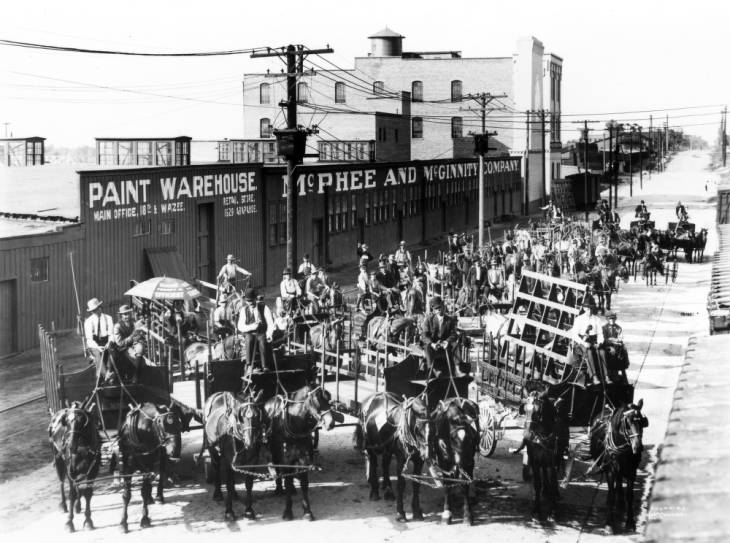
Lumber wood produced at McPhee was rough-cut, finished later at the McPhee and McGinnity plant in
Denver, located at Blake and 23rd Street. 
 

The lower grades of lumber were made into railroad ties, to satisfy contract with the Denver and Rio Grande Western Railroad. This contract enabled the lumber company to survive the Great Depression.Other lumber from McPhee was utilized for a variety of purposes and reached many destinations.

"Superior lumber grades were used for building construction and were also shipped to sash and door factories along the Missouri River. Additionally, contracts, including one for lumber to build local Civilian Conservation Camps in 1933 and another to manufacture army locker trunk trays during world War II, The McPhees pioneered logging railroads. Their decision to use the logging railroad in this area was a response to the type of lumber which they sought," says Mausolf, in her field notes.
 

Unlike species like cottonwoods which thrive in river bottoms and can be cut, dumped into a river and floated, the tall Ponderosa pines require dry and well drained soil, normally found on mesas away from river bottoms. Land transportation either utilizing horses or logging railroads was, therefore, the only alternative.

The McPhee railroad was the last narrow gauge logging railroad in southwestern Colorado. The railroad officially came to the Dolores River Valley in 1891, in the form of the Rio Grande Southern. Due to McPhee's relative isolation, the New Mexico Lumber Company decided to link the mill town with the main line railroad as well as construct track or each into the timberlands.

The participation of a mainline railroad in the operation of logging lines was unprecedented in the United States Railroad construction began in 1924, using an incomplete survey commissioned for the Dolores, Paradox and Grand Junction Railroad in 1913.  In 1924, a line was built westward five miles from Dolores, terminating at McPhee. Many logging lines of the region, Colorado and Southwestern, as the McPhee's line was named, were formally incorporated rather than operating under the lumber company name.


As logging operations moved deeper into the timber, railroad spur lines followed. At its peak the company amassed sixty miles of railroad. The New Mexico Lumber Company had five logging locomotives, one geared and four rod. The rod locomotives were mostly obsolete, obtained second-hand from the Denver and Rio Grande Railroad with one from Rio Grande and Southwestern Railroad at El Vado.

"The Montezuma Lumber Company, which took over in 1936, decreased the trackage substantially and reduced the locomotives to two. Most of the 45 flat cars came from nearby declining operations• Second hand track was imported from Salida and Pagosa Springs. 
In the 1930s, the Montezuma Lumber Company purchased an 1880 duckbill coach (#311) from the Denver and Rio Grande Western Railroad to transport employees and their families to Dolores behind the regular lumber train. On Saturday nights the train transported the townspeople to Dolores for dances, movies and drinking in the gas-illuminated car with faded red plush seats.," says Mausolf, in her field notes.
"The end of narrow gauge logging in southwest Colorado came in 1932 when the expense of hauling lumber by rail gave way to hauling by trucks. The five miles of track between McPhee and Dolores remained, however, and continued to service McPhee residents. The scrapping of the last of this segment occurred in 1948, after an intense struggle and a brief period of receivership in the 1940's the Denver and Rio Grande Southern Railroad abandoned operations in the area," she wrote.


"The logging operations at McPhee have been criticized for their continued dependence on the railroad and failure to mechanize production. Logging in Colorado as exemplified by McPhee was marked by the absence of mechanical loading devices used on the Pacific Coast. It represented instead a marked dedication to horsepower. Four-horse teams, with either big wheeled rigs or eight wheeled wagons were used to haul the trees to the loading station. Instead of steam donkey engines, Colorado loggers used cross-hauling, by which a team of horses dragged trees up a ramp onto log cars. Seven to ten flat cars made up a train with two locomotives used to haul from forest to mill," according to Mausolf, in her field notes.

A locomotive hauled the loaded cars to the unloading skids at the mill pond. It is interesting to note that most of the hay and grain for the 200-250 heavy draft horses had to be shipped in as "no local 50" by the sales agency could regularly meet the demand. 50 Social communities, separate from that of the company town of McPhee, sprang up as new logging camps were established. The sites of the camps moved every few years as logging operations ventured deeper to secure timber. The earliest, Horse Camp, was little more than a construction camp, though it did have a school. Beaver Camp in 1925 represented a more permanent encampment, with a store and post office.

From then on, a small commissary was always moved along with the camp. Lawrence Sullenberger did most of the construction work and establishing of camps for the New Mexico Lumber Company. Small board cabins were built on skids, easily hitched to four or six horses for transportation to new sites. Tent colonies were often constructed at the camps. Entire families often moved to the hills so the head of family could earn a living. Characteristically the camp housed several hundred loggers and their families. No rent was charged in the log camps. During the winter people from the logging camps resided in McPhee, reported Mausolf.


“The town of McPhee was only part of the company’s expansive lumber monopoly,” writesMausolf in her book The River of Sorrows: The History of the Lower Dolores River Valley. “During its peak in 1927 McPhee and McGinnity had five lumberyards in Denver, five in San Luis Valley and five on Moffat Road with 25 branches in Colorado, Nebraska and Wyoming.”
 
The company originally looked at placing the mill in or near the town of Dolores but local opposition forced them to look elsewhere. That is how they arrived at the 800-acre site of the old Charlie Johnson homestead.

“The town site was originally known as Ventura. It was also temporarily called Escalante. McPhee was situated on the alleged spot where in 1776 Father (Silvestre Velez de) Escalante stopped for several weeks beside a stream he called the Dolores River. The town was given its final name after an influential visit to the site by William McPhee in 1924,” wrote Mausolf.

By 1925, the mill at McPhee was producing 61 percent of all lumber in the entire state, more than 27,445.360 board feet. The mill itself covered a city block with a three-story main building, three-acre pond planing mill and box factory.


Tuesday, March 16, 2021

Scotch, war stories and ag journalism


"
Too much of anything is bad, but too much good whiskey is barely enough.” – Mark Twain

" Always carry a flagon of whisky in case of snakebite, and furthermore, always carry a small snake.” – W.C. Fields

Lit up like Christmas

By Rob Carrigan, robcarrigan1@gmail.com

Once, I had some friends that would get lit up like Christmas on occasion — then badger me into lighting my own tree. After that, they seemed to be able talk me into almost anything. That is why I have sympathy for Captain Lyluph Gilchrist Stanley Ogilvy, or as he was also known as ... Lord Ogilvy. His famous friends had a way.

"He was often described as a man of superb education and aristocratic background. His full name was Lyluph Gilchrist Stanley Ogilvy, younger son of the eighth Earl of Airlie and uncle of the ninth, making him a true aristocrat," notes Dick Kreck in a 2017 piece for the Denver Post.


Ag and livestock editor

He arrived in Colorado in 1889 from his native Scotland and fell in love with the wild, wild West. In recounting Ogilvy’s transition to America, Gene Fowler in his reminiscence 'Timber Line' recalled that when Ogilvy went to work for The Denver Post, Harry Tammen, his new boss whom he met during frequent visits to the bar at the Windsor Hotel, reportedly said, "To hell with calling yourself ‘Lyluph.’ I wouldn’t know what it means in a thousand years. You’re the son of an earl, aren’t you? Well, you’re going to work for me, and you’re going to be ‘Lord Ogilvy’ to me, whether you like it or not."

"As the paper’s agriculture and livestock writer until 1945, Ogilvy became the reigning expert on topics such as irrigation, breeding livestock and the worth of farmland. Standing 6-foot-2 and handsome in his black-and-gray beard, Ogilvy was polished, bright and well-bred, all of which Tammen loved. A superb horseman, Ogilvy is rumored to have driven two ponies into the lobby of the posh Windsor Hotel," wrote Kreck.

"By 1902, he decided he had had enough wild living and married Edith Boothroyd, and they settled down on his farm near Greeley. But his wife’s fragile health forced him to sell the ranch and move to Denver, where she died and he lived alone."

According to  Kreck, he was famous among his co-workers for the illegible handwriting in his copy and equally renowned for his careless dressing habits. 

His son, Jack, told author Bill Hosokawa for “Thunder in the Rockies,” his history of The Post, “His uniform at The Post consisted of a blue work shirt 2-inches too large in the neck with a World War I surplus olive-drab tie which extended 4 inches below the four-in-hand knot.” A fellow staffer noted with alarm that his saggy pants often appeared ready to fall to the floor.

In 1945 he retired from his work at the Post and moved to live with his son in Boulder. He died
of pneumonia
in a Boulder nursing home on April 4, 1947. He was also a veteran of three wars, serving in both the US and British military organizations.

A newspaper clipping of April 4, 1947, titled “Captain the Honorable,” remembered Ogilvy as a “Veteran of three wars, Colorado pioneer, one-time bon vivant, in his youth daredevil and roguish prankster, agriculturalist and an expert writer on agriculture.” The article also noted that Ogilvy was an ardent promoter of the National Western Stock Show.


Legendary prankster

According to a biography written by his son, Jack Ogilvy, Lyulph would not confirm or discuss rumored youthful escapades, referring to them as “silly.” Over the years, Ogilvy acquired a reputation as a colorful and feisty man with an affinity for horse racing and pranks. Several legendary pranks occurred at the Windsor Hotel in Denver, at the time a new establishment frequented by cattlemen. One incident involved Ogilvy bringing in roosters to rouse the desk clerk after he failed to wake Ogilvy in time to catch a train. Another time he staged a rat hunt in the hotel, letting loose a pack of rats and then unleashing dogs to hunt them down. Perhaps his most famous prank was staging his own mock funeral, complete with an open casket viewing, in downtown Denver. Once the casket made the trip to Riverside Cemetery, Ogilvy emerged, Scotch bottle in hand, very much alive.

At the Windsor Hotel, he developed a group of friends inclined toward the wholesale consumption of liquid refreshments, wrote Colorado historian Kenneth Jessen.

"One story tells of a meeting with Buffalo Bill Cody at the Windsor. Ogilvy remained at the bar beyond the departure of the last train north. To solve his need for transportation, he spotted a steam roller near the hotel and drove it to his ranch near Fort Morgan, a distance of more than 80 miles. As the story goes, the trip took most of the night, and Ogilvy would stop the slow-moving piece of machinery for fuel and water along the way. Most of the bridges were wooden and due to the ponderous weight of Ogilvy's vehicle, later had to be condemned," wrote Jessen.

Years after this story appeared, his son Jack set the record straight by saying it was not a steamroller, but rather a steam tractor of equal size. It was purchased by Ogilvy to dig a ditch near Fort Morgan. Jack says his father drove the noisy machine home at night to avoid spooking teams. 

"The bridges had to be replaced, but in Lyulph's mind, they needed to be rebuilt anyway," according to his son.

Early Life

Lyulph Ogilvy was born in 1861 as the second son of David Graham Drummond Ogilvy, Tenth Earl of Airlie (a Scottish Peerage), and Henrietta Blanche Stanley Ogilvy. Educated first by governesses, as was the custom among the Scottish aristocracy, Lyulph later attended Eton College. He left Eton early for military training, likely with an eye toward service in Queen Victoria’s British Empire. The British followed the system of primogeniture, in which only the first son inherits, so as a second son Lyulph had few opportunities outside of the armed forces, the church, or imperial service. His family’s overseas ambition, however, eventually took him to the American West.
 
After the American Civil War, interest in the American West grew both at home and abroad. Several English companies promoted land sales, including the English-owned Colorado Mortgage and Investment Company (known as the English Company) and XIT Corporation, which bought, sold, and leased ranch land from Texas to Montana. In 1874 the Earl of Airlie, along with his son Lyulph and daughter Maude, visited Colorado with Lord Dunraven when he negotiated the purchase of Estes Park. Like other members of the British aristocracy, Lord Airlie eventually had many holdings in the western United States. In 1879 he decided to tour them again with his son and daughter. The trip ranged from Texas to California and Oregon. At its end, Lyulph decided to stay in the United States, and in 1880 his father bought 3,500 acres of land in Weld County, northeast of Greeley on Crow Creek, where the family established a cattle ranch that Lyulph managed.

Lyulph’s father died in 1881 after getting sick while visiting New Mexico. The Earl had not yet legally conveyed the Crow Creek Ranch land to his son, and Lyulph waited seven years for the estates to be sorted out before he could acquire title. During that time, he and some partners established the Polled Angus and Swiss Company on June 6, 1883. The next year, on a visit to his mother in Scotland, Ogilvy arranged to bring the first Aberdeen Angus cattle to Weld County, a breed that is today one of the primary sources of beef cattle. He also brought in stallions—although not from abroad—to breed larger draft horses for farming and ditch building.

Irrigation Work

From 1880 to 1898, Lyulph Ogilvy did part-time contract work with local ditch builder Edward Baker, building portions of many ditches including the Ogilvy Ditch northeast of Greeley. The ditch that bears his name was built in 1881 to bring water to Crow Creek Ranch, which Ogilvy managed after his father’s death as he waited for legal title to the land. Originally known as the Baker and Ogilvy Canal, the ditch was engineered by Baker, one of the original Union colonists who also helped build the Greeley #2 Ditch.

The Ogilvy Ditch, along with others, was built in the wake of the Desert Land Act of 1877, which encouraged economic development in the arid western states. The Ogilvy Ditch’s first water right dates to 1881, and a second right dates to 1986. The Ogilvy Ditch is the last irrigation diversion on the Cache la Poudre River before its convergence with the South Platte River southeast of Greeley. Today the ditch is within the Cache la Poudre National Heritage Area and provides water for thirty-three shareholders of the Ogilvy Irrigating and Land Company, formed in 1883 with Lyulph Ogilvy as president.

Initially, the ditch brought some prosperity, and Ogilvy built a two-story ranch house at Crow Creek Ranch in February 1885. But he soon lost money on another ditch project (the Platte Ditch), as the natural springs in the area prevented the use of standard construction methods. These losses, coupled with a string of disastrous winters that killed the open-range cattle industry, forced Ogilvy to sell Crow Creek Ranch in 1888 to Franklin Murphy, secretary of the Percheron-Norman Horse Company. Ogilvy bought a smaller farm closer to Greeley. After the sale of his ranch, Ogilvy worked for a while as a ditch rider, controlling head gates and the release of water onto shareholders’ lands for one of the Greeley ditches.

Soldier and Journalist

In 1898 Ogilvy enlisted in Company D, First Colorado Infantry, during the Spanish-American War. He later served in the Boer War in South Africa as a British cavalry captain. In 1902 Ogilvy bought a ranch in LaSalle known as the Ogilvy LaSalle Ranch, which he owned for eight years. In 1902 he also married Edith Gertrude Boothroyd, whose English family had settled along the mouth of the Big Thompson River near Loveland. Edith died six years later, leaving her husband with a daughter, Blanche, and a son, Jack David Angus Ogilvy. Jack later became a professor at the University of Colorado and wrote a series of articles about his father.

After the death of his wife, Ogilvy left his children to be raised by their maternal grandparents on their farm in Loveland and moved to Denver, where he took a job as a night watchman for the Union Pacific Railroad in 1909. There he was reacquainted with Harry Tammen, a former bartender at the Windsor Hotel. Tammen co-owned The Denver Post and, wanting to attract rural readers, offered Ogilvy a job as an agricultural journalist. Ogilvy turned that into a thirty-six-year career, with a two-year break for an additional military enlistment, serving with the British army in World War I. Tammen introduced his new journalist to readers as “Lord” Ogilvy, which stuck with him, though coworkers called him Captain in recognition of his rank from the Boer War.

SLW Ranch 

Today, Ogilvy’s Crow Creek Ranch, originally 3,500 acres, is part of the SLW Ranch. In 1889, one year after Ogilvy sold Crow Creek, new owner Frank Murphy deeded the property to John M. Studebaker of the Studebaker Wagon Company and Lafayette Lamb, a director of the Weyerhaeuser Lumber Company. Together they expanded the Crow Creek Land Company to 22,000 acres and built an enormous barn to service 2,400 head of brood mares.

The same year, Studebaker, Lamb, and Harvey Witwer incorporated the SLW Ranch Company. Witwer was John Studebaker’s nephew and a salesman for the Studebaker Wagon Company. Witwer was responsible for selling and leasing 80- and 160-acre parcels with water rights to the Ogilvy Ditch. He also worked to establish a Hereford cattle herd, making SLW one of the oldest continuously operating Hereford ranches in the country. Eventually Harvey Witwer acquired sole ownership of the ranch, which remains in the Witwer family today.

Education of aristocrat

According to Biographical note on Lyulph Ogilvy, he was born June 25, 1861, the second son of the Earl and Countess of the Scottish House of Airlie. His early education was through governesses. He attended Eton College but dropped out at the end of the fifth form to prepare for military training. His father, the Earl of Airlie, had purchased lands in the Western United States and in 1879 decided to visit those holdings. He brought his daughter and second son, Lyulph, with him. When the Earl decided to return to Scotland, Lyulph decided to stay and his father set him up with a cattle ranch on Crow Creek northwest of Greeley. 

For most of his life Lyulph remained in the Northern Colorado area where he became a notable and colorful Colorado figure until his death in 1947. Lyulph was an accomplished horseman and rancher, gaining some notoriety from his pioneering work on Weld County and other Colorado ditch irrigation projects. He was also noted for his extracurricular activities, demonstrating a wild streak that somewhat belied his noble heritage. Despite his occasional antics, he was reportedly widely respected by those who knew and worked with him.

In 1898 he left Greeley to join the Spanish American War, serving with what was to be later known as Torrey’s Rough Riders. Then from 1899 — 1900 he served in South Africa in the British Calvary during the Boer War.

After returning from Africa he became a sheep rancher, settling outside of LaSalle. In 1902 he married Edith Gertrude Boothroyd and their son, Jack D.A. Ogilvy was born in 1903. His wife died in 1908 which caused Ogilvy to sell his ranch and move to Denver. Later he procured his wife’s family’s ranch near the mouth of the Big Thomson, called the Three Waters Ranch. Over several decades he visited there frequently and experimented with various growing techniques. In 1914 he enlisted in the Northumberland Regiment where he spent two years training troops before returning again to Colorado.

For fifteen subsequent years he worked as an agricultural columnist for the Denver Post, while spending time both in a home in Denver and at the Three Waters Ranch.


Saturday, February 27, 2021

Cold War's cozy comand center

 “All autumn, the chafe and jar of nuclear war;
we have talked our extinction to death.
I swim like a minnow behind my studio window.”

Robert Lowell, For the Union Dead 

NORAD blast doors entrance.

Safe inside the mountain

By Rob Carrigan, robcarrigan1@gmail.com

When I was in high school in southwestern Colorado in the 1980s, conventional wisdom (as much as our small minds had access to) suggested that because the North American Air Defense Command system was headquartered in Colorado Springs, it was considered a likely nuke target. Though several mountain ranges separated us, we still postulated that we were way too close — being in the same state and all.

The North American Air Defense Command (NORAD) was established and activated at Ent Air Force Base in Colorado Springs on September 12, 1957. The bi-national command of Canadian and United States Air Defense units, in accordance with NORAD Agreements first made on May 12, 1958, was a plan developed to construct a command and control center in a hardened facility as a Cold War defensive strategy against long-range Soviet bombers, ballistic missiles, and a nuclear attack.

In 1957 the Strategic Air Command began construction in New England inside Bare Mountain for a hardened bunker to contain the command post for the 8th Air Force, which was located at nearby Westover Air Force Base, Chicopee, Massachusetts. This underground facility was nicknamed "The Notch" (or formally as the 8th AF "Post-Attack Command and Control System Facility, Hadley") and was hardened to protect it from the effects of a nearby nuclear blast and designed so that the senior military staff could facilitate further military operations. 

Contruction of NORAD in Cheyenne Mountain.


Four years later, construction at Cheyenne Mountain was started to create a similar protection for the NORAD command post. Cheyenne Mountain was excavated under the supervision of the Army Corps of Engineers for the construction of the NORAD Combat Operations Center beginning on May 18, 1961, by Utah Construction & Mining Company.

According to locals from the Pikes Peak area, much of the blasting work was done by miners from the Cripple Creek District, says longtime area historian Ray Drake. "When the Golden Cycle closed the Ajax in 1962, the miners carpooled and were employed at NORAD," notes another local Tish Allen. "They were glad to get the work and the government was happy to get experienced underground workers."

The Space Defense Center and the Combat Operations Center achieved full operational capability on February 6, 1967. The total cost was $142.4 million. Its systems included a command and control system developed by Burroughs Corporation. The electronics and communications system centralized and automated the instantaneous (one-millionth of a second) evaluation of aerospace surveillance data.[The Space Defense Center moved from Ent AFB to the complex in 1965.The NORAD Combat Operations Center was fully operational April 20, 1966. The Space Defense Command's 1st Aerospace Control Squadron moved to Cheyenne Mountain then. The following systems or commands became operational between May and October, 1966: The NORAD Attack Warning System, Combat Operations Command,and Delta I computer system, which recorded and monitored every detected space system.

"With the beginning of the Cold War, American defense experts and political leaders began planning and implementing a defensive air shield, which they believed was necessary to defend against a possible attack by long-range, manned Soviet bombers. By the time of its creation in 1947, as a separate service, it was widely acknowledged the Air Force would be the center point of this defensive effort. Under the auspices of the Air Defense Command (ADC), first created in 1948, and reconstituted in 1951 at Ent AFB, Colorado, subordinate Air Force commands were given responsibility to protect the various regions of the United States. By 1954, as concerns about Soviet capabilities became more grave, a multi-service unified command was created, involving Naval, Army, and Air Force units—the Continental Air Defense Command (CONAD). Air Force leaders, most notably Generals Benjamin Chidlaw and Earle Partridge, guided the planning and programs during the mid 1950s. The Air Force provided the interceptor aircraft and planned the upgrades needed over the years. The Air Force also developed and operated the extensive early warning radar sites and systems which acted as “trip wire” against air attack. The advance warning systems and communication requirements to provide the alert time needed, as well as command and control of forces, became primarily an Air Force contribution, a trend which continued into the future as the nation’s aerospace defense matured,"wrote General Charles H. Jacoby, Jr., Commander, North American Aerospace Defense Command, August 3, 2011, in "A Brief history of NORAD."

"As Air Force leaders developed plans and proposed warning system programs, they became convinced of the logical need for extended cooperation with America’s continental neighbor, Canada. US-Canada defense relationships extended back to World War II when the two nation’s leaders formally agreed on military cooperation as early as 1940, the Ogdensburg Declaration. These ties were renewed in the late 1940s with further sharing of defense plans in light of increasing Soviet military capabilities and a growing trend of unstable international events, such as the emergence of a divided Europe and the Korean War," said Jacoby.

"Defense agreements between Canada and the United Stated in the early 1950s centered on the building of radar networks across the territory of Canada—the Mid- Canada Line (also known as the McGill Fence), the Pinetree Line, and the famous Dew Line. This cooperation led to a natural extension of talks regarding the possible integration and execution of air defense plans. The RCAF and USAF exchanged liaison officers and met at key conferences to discuss the potential of a shared air defense organization. By 1957, the details had been worked out and the top defense officials in each nation approved the formation of the North American Air Defense Command, which was stood up on 12 September at Ent AFB, in Colorado Springs, Colorado, home of the US Continental Air Defense Command and its subordinates, including USAF Air Defense Command. General Earl Partridge, USAF, who was both the ADC and CONAD Commander, also became commander of NORAD, and the senior Canadian RCAF official, Air Marshal Roy Slemon, who had been the key Canadian delegate in most of the cooperation talks, became deputy commander, NORAD. Nine months after operational establishment of the command, on 12 May 1958, the two nations announced they had formalized the cooperative air defense arrangements as a government-to-government bilateral defense agreement that became known as the NORAD Agreement. The NORAD Agreement and its associated terms of reference provided the political connections which would make possible the longevity of the Canadian-US aerospace defense relationship into the future years."

Another example of NORAD’s continuing adaptability also came in 2006. In NORAD’s fifty-year history, perhaps the most notable symbol of the command has been the Cheyenne Mountain Operations Center (CMOC), often referred to as simply “Cheyenne Mountain.” This vast bunker complex, which became fully operational in 1966, sat more than 1500 feet underground and consisted of fifteen buildings which comprised the central collection and coordination facility for NORAD’s global-sensor systems. In early 2006, after studies and reviews, the NORAD and USNORTHCOM commander, decided, because of the changing nature of the threat in a post-9/11 world and because of gained efficiencies in monitoring the warning networks, the CMOC surveillance and warning of attack command centers could be relocated into a dual- purpose command center located at NORAD and USNORTHCOM headquarters on Peterson AFB. Cheyenne Mountain would become an alternate command center rather than be maintained on a 24/7 basis. The NORAD and USNORTHCOM Command Center at Peterson would become the official surveillance center for both commands, designed to give the commander and the Canadian and US leadership an accurate picture of any aerospace and other domain homeland threat."


"As NORAD reached its fiftieth year, most believed the command was on sound footing. The 2006 NORAD Agreement renewal expanded the mission to include a non-aerospace responsibility—maritime warning—and removed the normal practice of a five-year expiration date for the agreement. Instead, the two nations would merely review the nature of the accord for potential changes. In 2008 the command celebrated its fiftieth anniversary, unveiling the new NORAD and USNORTHCOM Command Center (N2C2). In a stellar example of governmental, military, and law enforcement cooperation, NORAD provided air security assistance to the Government of Canada for the 2010 Vancouver Winter Olympics."
 

Ent Air Base.


In 2011 and 2012, the mutual cooperation continued in the form of numerous exercises and real world events. In October of 2012 the NORAD and USNORTHCOM headquarters building at Peterson Air Force Base was renamed the Eberhart-Findley Building in honor of U.S. Air Force General (Ret.) Ralph E. Eberhart and Royal Canadian Air Force Lieutenant-General (Ret.) Eric A. Findley. This is the first time the name of a U.S. military combatant command headquarters included a Canadian military officer’s name. In December Army Gen. Charles Jacoby, Jr., commander of NORAD and U.S. Northern Command, and Lt.-Gen. Stuart Beare, Canadian Joint Operations Command commander, signed the Tri Command Framework for Arctic Cooperation and the Tri-Command Training and Exercise Statement of Intent – during the 230th meeting of the Canada-U.S. Permanent Joint Board on Defense in Colorado Springs, Colo continuing the mutually beneficial relationship of defense to the homeland.

In 2013, the command, looking to the future and at the same time responding to decades old threats made new,  developed the concept of “NORAD Next” as a way to ensure meeting and outpace emerging threats in all domains. The current NORAD agreement needed to “continue to adapt to future shared security interests to ensure that heir respective and mutual defense requirements are met in the current and projected geostrategic circumstances.” 

NORAD Next became the modernization efforts inside the command towards 2025-2030. At the same time, NORAD launched fighters, AWACS, and tankers from the Alaskan and Canadian NORAD Regions in response to a renewed Russian Long-Range Aviation. These sorties, were not identified on international flight plans and penetrated the North American Air Defense Identification Zone. Detect and intercept operations demonstrated the ability and intent to defend the northern reaches of the homeland and contributed to the strategic deterrence of aerospace threats.

Saturday, February 6, 2021

Up on high and mighty Altman's mean streets

 "Critics are men who watch a battle from a high place then come down and shoot the survivors."

 ___ Ernest Hemingway


Altman, highest incorporated town in the world, elevation 11,200 ft., Pikes Peak in distance,Andrew Jame Harlan photo, Denver Public Library Special Collections.

Highest incorporated city in the United States in its day

By Rob Carrigan, robcarrigan1@gmail.com

Up in the high and mighty part of the Cripple Creek Gold District, ran perhaps the meanest streets of all. Altman was the highest incorporated town in the United States in its day.

The first stamp mill in the Cripple Creek area was built by a Sam Altman after whom the town was named. Among the most bustling small cities in the district at the turn of the last century, Altman was dominated by union miners and was one of the headquarters during the bloody strikes of 1894. It always seemed to find itself in the center of labor violence during its lifetime.

"It is said violence was so common at one time, a busy undertaker offered to give group rates if all killings were done on Saturday. The town covered the entire top of a hill, had several hotels, restaurants and saloons, " according to Henry Chenoweth, writing of Altman.

"Along the main thoroughfares of Main, Baldwin, and Brown Streets were wooden, false-fronted buildings. Four restaurants, six saloons, six grocery stores, a schoolhouse and 200 homes already dotted the hillside by the time the town was platted," writes Jan Mackell Collins in her 2016 book "Lost Ghost Towns of Teller County."

"Almost immediately, a few roughnecks moved into town. On Oct. 10, 1893, Felix Parrow, Robert McCullough, Harry Cavanaugh, and Jim McDonald showed up at W.R. Goodey's saloon. The men spent the entire night and early morning playing cards for drinks. Around 4 a.m., the men suddenly broke into a fight as a ruse to rob the place. Barkeeper John Ashley was whacked in the head with a gun and "laid out," while faro dealer J.S. Bush was disarmed. In all, the robbers took $610 in cash and another $350 in checks, along with five gold watches and a pair of braclets. Then in November, ex-prizefighter George Lear was labeled a "Green Monster" when he shot and killed a dance hall girl named Irene Goode during a jealous rage. A short time later, Altman bartender Sam Jones killed Lear at Kilday & Sullivan's Saloon," wrote Jan MacKell Collins.

Similar stories raged on for years as the Altman crime spree continued as long as the town survived.

"Nobody seems to agree about the exact altitude of Altman," notes Jan MacKell Collins however.

"The elevation was first reported in the 1894 Cripple Creek District Directory as 10,500 feet. Other sources have claimed altitudes ranging from 10,700 feet to 11,650 feet. At the very least, everyone agrees that during its heyday, Altman was the highest incorporated city in the United States," she writes.


Neil McGee poses next to a brick furnace inside a smelter plant in Altman, about 1900; tools hang on the wall. Denver Public Library Special Collections.

The American Eagle Mine dominated what was left of the skyline of Altman, into this millennium.

"One of the dozens of people making the final trip to the overlook was Liz Hunter. Her parents, Cherry and Ed Hunter, were well known in the area. Her father has a building that bears his name in Cripple Creek. Under the 60-foot tall American Eagles Mine headframe sits a commemorative bench placed in her parents' honor.," wrote Nathan Heffel, of Colorado Public Radio in 2016, at the time of the last public tour of the American Eagles Overlook. The American Eagles Overlook and Historic Mine was situated in the middle of the active Cresson surface gold mine, owned by Newmont CC & V — the largest of its type in Colorado.

An inscription reads, “May all your labors be in vein.”

Liz Hunter held a personal ceremony at the overlook, taking a bag of flower petals and sprinkling them on her parents' bench, at the time. The strong winds carried them over the entire mine site, reported Colorado Public Radio.

“It’s sad that it’s closing. It’s such a wonderful place,” Heffel quoted Hunter. “It’s so beautiful to come and just look at the beautiful Sangre De Cristos, Pikes Peak, have a picnic lunch, see the mines. Be close to mom and dad."

Altman was one of many towns that formed around the rich mines of the Cripple Creek District, according to Western Mining History. The town was situated at the highest point in the district and covered most of the hill.

"Altman had a central role in the Cripple Creek miners' strike of 1894. The Western Federation of Miners Local 19 was based in Altman during the strike. This resulted in many violent incidents in and around Altman as deputies hired by the mine owners made their camp above the town on Bull Hill," says Western Mining History.

"Miners in Altman responded to the threat by barricading the entire town and announcing they had seceded from the country. They were said to have made a catapult that would hurl dynamite bombs at the deputies camp. Colorado state militia would be brought in to restore order. The strike ended after five months, with the miners scoring a major victory over the mine owners."

At the end of the 19th century, Cripple Creek was the largest town in the gold-mining district that included the towns of Altman, Anaconda, Arequa, Goldfield, Elkton, Independence and Victor, about 20 miles from Colorado Springs on the southwest side of Pikes Peak. Surface gold was discovered in the area in 1891, and within three years more than 150 mines were operating there.

The Panic of 1893 caused the price of silver to crash; the gold price, however, remained fixed, as the United States was on the gold standard. The influx of silver miners into the gold mines caused a lowering of wages. Mine owners demanded longer hours for less pay.

In January 1894, Cripple Creek mine owners J. J. Hagerman, David Moffat and Eben Smith, who together employed one-third of the area's miners, announced a lengthening of the work-day to ten hours (from eight hours), with no change to the daily wage of $3 per day. When workers protested, the owners agreed to employ the miners for eight hours a day – but at a wage of only $2.50.

Not long before this dispute, miners at Cripple Creek had formed the Free Coinage Union. Once the new changes went into effect, they affiliated with the Western Federation of Miners, and became Local 19. The union was based in Altman, and had chapters in Anaconda, Cripple Creek and Victor.

On February 1, 1894, the mine owners began implementing the 10-hour day. Union president John Calderwood issued a notice a week later demanding that the mine owners reinstate the eight-hour day at the $3.00 wage. When the owners did not respond, the nascent union struck on February 7. Portland, Pikes Peak, Gold Dollar and a few smaller mines immediately agreed to the eight-hour day and remained open, but larger mines held out.

On March 16, an armed group of miners ambushed and captured six sheriff's deputies en route to the Victor mine. A fight broke out, in which one deputy was shot and another hit by a club. An Altman judge, a member of the WFM, charged the deputies with carrying concealed weapons and disturbing the peace, then released them.

Calderwood was leaving on a tour of the WFM locals in Colorado to raise funds for the Cripple Creek strike, and so appointed Junius J. Johnson, a former U.S. Army officer, to take over strike operations. Johnson immediately established a camp atop Bull Hill, which overlooked the town of Altman. He ordered that fortifications be built, a commissary stocked and the miners be drilled in maneuvers.

On May 24, the strikers seized the Strong mine on Battle Mountain, which overlooked the town of Victor. The next day, at about 9 a.m, 125 deputies arrived in Altman and set up camp at the base of Bull Hill. As they started to march toward the strikers' camp, miners at the Strong mine blew up the shafthouse, hurling the structure more than 300 feet into the air. A few moments later, the steam boiler was also dynamited, showering the deputies with timber, iron and cable. The deputies fled to the rail station and left town.

A celebration broke out among the miners, who broke into liquor warehouses and saloons. That night, some of the miners loaded a flatcar with dynamite and attempted to roll it toward the deputies' camp. It overturned short of its goal and killed a cow. Other miners wanted to blow up every mine in the region, but Johnson quickly discouraged them. Frustrated, several drunken miners then stole a work train and steamed into Victor. They caught up with the group of fleeing deputies, and a gun battle broke out. One deputy and one miner died, a man on each side was wounded, and six strikers were captured by the deputies.The miners subsequently captured three officials of the Strong mine who had been present when the shafthouse was blown up. A formal prisoner exchange later freed all prisoners on both sides.

With 1,300 deputies still in Cripple Creek, Sheriff Bowers was unable to control the army he had created. On June 5, the deputies moved into Altman, perhaps as a prelude to storming Bull Hill. The deputies cut the telegraph and telephone wires leading out of town, and imprisoned a number of reporters. Concerned that the paramilitary force might get out of hand, Gov. Davis Hanson Waite again dispatched the state militia, this time under the command of General E.J. Brooks.

When Colorado state troops arrived in Cripple Creek early on the morning of June 6, more violence had already broken out. The deputies were exchanging gunfire with the miners on Bull Hill. Gen. Brooks quickly moved his troops from the train station to the foot of Bull Hill. As Sheriff Bowers and Gen. Brooks began to argue about what course of action to take next, the deputies took advantage of the lull and attempted to charge the miners.The miners sounded the whistle at the Victor mine, alerting Gen. Brooks. Soldiers of the state militia quickly intercepted the deputies and stopped their advance. Brooks ordered his men to occupy the top of Bull Hill, and the miners offered no resistance.

The deputies turned their attention to Cripple Creek itself. They arrested and imprisoned hundreds of citizens without cause. Many inhabitants of the town were seized on the street or pulled from their homes, then clubbed, kicked or beaten. The deputies formed a gauntlet and forced townspeople to pass through it, spitting, slapping and kicking them. With Bull Hill in his possession, Gen. Brooks began detaining the deputies. By nightfall, Brooks had seized the town and corralled all of Bowers' men.

Waite threatened to declare martial law, but the mine owners refused to disband their deputy force. Gen. Brooks then threatened to keep his troops in the region for another 30 days. Faced with the prospect of paying for a paramilitary force which could only sit on its hands, the owners agreed to disband it. The deputies, which Gen. Brooks had dispatched via rail to Colorado Springs, began dispersing on June 11. The Waite agreement became operative the same day, and the miners returned to work. Union president Calderwood and 300 other miners were arrested and charged with a variety of crimes.

Only four miners were convicted of any charges, and were quickly pardoned by the sympathetic populist governor.

In 1892, Gov. Davis Hanson Waite had been nominated as the Populist candidate for Governor of Colorado and he was inaugurated on January 10, 1893. A passionate supporter of the Populist's Omaha Platform, he was nicknamed "Bloody Bridles" for an 1893 speech, in which he proclaimed, "It is better, infinitely better that blood should flow to the horses' bridles rather than our national liberties should be destroyed."


Lower edge of Altman about 1900 with the Isabella Mine below, Teller County, Colorado, includes a slope covered with small log cabins, wood frame residences, outhouses, sheds, smelters, mines, and tailing dumps. The narrow gauge Golden Circle railhead, switchback, ore and coal bin spurs, show around the large multi-structure ore processing plant with tall smokestacks and ore bins. Denver Public Library Special Collections.