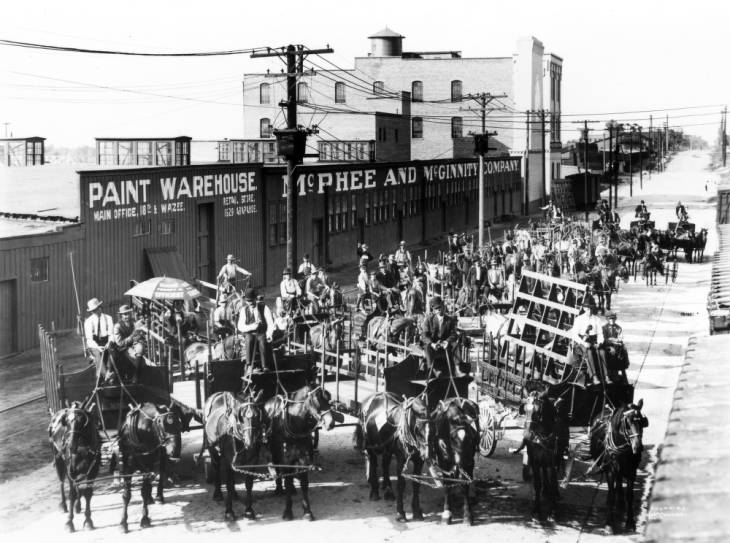
Showing posts with label McPhee. Show all posts

Saturday, August 19, 2023

Dolores Dam, Jeffers School, Iola, McPhee, Gold Coin, Telluride Town Hall


Thing of the past ...
Montezuma Valley Irrigation Company System, Concrete Diversion Dam, Dolores, Montezuma County, CO,
Historic American Engineering Record, creator
Lowe, Jet, photographer, Historic American Engineering Record (Library of Congress) Photos from Survey HAER CO-4-G
Date; 1978?


Thing of the past ...
This is the attendance at the Jeffers School, #29 on November 1. 7 present out of the possible 20. Absences due chiefly to beet work. See also 4060. Location: Loveland [vicinity], Colorado / L.W. Hine.
Contributor Names
Hine, Lewis Wickes, 1874-1940, photographer
Created / Published
1915, November 1.


Thing of the past ...
Farmington-Shiprock auto truck
Creator: Poley, H. S. (Horace Swartley)
Date: 1912
A group of Native American (Navajo) men and boys, in hats, shirts, overalls or pants, pose on a sidewalk in Farmington, New Mexico, by the Farmington to Shiprock auto truck. The convertible truck has packages and bundles tied to the back and one man seated on a square basket; another man stands by the running board. Shows store fronts with signs that read: "Mercantile Co." and "The Rexall Store" and a large "Rexall" thermometer on wall.
Inked on negative: "N-97."; Title from label in negative. Written on back of print: "Farmington-Shiprock Stage at Farmington."
Denver Public Library Special Collections


Thing of the past ...
John W. Bailey, owner of Gold Park Milling and Mining Co. and founder of Holy Cross City
Date:[1880-1890]
Donor: Muriel Sibell Wolle estate, 1977.
John W. Bailey, with double-barrel rifle and ammunition belt, poses with dogs in Holy Cross City, Eagle County, Colorado. Sheds and lower tunnel of Pelican Mine in background.
Original Material Found in Collection Fred Mazzulla papers
Subject Holy Cross City (Colo.); Mining--Colorado--Holy Cross City; Bailey, John W., founder of Holy Cross City, Colo.
Notes Hand-written title and adhesive stains on back. After title: "Pelican Mine, lower tunnel, is in background. Site is Holy Cross City."
Denver Public Library Special Collections.
 

Thing of the past ...
Iola, Colorado
Creator Price, Charles S.
Date:[1910-1940?]
Two wood buildings and an observation tower in Iola, Gunnison County, Colorado, are near the Gunnison River. The larger building has a sign in a large gable reading "Iola Hotel and Fishing Resort;" a smaller sign reads "Iola Post Office." A Black man in a white apron and hat stands on the porch near a suitcase, and a child and a man in overalls sit on the edge. The tower is on a small hill with an entrance built into the ground; a tripod, barrels, and a fenced garden are in front of the buildings.
Denver Public Library Special Collections.
 

Thing of the past ...
Photocopy of photograph (from Colorado Railroad Museum) U.S. Forest Service photo by C.W. Sward, February 14, 1930 NEW MEXICO LUMBER COMPANY - Town of McPhee, McPhee Road, Dolores, Montezuma County, CO Photos from Survey HABS CO-36
Significance: The company town of McPhee, Colorado, owned and operated by the New Mexico Lumber Company, lasted from 1924-1948, serving as an important economic and cultural town of the Delores River Valley. During the industrial town's peak of operations in 1927, it was Colorado's largest and most productive mill town, producing more than half the State's annual lumber. The town featured a lumber mill, housing for approximately 1,500 employees and the last logging railroad in Southwestern Colorado.
- Unprocessed Field note material exists for this structure: FN-14
- Survey number: HABS CO-36
Library of Congress


Thing of the past ...
Gold Coin Club, Victor
Date:[1900-1905]
Gold Coin Club, 413 West Diamond Avenue, with large group of men posed on first & second story portico in Victor, Colorado. The club house (rebuilt after August 1899 fire and formally reopened in March, 1900) was constructed by Wood Investment Company for employees of Gold Coin Mine and eventually sold by Wood brothers after 1904 to Dr. C.E. Elliot who converted it to a Red Cross Hospital for nearly a decade. The two-story rectangular social club building was constructed of brick with stone & wood trim in Colonial Revival style with truncated hip roof, projecting cornice with exposed rafters, classical pediment across front with decorative frieze around entire building, first floor windows with single sash & leaded glass transoms, double entry doors with segmental arched top & side panels, and two-story front portico with Ionic columns on both floors.
Hand-written on back of photoprint: Gold Coin Club, 1899-1900.
Denver Public Library Special Collections.
 

Thing of the past ...
Telluride, San Miguel Co Courthouse, built in 1887
Date:[1910-1930?]
North up dirt and snowy North Oak Street to exterior of San Miguel County Court House, Telluride, Colorado. Constructed in 1887 with bricks from the first courthouse destroyed by fire in 1885, it has undergone many renovations and additions. The two-story structure with a third-story tower over center front entry bay has a balcony on second story of tower, arched lintels with central keystones above windows, wooden double stair with lattice front, and a corrugated metal roof. The top of tower is not shown. A dog is on side of street; people are around courthouse; residences are around and behind courthouse. Telluride Historic District designated a National Historic Landmark in 1964.


Thing of the past ...
Saloons and hotel burned 1919
Date: [1908]
Men pose on columned porches of frame saloons in Placerville, San Miguel County, Colorado. They wear vests, suspenders, aprons, hats, and bib overalls. A dog and horse are to one side.
Denver Public Library Special Collections.
 

Thing of the past ...
Old trucks, used to haul fruit from nearby orchards in Grand Junction, Colorado. The vehicles are displayed at the Museum of Western Colorado's Cross Orchards Historic Site.
Highsmith, Carol M., 1946-, photographer
Created / Published : 2015-06-04.
Notes
- Title, date and keywords based on information provided by the photographer.
- Gift; Carol M. Highsmith Photography, Inc.; 2017; (DLC/PP-2002:038-13).
- Forms part of: Gates Frontiers Fund Colorado Collection within the Carol M. Highsmith Archive.
- Credit line: Gates Frontiers Fund Colorado Collection within the Carol M. Highsmith Archive, Library of Congress, Prints and Photographs Division.


Thing of the past ...
Main street of Craig, Colorado. A new and thriving boom town.
Name: Wolcott, Marion Post, 1910-1990, photographer
Created / Published: 1941 Sept.
Notes:
- Title and other information from caption card.
- Transfer; United States. Office of War Information. Overseas Picture Division. Washington Division; 1944.
Prints & Photographs Catalog (Library of Congress)


Thing of the past ...
Colorado Midland Band, Colorado Springs, Colo.
Male band posed on stage.
Created / Published:c1908.
Library of Congress Prints and Photographs Division Washington, D.C. 20540 USA


Thing of the past ...
Spectators at childrens' races, Labor Day celebration, Ridgway, Colorado.
Lee, Russell, 1903-1986, photographer, Created / Published, 1940 Sept.,
- Title and other information from caption card.
- Transfer; United States. Office of War Information. Overseas Picture Division. Washington Division; 1944.
Source Collection: Farm Security Administration - Office of War Information Photograph Collection (Library of Congress).


Thing of the past ...
Ore being brought down from the gold mine by truck, Telluride, Colorado.
Photographer: Lee, Russell, 1903-1986, photographer
Created / Published: 1940, Sept.
Farm Security Administration/Office of War Information Black-And-White Negatives. Library of Congress Prints and Photographs Division Washington, DC 20540 US


Monday, June 7, 2021

Rise of facism and fall of McPhee

"The Klan constituted an alternate civic authority, parallel to the legal state, which, in the eyes of the Klan’s founders, no longer defended their community’s legitimate interests. By adopting a uniform (white robe and hood), as well as by their techniques of intimidation and their conviction that violence was justified in the cause of their group’s destiny, 88 the first version of the Klan in the defeated American South was arguably a remarkable preview of the way fascist movements were to function in inter-war Europe. It should not be surprising, after all, that the most precocious democracies—the United States and France—should have generated precocious backlashes against democracy.”
Robert O. Paxton, The Anatomy of Fascism


Klan present as a force against McPhee

By Rob Carrigan, robcarrigan1@gmail.com

It can be difficult to talk about — but what had been one the biggest towns and the largest industries in Montezuma County — also suffered from rising fascism in the form of local Ku Klux Klan ascendancy. The effect of a Klan boycott of mill products should not be underestimated as a contributing factor to the demise of the town of McPhee, according to area historians.

"The company town of McPhee, Colorado, owned and operated by the New Mexico Lumber Company, lasted from 1924-1948, serving as an important economic and cultural town of the Dolores River Valley. During the industrial town's peak of operations in 1927, it was Colorado's largest and most productive mill town, producing more than half the State's annual lumber. The town featured a lumber mill, housing for approximately 1,500 employees and the last logging railroad in Southwestern Colorado," says historian Lisa Mausolf, in her field notes at the Library of Congress, August, in 1981. 

In one of the more embarrassing chapters of Colorado conservative history, Clarence Morley, the Ku Klux Klan-picked Republican candidate, became Governor of Colorado in 1925.

“In the spring of 1924, Klan members packed the precinct caucuses of both the Democratic and Republican parties , then supported Klan candidates in the primary and general elections.” according to a 2003 article by Ed Quillen. “In Colorado, the Klan captured few Democratic nominations, but had its most success infecting the Republicans.”

Jason Brockman and Erin McDanal, staff archivists for the Colorado State Archive, said Morley’s “political ascent paralleled the anti-minority, anti-foreign, anti-Jewish, and anti-Catholic sentiment that existed throughout the country during the 1920s.”

Under the charismatic and persuasive tutelage of Grand Dragon John Galen Locke, the Klan was able to create one of strongest political machines in state history. Locke, the short, extremely overweight Denver physician, ran the Klan and much of the state from his office at 1345 Glenarm Place.

“Beyond any doubt the KKK is the largest and most cohesive, most efficiently organized political force in the state,” according to the Denver Post at the time. Locke, as Klan Grand Dragon controlled Morley as Governor, Ben Stapleton as mayor of Denver, obtained a majority in the House and Senate, elected the Secretary of State, and secured a Supreme Court Judgeship and seven benched in Denver District Court, according to state archivists.

Although, on cue Locke espoused the usual Klan nonsense messages of hate and bigotry in public, but didn’t seem to live the life himself. “He had been married to a Catholic and employed two Catholic secretaries, paying their pew rents,” wrote Dark Cloud column author Richard L. MacLeod of the Boulder Lout Forum.

"Despite all attempts to create a cohesive community at McPhee, the town remained a loose union of transients on their way to new lumber operations. Much of the local news in the Dolores Star related the immigration in and out of town. Many came to McPhee from neighboring lumber mills, numerous Mexican-Americans from Lumberton, Chama, Alamosa and El Vado," said Mausolf.

Anti-papist sentiments permeated McPhee and McGinnity operations in the Company town of McPhee.

The period around 1925 marked a peak in Ku Klux Klan activity in Colorado as well as in Montezuma County. The power of the Klan and their prejudices against Black, Catholic and Jewish persons during this period has been generally underestimated. The year 1924 marked a wave of bigotry witnessing the election of all KKK candidates in Denver. The Klan's influence reached McPhee in the form of a boycott on McPhee and McGinnity and their subsidiaries. The Dolores Star hailed the alleged efforts of the Klan to root out bootleggers, gamblers and the like and went so far as to declare in 1925 that today the best Americans are Klansmen. 

 
A group of Blacks was hired from McNary, Arizona, remaining until World War II. Farmers from Oklahoma came westward pitching tent colonies. Swedes and Finns were also present, common in the logging camps. A large number of local small ranchers and farmers also sought work in the off season. There were few Indians. One of Colorado's longest lived Civilian Conservation Corp camps also located at Beaver Camp 20 miles north of Dolores between 1933 and 1945 adding yet another group of transients to the community. The CCC men sometimes shopped at the commissary and attended local dances. 

Religious worship in McPhee was influenced by the company. Because McPhee and McGinnity were both Roman Catholic, as were a large number of Hispanic workers, this denomination received special attention and support from the company. 


In the early years a train was sent into the town by the company to take Catholic employees into Dolores for mass. Work began on a Catholic Church in 1928, to be located near the school/ on a hill to the west overlooking the town. A cemetery was planned and constructed on adjacent land serving all employees of the New Mexico Lumber Company Company carpenters were released from other work to build the church with lumber also donated by the company. Two dollars a month was withheld from the wages of all Mexican-American employees for the building. Apparently this met some dispute from non-Catholic Hispanic workers. 

These funds were combined with a $2500 donation by McPhee and a $100 donation from the Catholic Extension Society. The church was dedicated in June, 1929 and merited a half holiday for services, work resuming at one o'clock so visitors could see the plant in operation.

It is indicative of the company's power over community affairs, the company refused the Archbishop's request that the land on which the church stood to be deeded to the diocese.  
 

The church, measuring 30' x 84' was labelled the "largest and finest edifice of the kind in Montezuma County." 
 
The building featured a single center bell tower extension and side wing. The roof was a single medium gable with projecting eaves and exposed rafters. The nave windows were multi-paned and double hung. The interior was constructed of vertical planks to a point four feet above the floor and the horizontal planking extended to the ceiling. The planks were three inches wide with decorative grooves. A semicircular loft extended over the rear; two broad platforms atop each other formed the chancel. On Sundays the church hosted one service for all worshipers, conducted in a combination of Latin, English and Spanish.The church was moved to Dove Creek in 1949 where it received a stucco covering.
 
"Other religious groups played lesser roles in the McPhee community. Many of the Mexican-Americans who migrated from El Vado brought with them a strong belief in the Penitente order. Frowned on by the Roman Catholic Church, the Penitents believed in penance such as flaggelation for sins. Private services were held in households, the believers keeping a rather low profile, A Baptist minister and reverend of the Salvation Army preached at the school at times; Latter Day Saints and Seventh Day Adventists were also active in the early years," Mausolf said.

"The initial parent company also owes its failure to reasons quite removed from those which ended the town of McPhee. McPhee and McGinnity filed bankruptcy in 1930 as an immediate result of the panic of 1929 which severely shook building and lumber industries. A hard winter in 1929 further worsened matters. The company had also over-invested in government and private timber purchases which proved too sparse for profits. Likewise, the effect of a Klan boycott of mill products should not be underestimated as a contributing factor," wrote Mausolf.

Yet McPhee and McGinnity's operations, as well as those which followed them were all impeded by the quality of the lumber, which did not prove as good as initially assumed. Much of the timber was overmature by grading standards and was knocked down in grade to utility construction level, resulting in losses and debts for the company, according to Lisa Mausolf in "The River of Sorrows: The History of the Lower Dolores River Valley," a publication put together by National Parks Service using much of the information gathered in her field notes.

Sunday, March 28, 2021

Last logging railroad in Southwestern Colorado


McPhee plant, company town, allowed moving tracks deeper into the timber

By Rob Carrigan, robcarrigan1@gmail.com 

It was a bit of a mad scramble to dig out, log off, and uncover things that had been gone, and almost forgotten for years, back in the early 1980s ... a race to to beat the dam water of McPhee Reservoir. What had been one the biggest towns and largest industry was soon to be underwater.

"The company town of McPhee, Colorado, owned and operated by the New Mexico Lumber Company, lasted from 1924-1948, serving as an important economic and cultural town of the Dolores River Valley. During the industrial town's peak of operations in 1927, it was Colorado's largest and most productive mill town, producing more than half the State's annual lumber. The town featured a lumber mill, housing for approximately 1,500 employees and the last logging railroad in Southwestern Colorado," says historian Lisa Mausolf, in her field notes at the Library of Congress, August, in 1981.

At the turn of the century, after the Rio Grande Southern Railroad arrived in the area and Edgar Biggs of the New Mexico Lumber Company began buying up cutting rights to newly accessible timber that now could be shipped somewhere, it was only a matter of time before all ‘woodcutting hell’ broke out in the forests north of Dolores.

“Biggs hired Arthur Ridgway to survey the region for its timber potential. Ridgway’s report estimated that 210 square miles or 134,400 acres of prime western yellow pine were available in the area. He proposed that Biggs construct a sixty-five mile logging railroad with which to harvest close to 135,000 narrow gauge carloads of lumber,” according Frontiers in Transition: A history of Southwestern Colorado. The book was developed for Bureau of Land Management’s Cultural Resource Series and written by Paul M. O’Rourke in 1980.

Biggs, who had worked with C.D. McPhee and J.J. McGinnity of the New Mexico Lumber Company at operations in Pagosa Springs and Lumberton, New Mexico, had planned to harvest the timber north of Dolores without the new Mexico Lumber Company backing. “McPhee caught wind of Biggs plan however, and purchased the Denver-based lumber company which Biggs had hoped would finance the operation. Although Biggs remained affiliated with New Mexico Lumber until 1917, McPhee and McGinnity, after their coup of 1907, took charge of operations in the Dolores River Valley.”
Lumber wood produced at McPhee was rough-cut, finished later at the McPhee and McGinnity plant in
Denver, located at Blake and 23rd Street. 
 

The lower grades of lumber were made into railroad ties, to satisfy contract with the Denver and Rio Grande Western Railroad. This contract enabled the lumber company to survive the Great Depression.Other lumber from McPhee was utilized for a variety of purposes and reached many destinations.

"Superior lumber grades were used for building construction and were also shipped to sash and door factories along the Missouri River. Additionally, contracts, including one for lumber to build local Civilian Conservation Camps in 1933 and another to manufacture army locker trunk trays during world War II, The McPhees pioneered logging railroads. Their decision to use the logging railroad in this area was a response to the type of lumber which they sought," says Mausolf, in her field notes.
 

Unlike species like cottonwoods which thrive in river bottoms and can be cut, dumped into a river and floated, the tall Ponderosa pines require dry and well drained soil, normally found on mesas away from river bottoms. Land transportation either utilizing horses or logging railroads was, therefore, the only alternative.

The McPhee railroad was the last narrow gauge logging railroad in southwestern Colorado. The railroad officially came to the Dolores River Valley in 1891, in the form of the Rio Grande Southern. Due to McPhee's relative isolation, the New Mexico Lumber Company decided to link the mill town with the main line railroad as well as construct track or each into the timberlands.

The participation of a mainline railroad in the operation of logging lines was unprecedented in the United States Railroad construction began in 1924, using an incomplete survey commissioned for the Dolores, Paradox and Grand Junction Railroad in 1913.  In 1924, a line was built westward five miles from Dolores, terminating at McPhee. Many logging lines of the region, Colorado and Southwestern, as the McPhee's line was named, were formally incorporated rather than operating under the lumber company name.


As logging operations moved deeper into the timber, railroad spur lines followed. At its peak the company amassed sixty miles of railroad. The New Mexico Lumber Company had five logging locomotives, one geared and four rod. The rod locomotives were mostly obsolete, obtained second-hand from the Denver and Rio Grande Railroad with one from Rio Grande and Southwestern Railroad at El Vado.

"The Montezuma Lumber Company, which took over in 1936, decreased the trackage substantially and reduced the locomotives to two. Most of the 45 flat cars came from nearby declining operations• Second hand track was imported from Salida and Pagosa Springs. 
In the 1930s, the Montezuma Lumber Company purchased an 1880 duckbill coach (#311) from the Denver and Rio Grande Western Railroad to transport employees and their families to Dolores behind the regular lumber train. On Saturday nights the train transported the townspeople to Dolores for dances, movies and drinking in the gas-illuminated car with faded red plush seats.," says Mausolf, in her field notes.
"The end of narrow gauge logging in southwest Colorado came in 1932 when the expense of hauling lumber by rail gave way to hauling by trucks. The five miles of track between McPhee and Dolores remained, however, and continued to service McPhee residents. The scrapping of the last of this segment occurred in 1948, after an intense struggle and a brief period of receivership in the 1940's the Denver and Rio Grande Southern Railroad abandoned operations in the area," she wrote.


"The logging operations at McPhee have been criticized for their continued dependence on the railroad and failure to mechanize production. Logging in Colorado as exemplified by McPhee was marked by the absence of mechanical loading devices used on the Pacific Coast. It represented instead a marked dedication to horsepower. Four-horse teams, with either big wheeled rigs or eight wheeled wagons were used to haul the trees to the loading station. Instead of steam donkey engines, Colorado loggers used cross-hauling, by which a team of horses dragged trees up a ramp onto log cars. Seven to ten flat cars made up a train with two locomotives used to haul from forest to mill," according to Mausolf, in her field notes.

A locomotive hauled the loaded cars to the unloading skids at the mill pond. It is interesting to note that most of the hay and grain for the 200-250 heavy draft horses had to be shipped in as "no local 50" by the sales agency could regularly meet the demand. 50 Social communities, separate from that of the company town of McPhee, sprang up as new logging camps were established. The sites of the camps moved every few years as logging operations ventured deeper to secure timber. The earliest, Horse Camp, was little more than a construction camp, though it did have a school. Beaver Camp in 1925 represented a more permanent encampment, with a store and post office.

From then on, a small commissary was always moved along with the camp. Lawrence Sullenberger did most of the construction work and establishing of camps for the New Mexico Lumber Company. Small board cabins were built on skids, easily hitched to four or six horses for transportation to new sites. Tent colonies were often constructed at the camps. Entire families often moved to the hills so the head of family could earn a living. Characteristically the camp housed several hundred loggers and their families. No rent was charged in the log camps. During the winter people from the logging camps resided in McPhee, reported Mausolf.


“The town of McPhee was only part of the company’s expansive lumber monopoly,” writesMausolf in her book The River of Sorrows: The History of the Lower Dolores River Valley. “During its peak in 1927 McPhee and McGinnity had five lumberyards in Denver, five in San Luis Valley and five on Moffat Road with 25 branches in Colorado, Nebraska and Wyoming.”
 
The company originally looked at placing the mill in or near the town of Dolores but local opposition forced them to look elsewhere. That is how they arrived at the 800-acre site of the old Charlie Johnson homestead.

“The town site was originally known as Ventura. It was also temporarily called Escalante. McPhee was situated on the alleged spot where in 1776 Father (Silvestre Velez de) Escalante stopped for several weeks beside a stream he called the Dolores River. The town was given its final name after an influential visit to the site by William McPhee in 1924,” wrote Mausolf.

By 1925, the mill at McPhee was producing 61 percent of all lumber in the entire state, more than 27,445.360 board feet. The mill itself covered a city block with a three-story main building, three-acre pond planing mill and box factory.


Friday, December 15, 2017

Dolores CCC Camp alleviates unemployment distress


Library, sports, education all part of program


By Rob Carrigan, robcarrigan1@gmail.com

The Civilian Conservation Corps (CCC), was the first of the national recovery organizations set up by President Franklin D. Roosevelt, following his inauguration on March 4, 1933. Locally, the Dolores Camp, under two different company occupations, did important work in the river valley.
"Launched on April 5, 1933, as a move to alleviate distress caused by unemployment through the establishment of a great chain of camps where young men would work on forest and park conservation projects, the CCC won instant approval from the public and the press. By July 4, 1933, the conservation corps was enrolled to its full authorized strength of 100,000 men,"  wrote Robert Fechner, Director of the CCC, five years later.
"Since that time, an average of more than 340,000 young men and war veterans have been constantly at work on park, forest and soil erosion projects," he said.
In rural Colorado, Wyoming, Utah and New Mexico, it is hard to find a small town that did not have a camp at one time or another. Amazing work, like the construction of structures in Red Rocks Amphitheater, and rock walls and buildings in Mesa Verde National Park, and railroad bridgework that is still in place today around the state, bear evidence of the organization's lasting impact.
In Southwestern Colorado, Camp 53-C, was the builder of rock bridges in the area in around Dolores, Colorado.
"On the project, company 898 has many monuments to its industry," notes a history of the Dolores Camp 53-C. "There are nine rock bridges that will endure longer than the men who built them. There is the McPhee Truck Trail and the Lone Dome Truck Trail, which through the company's industry, have made a large part of Montezuma Forest accessible for lumbering and recreational purposes. Some work on the improvement camp grounds, begun by 898, will be finished by Company 2118. The Cottonwood Truck Trail, built by a side camp of Company 898 in the summer of 1936, offers a short cut between the West Dolores and the Norwood roads. The entire Montezuma Forest was covered by this company in insect control work. Many stock trails and drift fences were built."
The place even had a woodworking shop and a dark room for photography.
"In the Library of Congress and in the foot lockers of many members of the old Company are copies of the Company paper, 'The Score.'" For two years this paper was published by Company 898.
And there were athletes in every barracks at the camp.
"Company 898, in athletics, will be remembered by many of their opponents for their formidable oppositions. In 1935, they were district baseball champions. In 1936 they were sub-district champions. In 1937, they were not defeated in the entire season, but did not enter a district tournament," said a late '30s history. Company 898 was disbanded in July of 1938 and men from the camp were sent to Meredith, Colorado and to Company 861 at Mesa Verde, Colorado. A new company with recruits from Hartford, Connecticut, and Fort Devins, Massachusetts, along with several other eastern cities, reformed as Company 2118, which was transported by "a Pullman train of exceptional length" across the country, "passing through the Great Lakes Region, the Corn Belt, the Wheat Belt, the Cattle Country, the train finally arrived at Alamosa.
"The companies changed from Pullmans to two narrow gauge railroad trains. Having never traveled on a narrow gauge train, the remainder of the trip was a novelty to this Eastern Company."
Company 2118 was working throughout Montezuma National Forest (even the signs called it that) under the supervision of G.W. Bauer, Project Superintendent.
"In the town of Dolores, which is seven miles from camp, it is landscaping the dwelling of the ranger. At Lone Dome, Transfer, Priest Gulch, Forks, and Mavareese, the company is building campgrounds. In the line of fire pre-suppression, the company mans the McPhee Lookout Tower. In order to have a means of conveying fire fighting equipment and men to forest fires, the company maintains the Glade, McPhee, West Dolores, West Mancos, and Lone Dome Truck Trails," said documents at the time.
"The construction of bridges at Cottonwood and Fish Creeks on the West Dolores Truck Trails is a noteworthy project," said the late 1930s history. "Not only will these bridges prevent washouts, but they will aid tourist in enjoying the beauty of the West Dolores River and Canyon."
Many of the men in camp desired improvement, and attainment of new skills,  in hard times of the 1930s, and the Dolores camp was no exception.
"The education program at the camp is under the supervision of David S. Sutherland. Classes in woodworking, blacksmithing, powder work, forestry, mathematics, algebra, photography, typing, first aid, truck operation, psychology, economics, current events, and upper grade school work are offered to the men. The old schoolhouse of Company 898 was remodeled to house a woodworking shop and a dark room. Many pleasant and instructive hours are  passed in developing and printing pictures in the dark room. The woodworking class, under the guidance of Mr. Dougherty, is making interesting souvenirs out of red cedar," it was reported.
"The library, consisting of some 800 books, is in constant use. A small library is established at the Dunton Side Camp. Once a week, books are taken to the Mancos Side Camp, to be distributed to the men there."
Members of Company 2118 were from Eastern states and new to the area.
"They soon became acquainted with the country and resident of the nearby town. They have learned to like and respect the people as they have become acquainted. Many of the men spend their leisure time taking pictures and developing them. Others go horse-back riding, swimming, hiking, and searching for Indian relics," said camp documents.
The basic cash allowance for all CCC men enrolled in the 1930s was $30 per month, of which $25 had to be allotted to dependents. Leaders and assistant leaders made a little more.
"Since July 1, 1933, an average of more than 300,000 families has been receiving allotment checks each month allotted by members of the corps," wrote Director Fechner in the late 1930s.
"At the time the CCC was initiated, the sponsors of this new venture in social relief stated that its major objectives were to give jobs to hundreds of thousands of discouraged and undernourished young men, idle through no fault of their own, to build up these young men physically and spiritually and to start the nation on a sound, conservative program which would conserve and expand timbered resources, increase recreational opportunities and reduce the annual toll taken by forest fire, disease, pests, soil erosion and floods."


Sunday, July 10, 2016

Dolores Archaeological Project sifts through time


“...as my eyes grew accustomed to the light, details of the room within emerged slowly from the mist, strange animals, statues, and gold - everywhere the glint of gold. For the moment - an eternity it must have seemed to the others standing by - I was struck dumb with amazement, and when Lord Carnarvon, unable to stand the suspense any longer, inquired anxiously, 'Can you see anything?' it was all I could do to get out the words, 'Yes, wonderful things.”

― Howard Carter, Tomb of Tutankhamen

In the late 1970s and early 1980s, Lipe and his colleagues roamed area of the project during the summers

By Rob Carrigan, robcarrigan1@gmail.com
As a youngster, some of my most vivid memories are surrounded by a pinion- and juniper-tree backdrop and the strange abandoned cities on the green table drained by the Mancos River in southwestern Colorado.
Early in those days, the entire mummified remains of “Ester,” and various other ancient pueblo inhabitants, still were displayed openly in cases at the museum on the rim above Spruce Tree House in Mesa Verde National Park.
And, of course, I had read books of archaeologists and seen "Curse of the Mummy," and other classic portrayals of the romantic view of the study. "Raiders of the Lost Ark" had not yet appeared. When it did in 1981, it pretty much fell into line with my early world view of what those cats do for a living.
But I don't really think I had really encountered a true, honest-to-goodness archaeologist yet.
That is, until that early spring day, in the late 1970s, right there at the nail counter of Taylor Hardware. Personified in the rough-and-tumble image of Professor Bill Lipe. I believe he was there to buy a mop bucket.
As things tended to do back then, he happened to catch Merton Taylor's attention. At that very point, conversations between the two progressed along the lines of wonder and awe, and mystery — twisting and turning, winding here and there, and landing at, what perhaps was already was known as DAP, or the Dolores Archaeological Project.
I talked with Professor Bill Lipe a few years ago in a telephone conversation, at his office, then professor emeritus of anthropology at Washington State University.
"Merton Taylor would have come in contact with, either as a child or later in the hardware store, these early archaeologists in the area. I’m sure he knew Paul Martin and Al Lancaster, and he very likely knew Arthur Rohn and Joe Ben Wheat," Lipe said about some of those early conversations, of which, I was the proverbial "fly on the wall."
"Paul Martin did extensive excavations in the Ackman-Lowry area near Pleasant View in the summers from 1928 to 1938. The best-known part of this work was his excavations of Lowry Ruin, now a BLM visitor site. He also did important work in some of the earlier sites of the Basketmaker III and Pueblo I periods. In the late 1920s, he worked for the Colorado Historical Society, but then moved to the Field Museum of Natural History in Chicago about 1930, and spent the rest of his career there. At the end of the 1930s, he shifted his area of study to the 'Mogollon' highlands of west-central New Mexico, where for many years he excavated sites that represented ancestral Pueblo traditions, but ones that differed from those of the 'Anasazi' of the Four Corners area. Martin was one of the best-known archaeologists of his era," Lipe said.
"Al Lancaster was a WW I veteran from Oklahoma who homesteaded near Pleasant View in the 1920s. As time permitted, he started identifying archaeological sites for Paul Martin and then started helping with the excavations. He became very skilled at this and Martin gave him increasing responsibility and employed him full-time directing excavation crews. Lancaster was the field foreman for Martin’s work at Lowry Ruin. In the mid-1930s, he was hired by J.O. Brew of Harvard University to be field foreman for some extensive excavations at Alkali Ridge in SE Utah. And later he served as field foreman for other major excavation projects with Brew at Awatovi in NE Arizona and for Emil Haury of the U. of Arizona at Snaketown in southern Arizona. Between these assignments, Lancaster worked for many years at Mesa Verde National Park, where he helped develop better methods for preserving and stabilizing standing masonry walls in the sites there. He also excavated and stabilized some of the mesa-top sites that visitors see on the 'ruins road' loop at the Park.
"In the late 1950s and earl 1960s, Arthur Rohn excavated the Mug House cliff dwelling on Wetherill Mesa in Mesa Verde National Park, as part of a major National Park Service project funded by the National Geographic Society. Following that, Rohn completed a PhD dissertation at Harvard and became a professor at the University of Illinois, moving later to Wichita State University. In the late 1960s and early 1970s, he excavated several open (non-cliff-dwelling) sites in Montezuma County, in the general Goodman Point area," said Lipe.
Merton Taylor may also have known Joe Ben Wheat, a University of Colorado Professor who for a number of years in the 1970s and early 1980s excavated several sites in the Yellow Jacket area of Montezuma County (though not the very large site typically referred to as the Yellow Jacket ruin). Wheat directed University of Colorado field schools at these sites, and a number of young archaeologists received their first field experience there.
"Southwestern Colorado has been an important area for archaeological research for many years, and many of the archaeologists and archaeology students who worked in this area may well have ventured into Taylor Hardware during the years when it was in business, Lipe said.
At the time back in the late 1970s and early 1980s, Lipe and his colleagues roamed area of the project and stayed locally during the summers.
"The Cline house we used as a base for our camp on the Dolores Project, my understanding is that it was a farmhouse, and not part of the McPhee community. We used it for office space and for cooking meals, but the members of the WSU excavation team lived in tents. It was a single story frame house with probably two bedrooms. There was also a functioning well, and that was useful. I don’t think I ever met any of the Clines, so I’m not sure of the name of the Cline family that lived in this house," he said.
"Another house that was left standing and was used to some extent by the Dolores Project was the Periman place. This was a two-story home made of concrete blocks cast to look like stone. There is information about it in the small book “River of Sorrows” that documented some of the historical sites and the history of the reservoir area," he said.
Longtime local musician and history buff Ellis Miller remembers those days.
"I returned to Dolores in June of 1979 after a long absence," Miller said,
"V.T. Boyd was mayor of Dolores, as well as owner of a couple of businesses including the restaurant formerly known as the Italian Cowboy and Shadow Mountain before that. It adjoined the Del Rio Hotel on the east. Prior to the beginning of construction on the dam project he expanded the restaurant to include a saloon, utilizing the vacant lot next door and called the whole enterprise the Sawmill Run. The saloon opened in June of 1979 and I was the first one to play there," he said
"The saloon was reminiscent of an old west saloon with a long bar, sawdust on the floor and a bandstand and dance floor at the far end. Shelled peanuts were served at the bar and on the tables with the expectation that the shells would be thrown on the floor to mingle with the sawdust. V.T. kept lots of cash on hand and would cash the dam worker’s paychecks with the certainty that they would spend a good amount at the establishment and that the dam workers would become a reliable customer base. He was correct on both counts. The Sawmill run did a roaring business with patronage from both the dam workers and locals," according to Miller.
"The Hollywood Bar, the long time local institution was down the street from the Sawmill Run. I called the distance between the two, the hundred foot mile. The Hollywood did a booming business as well. The Sawmill was geared more toward entertainment and the Hollywood was more about shooting pool and solving the problems of the world, and both were about serious drinking. Patrons would usually fit into one of several groups: The home guard – cowboys, loggers and other locals, the Archeologists and the dam workers. People would meander up and down the street as moods dictated and the money flowed freely. While it was not too hard to arrange a fist fight between the various factions (and there were a few), most of the time everyone got along well," he said.
"I was also on the Town Board during the early 1980s. The major federal force through the process was the BLM. A unique aspect of the Dolores Project is that there was to be no private land adjoining the Lake or in the river valley downstream from the dam to the Bradfield Bridge. Therefore imminent domain came to play both in acquiring the land for the lake, the area surrounding it and downstream from the dam. I don’t know the particulars, but there were a couple pieces of property that the BLM was not able to acquire. One was up House Creek, owned by Eldon Zwicker and there was a 20-acre parcel in the river bottom about half way between the dam and the Bradfield Bridge. There were also a couple of properties on the downstream end of Dolores that were actually condemned but somehow got returned to the owners. One was the house on the hill by the sewer plant and the other was the old Porter place. The old Dolores Cemetery was preserved," Miller said.
"The BLM went out of their way to work with the Dolores Town Board. Joe Rowell Park is the result of a joint effort between the Town and the BLM. The BLM filled and graded the area which opened the door for the Town to secure funding from the Department of Local Affairs to put in the irrigation system, grass etc. Corky McClain expressed concern that during low water the area below the bridge would become an unsightly mud flat. The BLM agreed to construct the ponds that are there now with the bypass channel for the river.
"The sewer plant was one of the more challenging issues. No one wanted it where it is but the choices were the current location or to pump the sewage to the top of the hill which would have been cost prohibitive. And so, the lesser of two undesirable possibilities – just like politics," he said.
I asked him if he thought DAP and the Dam project changed the place and how.
"It seems to me the Dam project and the DAP were part of several factors leading a general opening of the area in the 80s and 90s. Dolores and SW Colorado in general were 'discovered.' Recreational property along the Dolores River and near the National Forest and BLM land increased in value as people of means built second homes. There were also the folks who wanted to move from urban areas in California, Texas etc to raise their families in a safer, rural, more family friendly place.
There were some impacts more specifically related to the Dam project, he said, and impacts were multi-pronged.
1. The Forest Service and BLM increased their presence in the area which brought a number of permanent, high paying jobs.
2. Agriculture became easier and more lucrative for farmers who were able to access Dolores Water Conservancy District water and dry farm crops (beans and wheat) were abdicated in favor of irrigated crops – mostly hay.
3. The Ute Mountain Ute Tribe was able to utilize water rights granted by treaty leading to a large farming enterprise on the Ute Mountain Ute Reservation.
4. The outdoor recreation and tourism industries in the area have experienced steady growth since the project albeit not as rapidly as many had hoped.
"In my opinion a more subtle but profound impact of the Dam project and the DAP was the elevation of the awareness of the archaeology in the area. The 'Indian ruins' at Mesa Verde were often perceived more as a novelty or a side trip. The archaeology that was done pursuant to the Dolores Project along with the building of the Anasazi Heritage Center provided a new dimension to perceptions of the importance of the Four Corners area as a world class archaeological destination," Miller says.
I asked him if it altered where we were headed.
"I don't think it altered where we were going as much as accelerated where we were going. Conversations of damming the Dolores River for a major irrigation project began in the late 1800s in the context of the first efforts to provide irrigation water to the Montezuma Valley. The area had been a recreation destination and the Dam enhanced the recreation experience. Agriculture had been a major component in the local economy and the Dam made it possible to farm more effectively and lucratively. The tourist / service industry didn't begin with the Dam project but was enhanced by it. There are other examples. Mining and logging have experienced significant changes that impacted the economics of the area, however, those changes had nothing to do with the Dam," according to Miller.
"The long term effects were not transformative. Instead the changes have been more subtle than perhaps was expected. Big picture, I think most would agree that the economy and quality of life were enhanced by the project in a slow and steady manner,"
A hundred years from now, what will be the legacy of the work that was done?
"That is a tough one, given the complexity of our times, rapidity of technological advancement and that sort of thing. My father once told me that if there was ever a 'shootin' war in this country" it would be over water. Water is often taken for granted, but can also be the source of huge political and economic power. In a worst case scenario, he who controls the water has the power of life and death over what and who resides downstream. The majority of water resting in McPhee Reservoir is owned by downstream entities, municipalities etc in Arizona, Nevada, California and Mexico. Water law is complex and hard to interpret. The Colorado River Compact which is the basis for allocation of water in the Colorado River drainage favors upstream states. Since the compact was written, the populations of Los Angeles, Las Vegas and Phoenix have expanded exponentially as has the demand for water. Therefore the Colorado River Compact is frequently challenged and efforts are usually afoot to rewrite it or do away with it altogether. We can see the conflict over the water intensifying now and it promises to escalate," Miller notes.
"I don't plan to be around in a hundred years but it will be interesting to see if dear old Dad called it correctly, " Miller said.
LouAnn Jacobson, Retired Manager, Anasazi Heritage Center and Canyons of the Ancients National Monument, also helped me understand the impacts of the project.
I asked her to describe the significance of that work, and the connection to the DAP in general?
"The DAP was one of the largest, for a long time, the largest (might still be—I’m not sure), archaeological projects in the US. It was one of the first to emphasize careful maintenance of the provenience of excavated materials. As a result, it is extremely valuable for researchers," she said.
"I wasn’t in SW Colorado during the height of the DAP but many of the DAP archaeologists stayed in the area; some becoming well-known, cutting edge archaeologists; others stayed because they loved the area and established themselves in other careers," Jacobson said.
"For a long time the AHC had a massive collection of sports trophies from the many DAP teams that participated in community sports leagues. There were so many archaeologists associated with the DAP that every year there were multiple DAP teams. The trophies took up a lot of valuable space and had no special significance to the AHC mission/scope of collections so we offered them to any DAP person who wanted one. Some folks raised quite a ruckus about this because they thought the trophies were a part of DAP history, but ultimately the trophy collection was culled down to a few representative examples."
"Initially, the Anasazi Heritage Center (AHC) was developed to be the curation facility for the DAP. Local citizens wanted to make sure that the collections stayed in SW Colorado rather than being moved to the University of Colorado, Washington State University, or some other far away location," she said.
"The AHC is a user friendly museum and interpretive center with exhibits and information about the archaeology and history of SW Colorado, the Ancestral Puebloan lifestyle, and relationship between the Ancestral Puebloans and Pueblo people today. The AHC is the primary curation facility for the DAP collections and the AHC continues to make the DAP collection available for research. The AHC library began as a reference library for DAP archaeologists and continues to be a reference source for professional and avocational archaeologists, educators, volunteers, and the general public. The complete 19-volume final report from the Dolores Archaeological Program (1978-84) is available, as are numerous technical reports and the original unedited field reports," she said.
Also, Jacobson recommends the following site for information about the collections there:
http://www.blm.gov/co/st/en/nm/canm/collections___research.html

http://www.blm.gov/co/st/en/fo/ahc/dolores_archaeological.html

Canyons of the Ancients National Monument was established in 2000 to protect cultural and natural resources on a landscape scale. More than 6,000 archaeological sites have been recorded in the Monument—which has the highest known density of sites in the United States. The Monument is primarily undeveloped back country and provides an opportunity for visitors to explore this outdoor museum on their own.
One of the noteworthy accomplishments and attributes of the Dolores Project, according to Lipe, was the fact that it was one of the first fully computerized. There is a wealth of precise data as result. The former 'Apple Barn' was once a big spacious building at the figurative center of the project where people writing the reports collected, and artifacts were stored for a time.
I recall the large crates and ladders, and surrounding orchards, peacocks and farm animals from a time before the project. And my mother picking apples for Everette Tibbits. Later, documentation, explanation and presentation of the massive project had a profound impact me personally. I continue down that, winding path, first hinted at in those barely-remembered conversations of long ago.


###

Photo information: Clearing and mapping the floor of a large pithouse dating to the AD 800s. Paper tags indicate where artifacts were found on the floor. Photo courtesy of William Lipe.


Saturday, November 7, 2009

Here for the summer, then gone for good


Peering through film-covered windows of times past


By Rob Carrigan, robcarrigan1@gmail.com

Try to remember because it is important. That’s what I’ve been telling myself about conversations I had more than 30 years ago, places that we went to, and people I knew then.
In the conversations, stories of the past rolled off their tongues and took me back to times and places long since disappeared. The world was changing – markedly, even then. But not so much as it had already changed.
We were trying to put plastic storm windows on the outside of the old house, the kind you stretched and then tacked in place with the little wooden strips. That’s how the topic came up – the old house.
Merton Taylor had moved it from the abandoned lumber town of McPhee, and he and Cecil had lived in it for years ever since. I, of course, had heard many accounts of McPhee. But then, they began to take on new meaning with the understanding that area would all be under water in a few years.
At the turn of the century, after the Rio Grande Southern Railroad arrived in the area and Edgar Biggs of the New Mexico Lumber Company began buying up cutting rights to newly accessible timber that now could be shipped somewhere, it was only a matter of time before all ‘woodcutting hell’ broke out in the forests north of Dolores.
“Biggs hired Arthur Ridgway to survey the region for its timber potential. Ridgway’s report estimated that 210 square miles or 134,400 acres of prime western yellow pine were available in the area. He proposed that Biggs construct a sixty-five mile logging railroad with which to harvest close to 135,000 narrow gauge carloads of lumber,” according Frontiers in Transition: A history of Southwestern Colorado. The book was developed for Bureau of Land Management’s Cultural Resource Series and written by Paul M. O’Rourke in 1980.
Biggs, who had worked with C.D. McPhee and J.J. McGinnity of the New Mexico Lumber Company at operations in Pagosa Springs and Lumberton, New Mexico, had planned to harvest the timber north of Dolores without the new Mexico Lumber Company backing. “McPhee caught wind of Biggs plan however, and purchased the Denver-based lumber company which Biggs had hoped would finance the operation. Although Biggs remained affiliated with New Mexico Lumber until 1917, McPhee and McGinnity, after their coup of 1907, took charge of operations in the Dolores River Valley.”
By 1913, they had amassed rights for cutting nearly 90 million board feet of lumber in the area. With another huge purchase of rights in 1924, the company made plans to build a mill town about four miles north of Dolores.
“The town of McPhee was only part of the company’s expansive lumber monopoly,” writes Lisa Mausolf in her book The River of Sorrows: The History of the Lower Dolores River Valley. “During its peak in 1927 McPhee and McGinnity had five lumberyards in Denver, five in San Luis Valley and five on Moffat Road with 25 branches in Colorado, Nebraska and Wyoming.”
The company originally looked at placing the mill in or near the town of Dolores but local opposition forced them to look elsewhere. That is how they arrived at the 800-acre site of the old Charlie Johnson homestead.
“The town site was originally known as Ventura. It was also temporarily called Escalante. McPhee was situated on the alleged spot where in 1776 Father (Silvestre Velez de) Escalante stopped for several weeks beside a stream he called the Dolores River. The town was given its final name after an influential visit to the site by William McPhee in 1924,” wrote Mausolf.
By 1925, the mill at McPhee was producing 61 percent of all lumber in the entire state, more than 27,445.360 board feet.
The mill itself covered a city block with a three-story main building, three-acre pond planing mill and box factory.
The town had 1,400 people living there, with a school for 500 enrolled students, company store complete with its own ‘picture show,” church, boarding houses and restaurants. It was connected to logging camps via 60 miles of logging railroad.
“The majority of the Anglo employee housed contained five rooms… The houses were simple rectangles capped by broad gable, with front and rear porches and painted dividing. In many cases the rear porch was screened for an additional sleeping area. Rent was $10 a month and was deducted automatically from wages. Electricity was provided by the company, as was running water. Sewers were connected to the superintendents’, doctors and some of the larger homes. The rest of the town had outdoor privies,” says Mausolf in her book.
“A separate area ¾ of a mile away from the Anglo community was reserved for the Mexican-American employees. This so-called ‘Mexican town,’ ‘Chihuahua’ or ‘Chilitown’ consisted of two rows of small houses of unfinished lumber, spaced at 15-feet intervals… Rent averaged about $2 per month.”
By 1945, the timber was all but gone, and the dismantling of a town had begun. The houses were sold at average cost of $100 to $125 but they had to be moved. It reportedly would take two days to jack one up and a day to move it.
Houses ended up in Dolores, Dove Creek and out at Lebanon.
Merton and Wilson Brumley bought several of them, relocated to 17th Street and Merton lived there the rest of his life. The superintendent’s house was moved out on Summit Ridge in the late 1970s and Evelyn Royce lived there for years. Dr. Speck’s office was moved to Cortez where it served as his office and then his son’s until 1968. The Catholic Church at McPhee ended up out in Dove Creek.
The town had lasted only 24 years.
The Bureau of Land Management purchased the old town site property to begin preparing for the McPhee Reservoir project from Fred and Margaret Sheperd who bought it in 1948 in the waning days of lumber production.
Today, I try to picture in my mind's eye what the area looked like before it was submerged under hundreds of feet of reservoir water. I try to remember the conversations of those who had been there and peer through the film-covered windows of times past.
I think it is important.
###