Showing posts with label Utes. Show all posts

Saturday, May 26, 2012

The Blue Sky People were here first


Tension and conflicts between the Utes and settlers trying to move into this area have occurred almost from the start 


By Rob Carrigan, robcarrigan1@gmail.com

The Utes may have first appeared as early as 2,000 years ago. They were definitely in this state and other mountain areas of the southern Rocky Mountains by 1500 A.D. Regardless of the time frame; either date makes them the longest continuous residents of Colorado.
The word Ute means “high land” or “land of the sun.” The Utes were also known as the “Big Sky People,” or tribe of “the shining mountains” among other Native Americans. According to tribal folklore, there were seven splinters of the tribe known as Ute. They ranged across much of the Colorado Plateau in the Mountains and the desert. Their hunting grounds extended up into Wyoming, south almost to Santa Fe, east into Kansas, and west almost as far as Nevada.
Four northern bands included the Uncompahgre (or Tabegauche), Parianucs (or Grand River), White River and Uintah. In the south, were the Mouche, Capote and the Weeminuche.
Today, Utes live on three reservations. The Northern Utes live on the Uintah-Ouray Reservation near Fort Duchesne in northeastern Utah. The Southern Utes occupy a reservation near Ignacio in southwestern Colorado. And the Ute Mountain Utes are located on a reservation near Towaoc which reaches over into New Mexico and Utah.
Tension and conflicts between the Utes and settlers trying to move into this area have occurred almost from the start of that settlement push. On Christmas Day in 1854, a band of Utes killed 15 inhabitants of Fort Pueblo. It was not recorded how many Utes were killed in that battle.
In another infamous incident, Nathan C. Meeker, and Indian agent on White River and several employees were killed in 1879. More than half the 160 troops under Major Thomas Thornburg were slain in a subsequent battle.
In September 1879, the Meeker incident and the Thornburg Battle, the governor of Colorado campaigned actively to limit the tribe’s freedom calling them “the Ute Menace,” and by 1881, the White River Utes were forced to leave for Uintah Valley Reservation in Utah. Other Northern Utes had been confined there since 1869 after the Walker War and other frays between Northern Utes and Mormon settlers. The Uncompahgre Utes joined them a year later on the adjoining Ouray Reservation.
By 1888, three years before Bob Womack’s discoveries in the Cripple Creek district, most of the fighting between Utes and aggressive settlers was done.
A band of Utes from Utah under Colorow made the last Indian raid into Colorado. The group was defeated and returned to the reservation in Utah.
Ute Pass was an ancient trail, first used by – and then named for the tribe that first traveled these hills as the “Blue Sky People.”

Photo: Native American (Ute) men and children ride on horseback as part of the marking ceremony for Ute Pass Trail, El Paso County, Colorado. Men wear feather headdresses. One wears a beaded vest. A child wears leggings and a fringed and beaded shirt. H.S. (Horace Swartley) Poley, photographer. August 29, 1912.
# # # 

Friday, August 22, 2008

In the name of Chipeta


I know of at least four places in Colorado called Chipeta Park. All are named after the famous Ute leader Ouray’s wife, Chipeta. There is, of course, the local version in the Ute Pass, which was renamed that in 1927, but spelled slightly different with an extra “i.” City parks in Poncha Springs, Nederland and Montrose also carry the moniker.

Ouray, himself, has more than a few things named after him in the state, among them, the southwestern town and county down in the San Juans. Many label Ouray the last great chief of the Utes, but historian Abbott Fay says it isn’t so.

“Ute Indians roamed the mountains in extended family groups but did, on occasion, elect a spokesman, called ‘Avought Datwdtch’ for each particular band. These representatives were therefore considered leaders only in a vague sense. Certainly Ouray served the purpose on occasion for the Uncompahgre Utes, his own band, but probably had no real leadership over the other four groups,” Fay wrote in “I Never Knew That About Colorado.”

“There were five bands of that tribe here in Colorado, but white military men and politicians liked to deal with Ouray,” according to Fay.

Perhaps Ouray was just in the right places at the right times, and knew the right people, in order to secure such a prominent role in Colorado history.

More than a few historians link him and Kit Carson, as they grew up in New Mexico. He learned to speak both English and Spanish and had additional knowledge of the Jicarilla Apache culture of his father’s family. When the Kit Carson Treaty was breached by silver miners in 1872, Ouray met with Otto Mears, who had begun work on a new toll road in affected areas even before Congress ratified the treaty in April of 1874.

Mears reportedly offered the Utes (represented in this case by Ouray) an annual annuity of $25,000 a year and Ouray himself would also be paid $1,000 per year, to allow relocation again, according to historians John H. Monnett and Michael McCarthy. He was also asked to travel to Washington, on the government’s dime, to meet with the president.

But who was Chipeta? According to the Women of the West Museum in Denver, White Singing Bird, as Chipeta was also known, was born in 1843 and grew up in the south central mountains of Colorado. She married Ouray when she was 16. Press reports commented on her beauty and grace.

She was called Queen of the Utes, though the term was meant in a derogatory way by a Rocky Mountain News reporter who described her presiding over Ute “vermin” in her buckskin.

But then Denver poet Eugene Field wrote a poem dedicated to Chipeta and her role in saving white hostages from Utes after the Meeker Massacre, and an adoring public embraced her for her wisdom, beauty and grace. She became as famous as Ouray.

Today, there are streets, places and organizations all over Colorado and Utah named after Chipeta, writes Dr. Colorado Thomas Noel. Other items share the name as well. For example, the Colorado moth Tricholita chipeta and the potato variety developed by agronomist at Colorado State University in Fort Collins.
“When Chipeta was a baby, a band of Tabeguache Utes found her crawling in the ruins of a Kiowa Apache village, the only survivor of a savage attack.
The Utes adopted her and raised her as their own. She became a caretaker for Ouray’s son after Ouray’s first wife died. The two became close and married. Ouray and Chipeta were inseparable. It was rare for Ute women to travel with their men, but the two traveled together as Ouray negotiated with whites and other Ute leaders for Ute lands. Ouray received a salary for his role as an interpreter and hunter for the Los Pinos Agency. Other Utes became suspicious and assumed that the money he received was in return for selling off Ute lands.” Noel writes.

But while Ouray was no longer welcome with certain Ute bands, Chipeta was accepted with open arms by everyone, according to Noel.

“The counsel she kept with other Utes became invaluable to Ouray. Soon, Chipeta was giving counsel to visiting chiefs, tribal headmen and U.S. functionaries. She continued in this role for the rest of her life. It was Chipeta who stayed up all night with Ouray as the White River Utes fought with the U.S. Cavalry up north, convincing him not to ride to their aid and thus, preserving what peace the Utes had left. After Ouray died and the Utes were stripped of their remaining Colorado lands, she continued to advocate for her people and for peace.”

The U.S. Government moved the Uncompahgre Utes to the Uintah Reservation in Utah. Ouray himself died in 1880. Three years later, Chipeta remarried and later adopted four children, says Women of West Museum.

“After being banished to Utah, she was forgotten. On the Uintah Reservation, the Utes faced a harsh climate far different than their ancestral homelands in Colorado. They were told to farm, but most of the land wasn’t arable. The government allowed miners and others to trick the Utes and steal land from them. Chipeta survived on government commodities. Then the government subdivided the reservation and took more land away. Yet Chipeta’s spirit wasn’t broken and she still spoke for many Utes. In 1897, her brother McCook represented her opinions in Washington D.C.,” according to Noel.

The public began to notice her again. People sent her gifts. She was invited to Colorado to visit Montrose and the Uncompahgre Plateau.

“President Taft insisted she ride with him on his train to watch the opening of the Gunnison Tunnel. She was once again Queen of the Utes,” Noel said.

She died in 1924 on the reservation in Utah.

“When she died, the city of Montrose insisted she be exhumed from her humble grave in Utah and buried in Montrose in an elaborate ceremony,” Noel said. “Her brother McCook agreed and today, she rests there in her ancestral homeland.”
Chipeta, who had been known to dine with Kit Carson’s family and in the lavish homes of Indian affairs agents, was eulogized in Washington D.C. newspapers and was well-loved. 
###
By Rob Carrigan
###
Top Photo Information:  
Chipeta in a visit to Washington D.C.
Bottom photo:
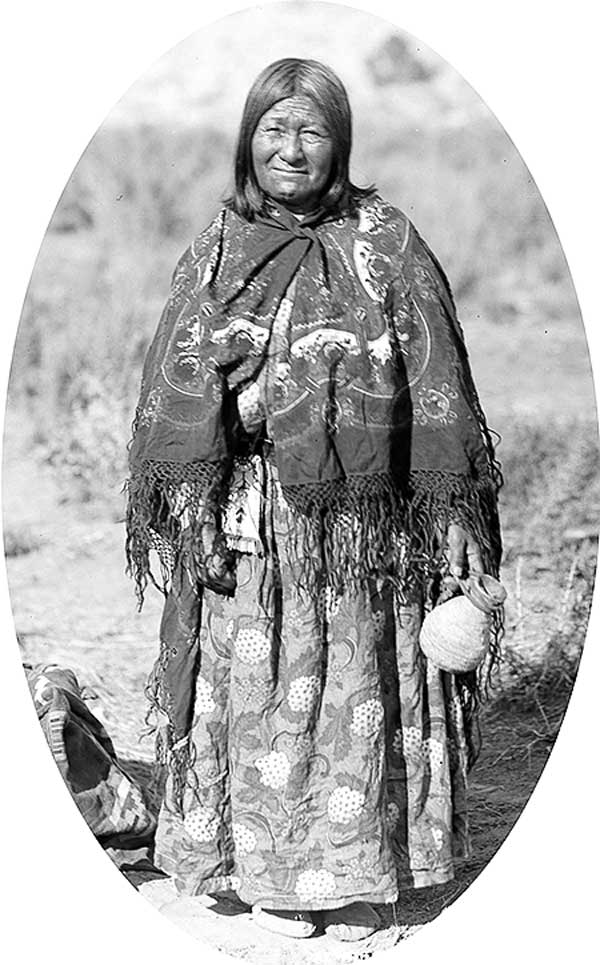
Chipeta as an older woman, near Montrose, about the time of completion of the Gunnison Tunnel.


Thursday, July 31, 2008

No excuses, perhaps understanding


Bad is never good, until worse happens.
Difficult times are relative. In order to grasp how a particular attitude may have developed, it is important to know the history surrounding it. The history offers no excuses, but perhaps understanding.
“I was about ten years old when the Utes were moved to western Colorado,” wrote Margaret Benn, longtime Douglas County resident and historian in the early 1960s. “So, as a youngster on the ranch, I had several personal experiences that made me very sad to think I was not big enough to kill an Indian. In fact I will confess I was 35 or 40 years old before that desire finally faded entirely out of my mind.”
From 1860 to 1875, families living in the settlements near Glen Grove School on Upper West Plum Creek in Douglas County were compelled to protect their own scalps if they wished to continue wearing them, according to Benn’s letters.
“They formed the practice of keeping each other posted on the temper and location of all Indians, who might be roving the hills. Any sign of danger in any region was quickly communicated to others,’ she said,
“But settlers did not live in terror, as many imagined they did. They could cope with the primitive, elemental savagery of pioneer life in pretty much the same spirit of native birds who sang and nested happily, even though the hawks and eagles constantly soared overhead.”
Benn had come to Colorado from Missouri at the tender age of three and her family settled near an uncle’s homestead on Spring Creek.
“My Uncle George (Dakan) had helped build Fort Washington and was a member of the cavalry troop under Captain John A. Koontz. Very naturally, I grew up in that neighborhood, from early childhood to maturity among the original settlers, I heard their experiences often told and retold, by the men, women and children that made Fort Washington their haven of refuge,” Benn wrote.
Today, although there are no visible remains of the log stockade that enclosed a homestead cabin and a large well near Larkspur, the Ben Quick ranch, which was built later in 1885, marks the spot of Fort Washington. The site has been on the National Register of historic places since 1974.
“And when my family took up life in that community, the Ute Indians still roamed the hills and valleys for many miles both north and south of us. The east slope of the mountains from near where Fort Collins now stands, to Canon City was their home and their original hunting grounds,” according to Benn’s letters.

###