Showing posts with label Taylor Hardware. Show all posts

Tuesday, March 26, 2019

Power of the world works in circles

"Everything an Indian does is in a circle, and that is because the power of the world always works in circles, and everything tries to be round. In the old days when we were a strong and happy people, all our power came to us from the sacred hoop of the nation, and so long as the hoop was unbroken the people flourished ...  Everything the Power of the World does is done in a circle. The sky is round, and I have heard that the earth is round like a ball, and so are all the stars. The wind, in its greatest power whirls. Birds make their nest in circles, for theirs is the same religion as ours. The sun comes forth and goes down again in a circle. The moon does the same and both are round. Even the seasons form a great circle in their changing, and always come back again to where they were. The life of a man is a circle from childhood to childhood, and so it is in everything where power moves. Our tepees were round like the nests of birds, and these were always set in a circle, the nation's hoop."

___ Black Elk Speaks: 
being the life story of a holy man of the Ogalala Sioux (1961), 
as told to John Neihardt 


Comfortable, familiar, solid. Like hardware.


By Rob Carrigan, robcarrigan1@gmail.com

I was thinking of Black Elk's pronouncement regarding the truths of the world. I remember the Amarillo Hardware salesman had great catalog, with a rounded leather loop, that snaked around and became a handle for a foot-thick volumn that he used to carry into Taylor Hardware, about twice a month.
The catalog had pictures and particulars, of about 40,000 items of common hardware and was the quick way to access items for sale without ginning up the Micro Fiche. At the time (more that 40 years ago,) but it took some 'know how' to access those particulars.
As a result, over time hardware became a metaphor for me. For knowledge, for experience, for the chance to learn ... and more.
Sort of like Black Elk's circles. But, in danger of mixing my metaphors, hardware was a kind of circle.
When ever in my life I sought to bring meaning and purpose and understanding, I often went back to the hardware store of my youth for those items. My experience, the lessons learned, the act of gathering knowledge all returned there.
Like the big ol' rounded, leather-covered hardware catalog, with its rounded rope-like handles that looped around it and held it together — the hardware looped around me and held me together.
Of course, like Black Elk and the hardware store, various versions of circle theory have come to surface in other forms.
Joseph Campbell’s 17 Stages of the Monolyth story structure is too complicated for screenwriters, Dan Harmon (creator and writer behind Community and Rick and Morty) and his Circle Theory of Story is an easier option that you can apply to the development of your stories and characters.
Based on the best selling book Third Circle Theory, Pejman Ghadimi author and creator of the Third Circle system takes you into a step by step breakdown and explanation of the key points found in each circle. "Expect appearances and discussions with Third Circle Readers including experienced Entrepreneurs. This 5 hour HD course was in the making for over a full 6 months in the hopes of helping more people discover how powerful being purposeful can be. It is a visual supplement to one of the most ground breaking modern concepts of Entrepreneurship."
But those, to me, seem too complicated for the truths that Black Elk spoke of.
It is probably closer to the ideas that J. K Rowling noted in "Harry Potter and the Deathly Hallows"
“Which came first, the phoenix or the flame?'
'Hmm . . . What do you think, Harry?' said Luna, looking thoughtful.
'What? Isn’t there just a password?'
'Oh no, you’ve got to answer a question,' said Luna.
'What if you get it wrong?'
'Well, you have to wait for somebody who gets it right,' said Luna. 'That way you learn, you see?'
'Yeah . . . Trouble is, we can’t really afford to wait for anyone else, Luna.'
'No, I see what you mean,' said Luna seriously. 'Well then, I think the answer is that a circle has no beginning.'
'Well reasoned,' said the voice, and the door swung open.”
A real circle is simple, easy to understand, with rounded-off edges and smooth traveling. Comfortable, familiar, solid. Like hardware. 

Saturday, April 23, 2016

Ways of times past prevails


I was just fifteen when I burst on the scene
At the store on the corner of the old river town
Once a cow camp, and later, log and miners tramp
Dolores was a place you couldn't knock down
In the southwest corner, downstream from Stoner,
It was marked by the passing of the long-gone rails
But the strangest of the batch, was Taylor's old patch
Where Merton, Cecile, and ways of times past prevails

There were red dogs in the floor, on oak between counters and near the door
Canine-filled blue Scout, at lunchtime about, added to the place's lore
Jason after rounds north and south, with bank bag in mouth, and a wag in his tail
Carried the cash, down the block in flash, to bank and post office for mail

In windows out front, a saddle, or stuff for the hunt, filled glassed-in holiday displays of regalia
Down through side isles, cabinet hardware and files, sandpaper, paint, stain, fastener paraphernalia
Above the nail bins, were the Gerry cans and tins, in the darkness near where cash register rung out
There on the scale, you might find coffee or cement-coated nail... perhaps lies, regarding size of trout

Back through double doors, near the basement stairs, and mops for the floors
Sat Merton cussin', wantbook, government, and technology he was fussin',  and Mirofiche he abhors
But what really sets him mad, is the times past he had, and the fading picture and store
The good old days gone and time marches on, new stories, same problems, new battles, same war

I was just fifteen back then on the scene
At the store on the corner of the old river town
Once a cow camp, and later, log and miners tramp
Dolores was a place you couldn't knock down
In the southwest corner, downstream from Stoner,
It was marked by the passing of the long-gone rails
But the strangest of the batch, was Taylor's old patch
Where Merton, Cecile, and ways of times past prevails

By Rob Carrigan, robcarrigan1@gmail.com

###


Saturday, November 29, 2014

W. H. Jackson and Dolores go way back


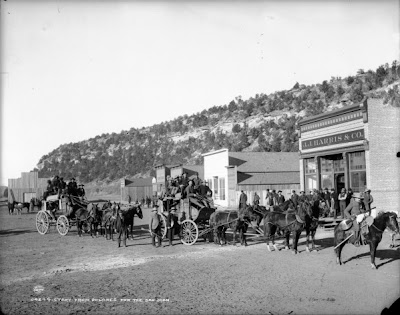
The iconic "Stage to the San Juan" Jackson photo must have been taken between 1891, and the fall of 1893


By Rob Carrigan, robcarrigan1@gmail.com

For me, it is almost a personal relationship with William Henry Jackson photos.
Starting the day after Thanksgiving in 1978,  I worked for Taylor Hardware in Dolores, Colo. for more than seven years with Merton Taylor and his family. Merton's father, George, had owned the store and had been around almost as long as the building, I think.
The old J.J. Harris & Co. building was built with the first structures in town when the little village was relocated upriver about two miles from Big Bend, on the Dolores River, when the Rio Grande Southern arrived in 1891. The hardware store still had elements of a bank, and beautiful hardwood floors that we mopped every day as long as it stood.
I speculate the iconic "Stage to the San Juan" Jackson photo must have been taken between 1891, and the fall of 1893, when the Silver Panic that year slowed activity of  the second San Juan rush and boosterism of that period. Merton had several copies of the photo (some displayed in the store) and Jackson must have spent the greater part of a day or two in Dolores, as he had had multiple frames. I have never been able to precisely date it but other photos appearing in Jackson albums indicate that he was likely shooting for a railroad company, and created at least several week's worth of work in the area.
The day after Christmas, in 1984, a terrible fire, that began in the T. H. Akin Merc. building next door (old building, but had not yet built at the time of Jackson's photo) destroyed the building.
I would guess the other photos included here, one from Rico by Jackson, and Cowboys of the Dolores were produced about the same time, perhaps in the same trip. But that is just speculation, as Jackson easily could have visited my hometown, Dolores, on several occasions.


Frame 1: Stages from Dolores
Creator: William Henry Jackson
Sumary: Stages load with men are in the street in front of the J.J. Harris & Co. mercantile store in Dolores (Montezuma County) Colorado. men stand on the sidewalks, and in the street, some with mining equipment and guns. A burro packtrain is in the street.
Date: Photo created between 1882 and 1900?
Attribution to Jackson based on the photo negatives inclusion in the History Colorado William Henry Jackson Collection. Hand-lettered twice on the negative, "3861." Phot negative, glass, 5" x 8."

Frame 2: Rico, Colo. , W.H. Jackson Sample Album, Colorado Book III, No. 169
Creator: William Henry Jackson
Summary: View of the town of Rico with frame buildings and dirt streets.
Date: Photo created between 1882 and 1900?
Attribution to Jackson based on in bound W.H. sample album. "3219" hand-lettered on negative and reproduced in print. Photoprint, 4"x 7" mounted on album page.

Frame 3: Cowboys of the Dolores, E.H. Allen
Creator: William Henry Jackson.
Summary: Cowboys on horseback in front of a sod-roofed log building in Colorado. A dog sits on the ground near probably E.H. Allen. Photographer's stamp printed on verso of card mount. Title, "3631" and "50" inked on original and reproduced in photographic print. Photographic print on card mount: 4 1/2" x 7".
Source: Pueblo Public Library
Western History/Genealogy Dept., Denver Public Library.

Thursday, August 21, 2014

Taking care of business with a button


“Computers are useless. They can only give you answers.”
― Pablo Picasso


Merton believed in technology, he just didn't like to deal with it.


By Rob Carrigan, robcarrigan1@gmail.com

Years ago, you couldn't talk to Merton Taylor on Monday afternoons.
He would hole himself up, back at the check-in stand, working on an order for Amarillo Hardware's truck coming in on Thursdays. Mostly, he would cuss the state of the nation, slur half the people in that nation, and then start in on the other half.
But the biggest problem with the world at that time, according to him, was technology.
Having experienced the turmoil he went through dealing with a microfiche reader, I can't imagine what kind of cussing would have went on — if he had to deal with the Internet.
Merton believed in technology. He just didn't like to deal with it.
Those were different days.
The Post Office and the Bank were on opposing corners of the center block of Sixth Street, and business was still a face-to-face affair in our little town. Every day, at 11 a.m. and 4:30 p.m., the entire population would converge between the two landmarks and do that business.
Though, Merton often sent a 'red dog' representative to conduct his.
Which means, one of his Irish Setters took the bank bag down and dropped it off with a teller, (slobber and all) with someone following to take care of the paper work.
But, back to the technology.
World War II was the last time any of this technology crap made sense, he said.
And to prove it, he would have you mark every one of any of the 40,000 common retail hardware items in Taylor Hardware, via black or red grease pencil, with his own secret cost code, that took employees about seven years to learn how to read.
That code had all kinds of blind alleys and blocks, repeaters and switches in it. It was similar to the one he used during the war, in the Philippines.
When I first worked there, the Amarillo Hardware salesman, carrying two leather-bound, foot-thick, catalogs (one in each hand suspended by tooled leather handles) into the store once a month, to take care of "problems."
Seems like there was always a "problem" or two to resolve.
The rest of the time, (weeks without a salesman) on Monday, Merton, after gathering up the seven or eight 'Want Books' off of counters throughout the store, creating a list, then would painstakingly look up and transpose numbers out of the microfiche cards.
Which was all well and good, as long as the 'fiche bulb didn't burn out. Or, the numbers matched up, or the quantities were acceptable, or the illustration correctly identified an item. All of whch, almost never happened.
But at least, at the end of the day, all five of the red dogs, and grey one, or perhaps a black one, would lumber out the side door after 5:30 p.m., load up in the old International Scout, frailest to most agile by order, and head home at the end of the day.
Ready to come back and do the same thing tomorrow.
Still, it is sort of like that today, with the use of computers, the Internet, and all business taken care of with a button. Maybe we haven't learned a thing in 40 years.
It is in this environment that I've have heard the common discussion among writers, and customers, sources, and co-workers, etc... the common discussion that goes something like this.
"You can't talk to Rob Carrigan on Monday afternoons. He'll cuss the state of the nation, slur half the people in that nation ... then start in on the other half.
The biggest problem in the world today is technology.
I have the answers.  What we really need ...  the questions.


Saturday, November 30, 2013

The Seven Wonders of Dolores


Intend to remedy that by naming a new list


 By Rob Carrigan, robcarrigan1@gmail.com

The Seven Wonders of the World has historically been a listing of seven sites known to the Ancient Greeks as the most notable locales in their known world. 
The originalsThe Colossus of Rhodes, The Great Pyramid of Giza, The Hanging Gardens of Babylon, The Lighthouse of Alexandria, The Mausoleum at Halicarnassus, The Statue of Zeus at Olympia, The Temple of Artemis at Ephesus. All fine attractions.
Over the years, and down through history, others have developed their own lists. The Seven Natural Wonders, developed by Cable News Network in 1990s, The Seven Modern Wonders, developed by the American Society of Civil Engineers, and even the "New" Seven Wonders. 
But like most secondary contrivances, the second string is just that. 
I intend to remedy that by naming a new list: The Seven Wonders of Dolores, and my selection criteria follows.
7. Rope elevator in the Exon Mercantile building. 
Never has an eighteenth-century marvel been so underrated as the the platform rope and pulley system near the back of the Exon Building that drops a 10-foot by 15-foot  section of the very floor out of one building and into the basement below.  Sure, maybe it is dangerous and maybe, Yes, you could fall down an poke your eye out, or perhaps run your fingers through the pulleys (or maybe even squash something like a bug if you dropped it while someone was below) but hours of entertainment offset all the dangers and then some.
6. Painted D on the side of the hill. 
Certainly a maintenance nightmare, once again rife with the dangers of actually falling from a sandstone cliff,  and less than environmentally sound, the faded black paint peeking from the tree-line stands as an icon of Doloresdom. Not to mention, the hours beneficially 'wasted,' instead of being in school attending to regular studies.
5. Second staircase in the Taylor Hardware's shop.
I know this is an obscure reference for many, but any that have known of, and witnessed the wondrous flight that drops out of the wooden ceiling to the cement shop floor below, and the pulley and weight system that allows it to do so, then be retracted if nothing occurred, are often awe-struck beyond belief.
4. Plywood raft in Town Pond
Utilitarian in nature, the raft bounced around the edges of the town pond for many years,  serving as a de facto fishing vessel, frogging operation, mud bog vehicle, and upon occasion search and rescue conveyance.
3. The retractable basketball supports on the stage in the High School Gym.
Two bolts removed, and retraction via cable and a hand winch, allowed the complete transformation of a stinking, hardwood-floor, basketball arena, and other athletic endeavors; to a stage and auditorium suitable for graduation, plays, and all school assemblies. No one knows the transformative powers better that the wood-ribbed edifice in the center of Dolores Schools.
2. Fourth Street Bridge.
A personal favorite, long-since removed, the cast iron structure, darkened with the rust of the ages, connected the outside world with the little town in the valley, as a ribbon of highway drops off the ridge and down into the mouth of a Lost Canyon. Fish lined up in the depths of the channels below, and hobos and delinquents camouflaged in the red willows and Cottonwoods nearby.  But as Neil Young noted "Rust never sleeps."
1. Big Rock between 7th and 8th Street.
Never in the course of human events in such a small town, have so many, owed so much to a single rock in the middle of the Dolores River. Entire languages have been developed and learned in the shadow of that stone. Working on mysteries without any clues, working and practicing... Perhaps my entire lyrical base (as well as Bob Segar's)  owes such a debt. "Like a rock, I was strong as I could be. Like a rock, nothin' ever got to me. Like a rock, I was something to see. Like a rock." 
I wonder — if there are other such wonders.

Saturday, October 12, 2013

Nobody has time for that anymore


Hear that lonesome whippoorwill?
He sounds too blue to fly.
The midnight train is whining low,
I'm so lonesome I could cry.
___ Hank Williams, 1942

I drift back through that building, take a walk back through time, and space, and memory


By Rob Carrigan, robcarrigan1@gmail.com

Nobody has time for their memories anymore. We seldom ride trains, buses, or even planes — for long, thoughtful trips into the nights and mornings of our past.
But I try to remember — because she can't.
Back in the fall of 1978, just a little before 8 a.m., any of six days of a week, Fifth and Main Street, meet me at the side door, Taylor Hardware, Dolores, Colo. Let's take a walk.
Jiggle the big ring of keys in the heavy wood frame door with thick plate glass in the center, beveled all the way around, glazed tight and solid nearly 90 years prior.
Inside the light switches are low, near the hardwood floor up front, and then in ceiling as we pass on either side, past the gun case, the cabinet hardware, t-hinges, gate hooks, flat bastards. Cant hook handles there, sanding belts under the stairs, and different-sized dowel rods in a rotating swivel display.
After the stairs, the high shelf carried items overhead. Calf feeder buckets, Gerry cans and pump sprayers, Number 10 galvanized pail (sometimes still half full of water from last night's rain)...
The building seemed to grow taller as you moved deeper into it. The leaky skylight illuminated the balcony filled with furniture, and the nail counter tucked in below.  Live plants, needing water at least every other day, draped over the balcony banisters.
But then the building tightened again, as you moved back from the side door, with its crossbar strips and glove counter. Linoleum, in eight-foot rolls, stood a sentinels against the back wall on the front room guarding the double doors, each latched at the top with a spring-loaded tooth, that could be released with the chain that hung from it.
On the other side of the doors,  was the tiny, 30s-era bathroom, with sink outside, two exterior hose bibs underneath (at times with a garden hose attached) and appropriately enough, the wooden bins with the bathroom parts. A steel case with closet bolts, and toilet rods, along with bins of Johnny rings and tank balls. Off to the left, as you looked toward the bathroom, and then the nail counter, was the big wooden rotary cabinet filled with fender washers, and expansion anchors, hitch pins and cotter keys, twirling with abandon.
The ancient scale rested on the corner of the nail counter, complete with inspection stickers from the '20s and beyond, certifying it accurate, and want books slipped between it and the excess weights.
Behind that, was a cave of sorts. Surrounded by dog collars, and horse tack, the coffee percolator topped a steel cabinet covered in contact paper. An aluminum tray, with seven or eight coffee mugs that were washed every day in the small sink, accompanied it like a best friend.
The second stair well (a ladder really) went through the balcony floor there. Customers, and some employees, drinking coffee — liked to lean on it as they told wild tales of times past.
In the back, thought the double doors, the plumbing counter and the high wall of bins of elbows and tees, bell reducers and bushings. Somebody was constantly standing there sharpening their knife on the well-worn oil stone, swapping lies with Merton Taylor at the check-in stand, or the micro-fiche machine.
Further back, the rope machine, and the paint equipment, and open area to receive shipments from Amarillo Hardware, or NW, or wherever —  delivered at the sliding door in the far corner.
And that was just the main building.
Sometimes, late at night or early morning, on a chilly bus (or if I'm lucky enough to ride a train), or in the stuffy space of a cramped plane, I drift back through that building, take a walk back through time, and space, and memory.
She doesn't remember much. And generally, nobody has time for that anymore.

Saturday, May 11, 2013

Hart Lee on the Hardware Store in the Star


The Best of Hart's Stuff from Rico


By Hart Lee,
The Dolores Star Press
copyright, 1968,
compiled, edited and published
by Lawrence and Marilyn Pleasant
MCMLXVIII
From the Files of the Dolores Star
(also known as The Splatter)

from Friday, August 16, 1963

Did you ever go into a store or someplace of business and and come out with more than you bargained for — Now for instance take Taylor's Hardware store, we have been trading there off and on for the last twenty or thirty years. Any time you go in there the first thing you see is an old beat up water bucket setting the front counter slushing over with hospitality — been setting in the same place ever since old Sy Perkins bought his wife her first two piece under ware. Then the two pouch hounds which are the trade mark of the joint are always found asleep in front of the nail rack — and should they be missen, you'll find the outfit out of gear and running on the rocks.
Sometimes you just drift in the place don't want to buy a thing, then you find a comfortable chair and watch television which is turned on as soon as the janitor shows up in the morning until its time to lock the doors, and you'll always find somebody around that's got time to shoot the bull for awhile. In fact nobody is in very much of a hurry. Take your time and live.
A lot of times you'll go in and ask for something — say a ram rod for a 10 gauge shot gun, well it might take a little while to find 'em but its a bet they have a dozen of the things when they do run them down.
And if they don't have what you want they'll grab a want book and order it for you whether it is a pound of roofing nails or a trainload of combines — Just a darn nice place to trade.

Saturday, October 20, 2012

Like sandpaper softly wearing edges off hardware


One could find him there every day, six days a week


By Rob Carrigan, robcarrigan1@gmail.com

He was traditionally a creature of habit, and the backroom. 
Behind the double doors, and the stairwell to the basement, at the check-in stand (or perhaps, on the tall red-seated metal barstool in front of the Microfiche), one could find him every day. That was true for… I don’t know, sixty… seventy years.
Merton Taylor surfaced at the coffee pot in the back corner of the front room, precisely at 10 a.m. daily, and then, again at 11:30 a.m., gathering the dogs in the Scout, for the trip home to lunch. He returned in an hour and spent the rest of the day in the backroom until someone asked him for a key at 5:30 that evening.
“They would not find me changed from him they knew – Only more sure of all I thought was true,” wrote Robert Frost in 1913. Merton Taylor and Frost, it seemed, were contemporaries.
I reveled in stories he would tell of Dolores area characters past, like Doc LeFeurgy, and Reverend Flanders, and the “Wild Woman of Horse Gulch.”
His odd take on life -- a constant draw for others, as well. His advice sought for particular hardware concerns, or archaeology, or mining, or forestry and farming. He held court in that back room, as surely and regularly as the federal district.
I knew him just barely before the “Walmarting” of America, but I think he would have understood and liked Sam Walton, the change agent who opened his first store in Rogers, Arkansas, more than 50 years ago, and altered retailing forever.
Probably, he would not agree with him however. It wasn’t his nature to necessarily agree with anyone.
It is not that the Walmart Top 10 would bother him: everyday low prices, selection, altering the retail landscape, the decline of the labor movement, supplier partnerships, the ‘cult’ of Walmart, data-driven management, a culture of over-consumption, with the odd partner of sustainability, and the power of access. He might just be slightly miffed that he didn’t become famous and rich for embracing them.
But on second look, he wasn’t really interested in becoming either that rich or famous.
He was interested in success, as evidenced by his involvement in the establishment of Dolores State Bank in 1959, and later the Bank of Telluride, but he measured things differently, I think.
He certainly looked at Dolores with different eyes than most. The long view, through birth, and school, railroad and dam building, lumber mills, plywood plants and dryland farming, depression to ‘80s recession, fires, floods, Roosevelt, and Reagan, WW II and the Iranian hostage crisis, Jack Dempsey and Elvis.
But times, they were a changing.

As Frost noted (again in 1913), in Reluctance.

“Ah, when to the heart of man,
Was it ever less than a treason
To go with the drift of things,
To yield with a grace to reason,
And bow and accept the end
Of a love or a season?”

Quite traditionally a creature of the backroom, in a time before great change, in the late fall, or early winter of a season of a different truth. One that I can barely remember.
###


Tuesday, June 14, 2011

The promise of history, habit and ritual


We have seen the sunset before

 By Rob Carrigan, robcarrigan1@gmail.com

 Ritual is a benefit for a regular guy.
Doing the same thing, over and over again, holds your place in the world. It allows you to recognize change. With it, comes a promise for tomorrow.
Make the coffee in the morning. Walk the dogs. See to it that the lilacs are watered. Mow the lawn. Work every day. Not just chores, but with a purpose… a history … a filter through which you can look at life. No wonder, ritual becomes a ritual for some.
Six days a week, almost precisely at 7:55 a.m., the light blue 1964 International Scout, loaded to the hilt with aging red dogs and nice old man with a history of his own, arrived and parked at side entrance to the hardware store in Dolores, Colorado. Merton Taylor would be wearing the same “uniform” as the day before… denim painter’s pants, a grey work shirt with button-down pockets, and crepe-soled, moccasin styled, split-leather, high-topped, work shoes and dented and stained mouse-colored Stetson. The dogs would disembark from the vehicle in precisely the same order everyday, all five of them. Jason, Feathers, Cindy, Christa, and Sarah.
Most of the time, for more than seven years in the late 1970s and early ‘80s, I would be waiting there for them. Merton would hand me the keys and I would head to the front door to unlock it, as he gathered boxes of newspapers, paper work and miscellaneous crap he had brought from home to the store that day.
Collectively, we would hit the various lights, unlock the side door and back slider, and I would head out to the incinerator to empty the big freezer box with hand holes cut in the sides. We had dumped all the trashcans in the building in there the night before. If there was no new snow to shovel, depending on how many of us were doing chores, one, usually Merton, would scrub the bathroom fixtures with a toilet brush. Another filled the big three-gallon mop bucket with a little bit of Tide, and hot water, from the outdoor hose bib under the indoor sink there in the corner. We would place the “mop wringer of death,” (a long-handled lever contraption that could explode a water melon if placed in the wringer carriage and squeezed) and wheel it up to the front door.
Every single day that I worked there during that time, we mopped the ancient oaken, hardwood floors, stem to stern — taking care on cold winter days to avoid the steel plate under the side door, lest the mop would stick and freeze. Around the two sides in front aisle, up by the office, register, nail counter to double doors just before you went in to the backroom. A red-handled mop and a splintery unpainted one that, when unused, hung over a shelf made just for that purpose on one side, above the stairwell to the basement. If you were not careful, and failed to wring them out good when finished, it would drip most of the morning on the bottom two steps.
Merton had been in the army, but loaned to the navy, during WWII and would ‘teach’ new recruits the exacting method that the floors were to be mopped, with long, sweeping motions that covered the most floor, with the least duplication — or he would come to expect old hands at the chore to do so.
One of us would make the coffee (always in a percolator, none of this new-fangled Mr. Coffee crap technology) and another would do the dishes, which consisted of eight to ten coffee mugs (used by the regulars almost every day) scrubbed and placed on paper towels that covered the bottom of a silver tray.
In the evenings, it was a similar routine in reverse. Rather than mopping the floors, however, we would pour carvous oil out of a 5-gallon container and into clean sawdust that was kept in a 55 gallon drum with a metal lid at the bottom of the stairs. We mixed our homemade sweeping compound in an old coal bucket with a coal shovel. Then we spread it on the same floors, and would take to it with long-handled push brooms.
When it was close to quitting time, I would ask Merton for key to lock the front door. He would hand it to me, usually with the same lame joke, “Aqui,” and I would turn it in the tumbler at exactly 5:30 p.m., unless there was a straggler rushing to buy a plunger before we closed. But stragglers usually knew to arrive at the side door, because the whole dog-loading process into the Scout had to be reversed before Merton could go home.
Certainly, at the hardware store there were other rituals, habits and history to follow. Things that had been done that way since George Taylor, Merton’s father had owned the business. Perhaps even things that occurred in perpetuatuity since the building was the old J.J. Harris & Co, with the mercantile and bank there as early as the 1890s.
The other day, when I was walking the dogs (after mowing the lawn and watering the lilacs), I thought about how, in a lifetime, you see the same things over and over again. I thought about the videotape I watched the other day of my kids when they were much younger. It seemed so familiar, but oddly different, because they are nearly grown now.
Feeling all whiney the next day, I quoted Martin Amis, “Sometimes I feel that life is passing me by, not slowly either, but with ropes of steam and spark-spattered wheels and a hoarse roar of power or terror. It's passing, yet I'm the one who's doing all the moving. "

Rosanne Gain offered perspective at the time with some advice from her mother. “When I was a callow youth, my Mother explained it this way: 'My dear, the older you get the faster the time will pass. In old black and white movies they marked the passage of time by showing a desktop day calendar with a wind blowing the pages back. One day you will understand.'"
The next night, I looked at the sunset, burning orange red over the Rampart Range, with the peak behind it. It sort of wraps itself around you, with the dark greens fading to blue into the white of clouds and brownish red of a smoky sky feathering off into grey and then darkness. I had seen that sunset before. Maybe, not exactly, but close enough that I felt the promise — the promise of history, of habit, of ritual.
# # #
Photo information: 
1. View of the stagecoach and passengers on the main street in Dolores (Montezuma County) Colorado. A passenger holds a gold pan. Men stand in front of a storefront with a sign that reads “J.J. Harris & Co.” Photographed by William Henry Jackson between 1890 and 1900. Colorado Historical Society, William Henry Jackson Collection.

2. Sunset on the Rampart Range, from near the North Gate of the Air Force Academy.


Friday, May 7, 2010

Coffee swilled around the character magnet


Old Coyote, Ripley often said, was his brother

By Rob Carrigan, robcarrigan1@gmail.com

The coffee pot at Taylor Hardware in Dolores apparently had a character magnet in it.
I say that, because when I was a youngster working there in the ‘70s and ‘80s, all sorts of characters would show up about 9:30 every morning. One of the most memorable was Don Ripley.
Ripley was a tall man, prone then to wearing bibbed overalls and a stark white goatee. He reminded me of Burl Ives, with a similar look, voice and demeanor as the Sam the Snowman narrator in “Rudolph, The Red-nosed Reindeer.“
Aside from the favorite Christmas program link, Ripley was memorable for other reasons. Signs, signs, everywhere a sign, all those signs became trademarks for him.
“Donald Gilbert Ripley, the first National Park Service ranger assigned to Hovenweep National Monument and the woodworker who designed the original signs for Mesa Verde National Park, died of respiratory failure May 7 at the Vista Grande Nursing Home in Cortez. He was 92 years old,” read his obituary by Claire Martin in the Denver Post on Sunday, May 18, 2003.
“Don was the chief ranger, the maintenance director, the caretaker and basically Hovenweep’s entire staff of one for many years,” the Post’s story quoted retired park ranger Bill Wade, whose father was the chief ranger at Mesa Verde National Park.
Wade recalled Ripley using a router to cut grooves for lettering and squeeze bottle filled with orange paint to tidily fill in the letters.
“When I think of him, the memory of those signs comes back immediately. They had a distinctive pattern that he designed, and he also made a kind of thing that went on top of the sign. You know designs you see on Navajo woven blankets? That zigzag thing? It resembled that. These were roadside sign and there were a lot of ‘em up there,” Martin quoted Wade.
With his attention to detail and respect for native culture, Ripley won friends and influenced people from the many walks he traveled in his life. In addition to his Park Ranger duties at Hovenweep and Mesa Verde, he worked at other parks including as superintendent of Salinas National Monument in New Mexico from the fall of 1965 to the fall of 1967. It seemed he always returned to his home in Dolores.
Utes, Navajos, and Crow all called him friend and the University of Colorado, through the Cortez Cultural Center, honored him as well for his archaeological work in 1992, according to the Cortez Journal.
“The Crow Tribe made Ripley an honorary brother, a tribute that he considered one of the highest complements of his life,” according to the Denver Post. “When Ripley finally finished his house in Dolores in 1958, he like to tell guests that he had asked for the blessing of Old Coyote, the sly, legendary medicine man. Old Coyote, Ripley often said, was his brother.”
At the hardware store back then Don, and occasionally his wife Bessie, whom he married in 1939 in Victor, would come in and grab a small item like sand paper or hinges for his woodworking “Jones” and would then put it in his own personal charge book for Taylor’s, without needing help from any store employee. Occasionally, owner Merton Taylor would convince him to make some sort of sign for a local service club that the two of them were involved in. Rotary, American Legion, NRA, CU Foundation, or maybe the Dolores Public Library Board would be the usual suspects.
Throughout my life, as I have traveled the west in California, Wyoming, New Mexico, and the four points of the compass in Colorado, I often would run into folks that knew, respected and enjoyed Don Ripley during his lifetime. I shared that respect and enjoyment.
One regret, I guess however, is that I didn’t seek more from such a memorable character as he sipped his coffee, and fished out a flat bastard file (or some other item) from the cabinet up front and scrawled it in the book marked “Don Ripley” every morning in hardware store, all those years ago.


###

Saturday, January 17, 2009

It depends where the light bulb is


A new year reminds me of the process of changing a light bulb. Out with the old, in with the new. Simple. That is, depending on where the light bulb is, and how you have to change it.
Many years ago, at one place I worked, the light fixtures were dropped three feet on swinging wire from 25-foot ceiling. There was a balcony all the way around the long narrow building at about the 12-foot level. That balcony had a four-foot rail or banister all the way around with top of that being made from a regular 2-by-6”.
To change a light bulb in that place, we had to stretch out a homemade cross platform across from banister to banister. The platform was made from two 12-foot, 2-by-4s” with a 3/4”plywood base in the center between them. A person had to shinny out on the platform and unscrew the large glass globes to get to the bulb.
So there you were, 20 feet up from the hardwood floor, on a narrow platform made out of two boards and a piece of plywood, with one hand holding the exterior globe, one hand to hold on to the platform, and one hand trying to change the bulb (yes, I know that is three hands) and customers and other employees below — all with ample measures of advice and cautionary description of what you would look like if you fell from that height.
Amazingly, you eventually reached a comfort level where it didn’t really bother you to change those bulbs. Or you didn’t bother to change them.
Such is memory. Warren Kliewer wrote, “Time passes and you accumulate a storehouse of memories. More time passes and you discover that looking up a long-lost friend is as interesting as making a new one, that revisiting a dreary neighborhood where you once lived is as stimulating as exploring a new place…I used to marvel at older people. ‘Why do they wallow in nostalgia?’ I wondered. I no longer regard it as frivolous.”
In the New Year, I wish you good memories — and good luck with any light bulbs you must change. May the next year be all at ground level and a simple exchange — out with the old, in with the new.
###

Friday, November 14, 2008

Christmas at Taylor Hardware


The store caught fire and burned to ground on the day after Christmas in 1984


By Rob Carrigan, robcarrigan1@gmail.com

Christmas today carries texture and color from our childhood. It is always enhanced by our memories from the past.
For seven years, beginning in 1978, the holiday season was represented for me by the warmth and the sounds, the comings and goings of a small-town hardware store.
Starting the Friday after Thanksgiving, right after we got the hardwood floors mopped, the season began. Taylor Hardware (the Red Dog Hardware) signaled the start by asking the hired help (a couple or three high school kids including myself) to attach a 2” x 4” frame that allowed us to elevate the front two counters into a three-tiered mega gift center -- where if you couldn’t find something to give Mom, or Uncle Bill or your pain-in-the-butt brother, well then, they didn’t need a present.
Then, after cleaning the front windows with a pail of sudsy water and a sisal brush as the help commonly did once a week anyway, it was time to build the holiday display in the four compartments behind the plate-glass windows in the front entrance.
One window was always filled with ideas for mom’s stuff: fancy silver trays, furniture, food processors, microwaves, decorative lamps, ladies watches, even an occasional elegant shooting iron.
Another window for dad: fly rod and reels, ice augers, power tools, Case and Oldtimer knives, chain saws and maybe a Toro snow blower with a bow on it.
One for the kids: solid Red Flyer wagons, steel Tonka trucks with authentic rubber wheels, real china-faced dolls, porcelain figurines and BB guns.
The final one could contain most anything, depending almost entirely on mood and inclination of the owner or his son or daughter-in-law. Ashely woodstoves, power splitting mauls, decorative glass dishes, it was hard to guess. One year, I remember a western working horse theme including a packsaddle, tack, bridles, lariat rope and other cowboy necessities.
But Dolores was the kind of place then that a rancher could come running in the store after an expensive item in emergency, grab and go, with instructions to “put it on a ticket and I’ll pay later.”
Though such shoddy accounting practices would never have been tolerated at the hardware store, one local story relates the hurried purchase of a new saddle at another local business. The owner of a saddle shop forgot which outfit the “in-a-hurry” cowboy worked for so he billed it to each of the nine biggest stock concerns in the area thinking that surely the responsible one would settle the bill. That turned out to be an error. Six of the outfits ended up sending a check in for the entire saddle amount with no questions asked.
Don Setser seemed to be the only one Merton Taylor, the owner, was comfortable with enough to hang the outdoor lights. Many years ago, as part of the high school student help, Don had won the local lighting contest in the business category and ever since, he was “forced” to roll back into town every year to string up an increasingly complicated and elaborate display.
The store, always a busy place, tended to hum for the next few weeks. What, with getting ready for inventory and the big bowl of eggnog and the ever-free and hot coffee at the back corner pot – along with busted pipes and broken chain saw files – this was ‘hammer time’ at the hardware.
Finally, on Christmas Eve, usually shortly after noon, came time for the deliveries. Owners Merton and his wife Cecil, had selected and wrapped presents all morning, and we loaded them in the beat-up 1965 International Scout, along with a couple of the Irish Setters of the ‘red dog store’ namesake, and began a distribution that would have made Santa proud.
Ironically, or perhaps symbolically, the store and nearly the whole city block, caught fire and burned to ground on the day after Christmas in 1984. With a changing retail landscape, aging owners and shifting loyalties, it was never rebuilt.
Those memories are not better or worse than many Christmas holidays that followed but certainly provide me a foundation of texture and color, sounds and warmth, the comings and goings of a small-town hardware store, and yes, a feeling of Christmas, that I can never forget.

###

Saturday, October 18, 2008

Things you can count on


Every single nut, bolt and screw 

between Christmas and New Years


By Rob Carrigan, robcarrigan1@gmail.com

At a hardware store where I once worked, we would inventory every single nut, bolt, screw and pipe fitting during the week between Christmas and New Years.
“There is over 40,000 common items of hardware in the modern hardware line,” went the speech from Merton Taylor, owner of Taylor Hardware. Merton tried to carry all of those items. And by Golly, we were going to count every single one of them, accurately, in all three buildings. Two of the buildings were two-stories and half-a-block long. The third was a track warehouse that stretched for a football field length along Railroad Avenue.
I was one of the regular employees but we would usually hire extra help during this massive inventory undertaking. High school kids would be camped in front of nail bins, pulling out 16 penny cement coat nails from CF and I Steel, weighing them, cleaning the bottom of the bin with a sponge and bucket of soapy water and then replacing them and dropping a paper tag with the counted weight. Then on to tackle the next bin of 20-penny cement coat.
A similar process occurred at the 10,11,12,14, 16, 20 gauge smooth black wire, and then the galvanized, and on to the chicken wire, hog fence and woven wire. We measured the joints of 1/2”, 3/4”, 1”... up to 2” galvanized and black pipe. We counted the bell reducers and 45-degree elbows. We weighed the fender washers, flat headed stove bolts, Mile High Grass Seed Mix, and 1/2” sisal rope. We separated and counted 80, 100, 120 grit sand paper and galvanized, black and aluminum stove pipe.
In the track warehouse and the two-story building we called the shop, there was no heat and we would usually work in two-person teams of a “caller” and a “writer.” The writer would be positioned in front a “torpedo” propane heater to keep his or her hands warm enough to continue writing as the caller would wade through the sometimes preweighed, precounted items calling the secret cost code.
And secret code it was. Merton, who had worked with Naval Intelligence in the Philippines (though he was in the Army) during World War II had devised a complex transference of numbers, letters, blocks and blind alleys that took two or three years and continuous practice to figure out how to read. I worked there seven years so I eventually became one of the elite group of “readers.” Which basically involved not only deciphering the complex code, but being able to read a seventy-five-year-old, semi-blind, hardware store owner’s shaky handwriting done with a number one black or red grease pencil.
Math skills were also required in that all the called items and their cost had to be “extended” which sometimes meant figuring out that were four squares per roll of asphalt rolled roofing, at $7 per square, times 400 rolls of red and 200 roles of green and so on.
At first I really hated working at the hardware store during inventory week in the week between Christmas and New Years. But later, I got to a point where I really enjoyed “knowing the code,” understanding what each of 40,000 common hardware item’s name was, comprehending that roofing is sold by the square, and being a master at “extension.” Inventory was a process involving various stages of personal enlightenment.
Today bar codes at the register and handheld scanners have replaced most of that process. I know it is faster. But, for things you can count on, I still sort of miss that week (in the old hardware store) between Christmas and New Years.
###